 Dexter Chew
Your child stands in front of you and something suddenly looks different.
One shoulder seems slightly higher.
One side of the waist looks more curved.
Or perhaps you notice that one side of the ribs becomes more prominent when they bend forward.
Then, after an assessment or X-ray, you hear the term:
Adolescent Idiopathic Scoliosis.
It can sound intimidating, especially when it is followed by numbers such as a Cobb angle or Risser score.
But an AIS diagnosis does not automatically mean the curve will become severe or that surgery will be needed.
The important question is not simply:
“Does my child have scoliosis?”
It is:
“How likely is this particular curve to progress while my child is still growing?”
That is where understanding adolescent idiopathic scoliosis becomes especially important.
What Is Adolescent Idiopathic Scoliosis?
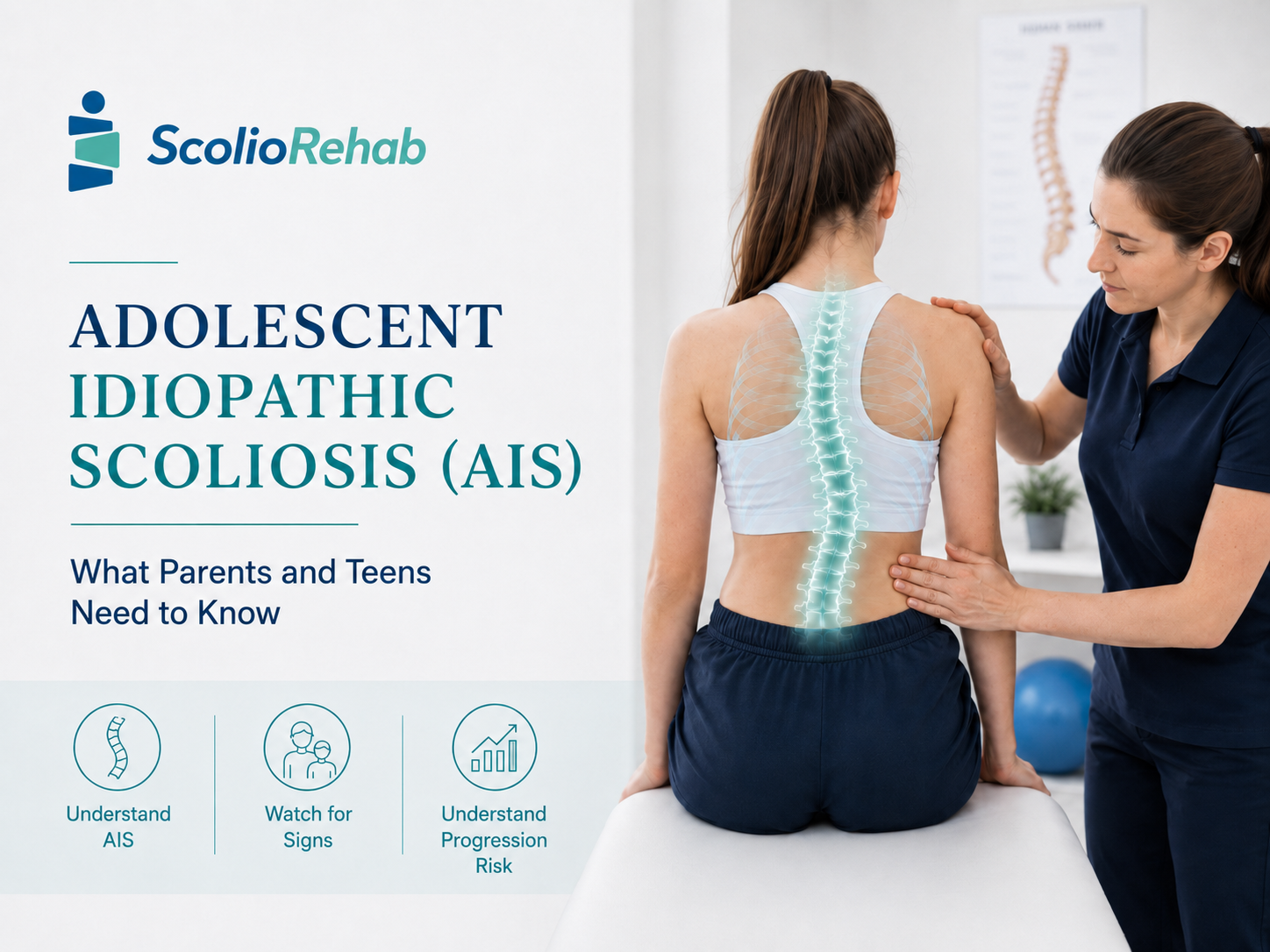
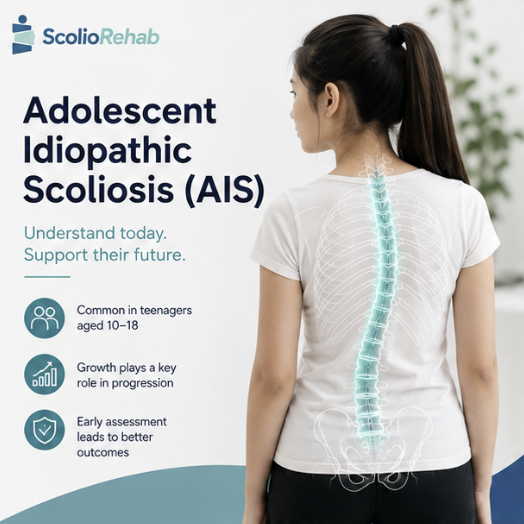
Adolescent idiopathic scoliosis, commonly shortened to AIS, is scoliosis that develops during adolescence without an identifiable underlying cause.
It typically occurs from around age 10 until skeletal maturity and is the most common form of scoliosis seen in teenagers. The Scoliosis Research Society reports that AIS may affect up to approximately 4 in every 100 adolescents.
The word idiopathic simply means that the exact cause is unknown.
Researchers believe several factors may contribute, including genetics and biological development, but AIS is not normally traced back to one specific activity or event.
If you are looking for a broader explanation of scoliosis itself, including the different types, causes and general symptoms, read What Is Scoliosis? Signs, Causes and When to Get Checked.
Why Does AIS Often Appear During the Teenage Years?
One of the most important things to understand about adolescent scoliosis is the relationship between the spine and growth.
During adolescence, the body can change rapidly.
Bones lengthen.
Height increases.
Body proportions change.
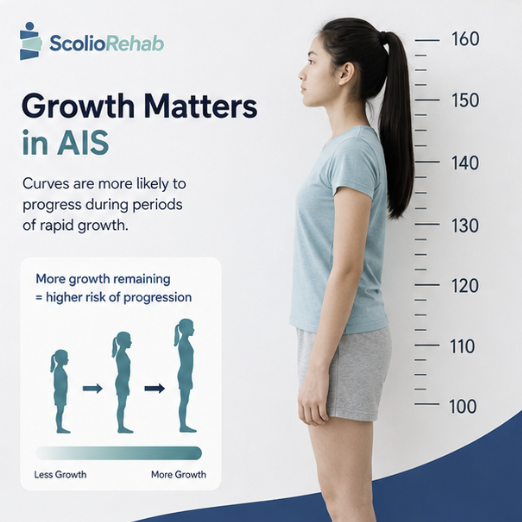
And for a teenager who already has scoliosis, this period of rapid growth can also be a period when the spinal curve has a greater opportunity to progress.
The Scoliosis Research Society notes that AIS curves tend to progress most during periods of rapid growth and usually slow considerably once skeletal maturity is reached.
That is why two teenagers with the exact same Cobb angle may not necessarily have the same risk.
A teenager who has significant growth remaining may require closer monitoring than someone with the same curve who has nearly completed skeletal growth.
The curve measurement matters. But growth matters too.
What Causes Adolescent Idiopathic Scoliosis?
Parents often ask themselves:
“Did we miss something?”
“Was it because of bad posture?”
“Was the school bag too heavy?”
“Did a sport cause it?”
For AIS, the answer is generally no.
Idiopathic scoliosis is not considered to be caused by carrying a heavy backpack, playing sports, an injury or simply sitting with poor posture.
The exact cause remains unknown.
Research suggests genetics probably plays a role, and scoliosis can occur more frequently within families, but inheritance is not simple enough to predict exactly who will or will not develop the condition.
This distinction matters.
Changing how a teenager sits may improve comfort or posture habits, but simply telling them to “sit straight” does not address the structural spinal curve associated with AIS.
What Does Adolescent Scoliosis Look Like?
Many adolescents with mild scoliosis feel completely normal.
There may be no obvious pain.
There may be no limitation in sports.
The first clue is often a change in body symmetry rather than a physical complaint.
Parents may notice:
- One shoulder sitting higher than the other
- One shoulder blade appearing more prominent
- An uneven waistline
- One hip appearing higher
- The body appearing shifted to one side
- Clothing hanging unevenly
- One side of the rib cage appearing higher when bending forward
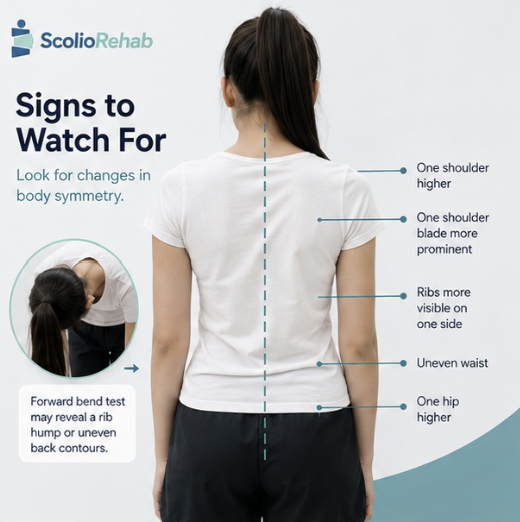
These signs do not tell yofu exactly how large a scoliosis curve is.
They are reasons to consider a proper assessment.
Why the Forward Bend Test Is Often Used
During a scoliosis assessment, a teenager may be asked to bend forward while the examiner looks at the back from behind.
This is commonly known as the Adam’s Forward Bend Test.
Because scoliosis involves spinal rotation as well as sideways curvature, rotation can create visible asymmetry such as a rib prominence.
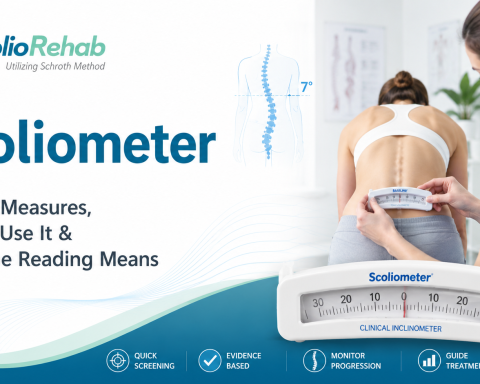
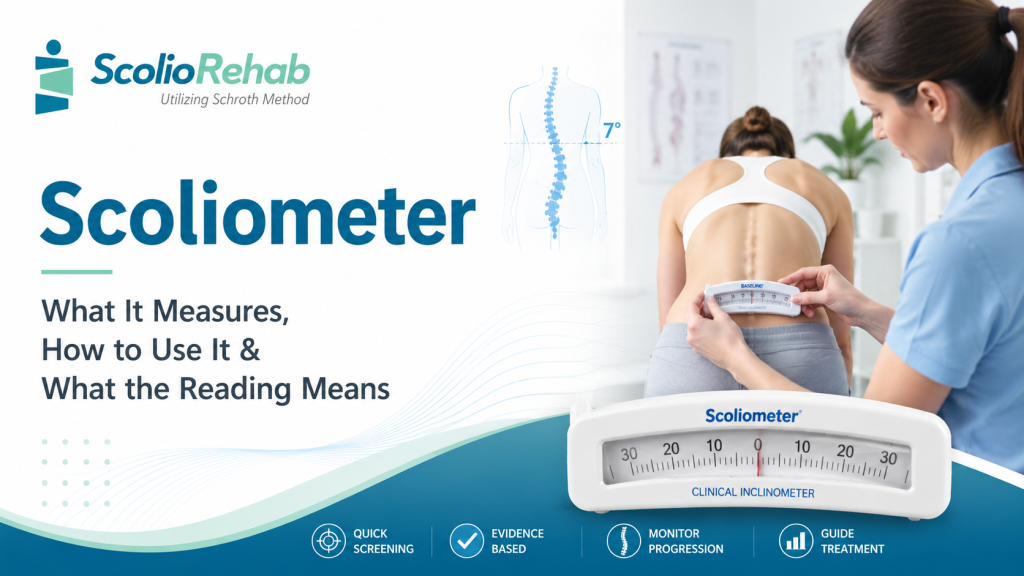
A clinician may also use a scoliometer during this test to measure the Angle of Trunk Rotation.
However, a scoliometer does not diagnose scoliosis and its reading is not the same thing as a Cobb angle.
For example:
7° on a scoliometer does not mean a 7° scoliosis curve.
They measure different things.
How Is Adolescent Idiopathic Scoliosis Diagnosed?
When scoliosis is suspected, assessment usually involves a combination of physical examination and imaging.
An X-ray allows the spinal curve to be measured using the Cobb angle.
A curve greater than 10° on X-ray is conventionally considered scoliosis.
But the Cobb angle should not be viewed as a standalone number.
For adolescent scoliosis, clinicians may consider several pieces of information together:
| Factor | Why It Matters |
|---|---|
| Cobb angle | Shows the magnitude of the spinal curve |
| Previous X-rays | Helps determine whether the curve is changing |
| Remaining growth | More growth can mean more opportunity for progression |
| Skeletal maturity | Helps estimate how far through growth the teenager may be |
| Curve pattern | Different curves may behave differently |
| Physical presentation | Shows trunk rotation and postural asymmetry |
The Cobb angle answers:
How large is the spinal curve?
Growth indicators such as the Risser sign help answer a different question:
How much skeletal growth may remain?
Keeping those measurements separate is important because they tell us different things about the same teenager.
Why the Risser Sign Matters in AIS
Parents sometimes focus entirely on the Cobb angle.
But with adolescent idiopathic scoliosis, clinicians are also interested in how much growing the teenager may still have left.
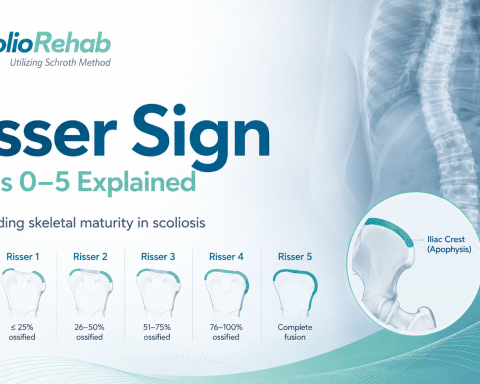
The Risser sign is one method used to estimate skeletal maturity from an X-ray.
It ranges from Risser 0 through Risser 5.
A lower Risser stage generally indicates that more skeletal growth may remain, while a higher stage indicates greater skeletal maturity.
This does not mean that a low Risser number is automatically bad.
It means the curve needs to be interpreted in the context of growth.
For example, the same Cobb angle may carry a different progression risk in a rapidly growing adolescent than in someone who is close to skeletal maturity.
We explain the measurement in detail in Risser Sign in Scoliosis: What Risser 0 to 5 Really Means.
Does Adolescent Idiopathic Scoliosis Always Get Worse?
No.
This is one of the most important things for parents to understand.
A diagnosis of AIS does not automatically mean the curve will continue getting larger.
Many adolescents have small curves that remain relatively stable and may require monitoring rather than aggressive intervention.
The likelihood of progression depends on the individual.
Factors clinicians may consider include:
How large is the curve now?
Has it changed since the previous assessment?
How much growth remains?
Is the teenager currently going through a rapid growth period?
This is why follow-up is important.
One X-ray is a snapshot.
Several assessments taken over time can begin to show a trend.
And in AIS, that trend may be more useful than becoming overly focused on one isolated number.
Girls and Boys Can Both Develop AIS
Both boys and girls can develop adolescent idiopathic scoliosis.
However, girls are more likely to develop curves that become larger and require medical attention.
That does not mean scoliosis in boys should be ignored.
Any teenager showing significant spinal asymmetry or a suspected curve should be assessed appropriately rather than relying on appearance alone.
What Happens After an AIS Diagnosis?
There is no single treatment plan that applies to every teenager with scoliosis.
Management depends on factors such as:
- Curve size
- Whether the curve is progressing
- Skeletal maturity
- Remaining growth
- Curve pattern
- Individual circumstances
Depending on the situation, management may involve observation, scoliosis-specific rehabilitation, bracing or specialist medical review.
The important point is that treatment decisions should be based on the teenager’s individual progression risk rather than simply the fact that scoliosis exists.
For a detailed explanation of the available approaches, visit our Scoliosis Treatment in Malaysia guide.
Observation and Monitoring
For smaller curves, especially when there is no evidence of significant progression, monitoring may be recommended.
This can involve scheduled clinical assessments and, when appropriate, repeat imaging to see whether the curve changes as the teenager grows.
Observation should not be confused with simply forgetting about the curve.
The objective is to identify meaningful progression early enough for the management plan to be reconsidered when necessary.
Scoliosis-Specific Exercise
Some adolescents may participate in physiotherapeutic scoliosis-specific exercises as part of conservative management.
Unlike generic strengthening exercises, scoliosis-specific approaches are designed around the individual’s curve pattern, posture and three-dimensional spinal alignment.
The Schroth Method is one such scoliosis-specific exercise approach.
Research and professional recommendations regarding scoliosis-specific exercise continue to evolve. SOSORT guidelines include physiotherapeutic scoliosis-specific exercises within conservative scoliosis management, while the strength of evidence varies depending on the outcome being assessed.
Rather than duplicating that topic here, you can learn about the approach in our dedicated Schroth Method guide.
Bracing During Growth
For certain adolescents who still have meaningful growth remaining and whose curves are considered at risk of progression, bracing may be recommended.
The primary purpose of scoliosis bracing during adolescence is generally to reduce the risk of further curve progression while growth continues, not to promise a perfectly straight spine.
A major clinical trial known as BrAIST found that bracing significantly reduced progression to the study’s surgical threshold among adolescents considered at high risk of progression.
Whether a teenager needs a brace, what type of brace is appropriate and how it should be worn require individual assessment.
For information specifically about bracing, visit our Gensingen Brace by Dr. Weiss (GBW) page.
Does AIS Mean My Teenager Will Need Surgery?
No.
An AIS diagnosis by itself is not an indication for surgery.
Many adolescents are managed through observation or conservative care.
Surgical evaluation is generally associated with larger or significantly progressing curves, and decisions involve much more than simply crossing one number on an X-ray.
If a curve becomes severe or continues to progress despite appropriate management, an orthopaedic spine specialist can discuss whether surgical treatment should be considered.
The purpose of early assessment is not to frighten families about surgery.
It is to understand the curve while there is still time to make informed decisions.
Can Teenagers With Scoliosis Still Exercise?
In most cases, yes.
Adolescents with idiopathic scoliosis can generally remain physically active and participate in sports according to their individual tolerance and medical guidance.
Scoliosis does not automatically mean your teenager should stop:
- Running
- Swimming
- Dancing
- Playing football
- Going to the gym
- Participating in school sports
Physical activity is important for general health.
If a teenager has a larger curve, wears a brace, experiences unusual symptoms or has received specific medical restrictions, their activities should be discussed with the clinician managing their condition.
What Should Parents Do After an AIS Diagnosis?
It is easy to leave a scoliosis appointment with a collection of numbers but still not understand what they mean.
Try to understand the whole picture.
Instead of asking only:
“What is the Cobb angle?”
also ask:
- “How much growth does my child have remaining?”
- “Has the curve progressed since the last assessment?”
- “What is the current progression risk?”
- “When should it be reassessed?”
- “What change would make us reconsider the current management plan?”
Those questions shift the conversation from simply identifying scoliosis to understanding where it may be heading.
When Should Scoliosis Be Assessed More Urgently?
AIS itself is often not painful, particularly when curves are small.
A teenager should receive appropriate medical evaluation if scoliosis is accompanied by symptoms that are unusual for typical AIS, particularly:
- Significant or persistent pain
- Weakness in the arms or legs
- Numbness or altered sensation
- Problems with balance or walking
- Rapid or unusual changes in spinal appearance
- Other neurological symptoms
Severe back pain associated with weakness or numbness warrants medical evaluation because another cause may need to be ruled out.
Adolescent Scoliosis Is About More Than One Number
It is understandable for parents to fixate on a number written on an X-ray.
18°.
25°.
32°.
But adolescent idiopathic scoliosis is not just a Cobb angle.
The more useful picture combines:
Curve magnitude + growth remaining + skeletal maturity + progression over time.
That is what helps determine whether a curve simply needs monitoring or whether additional management should be considered.
The earlier families understand these factors, the easier it becomes to make decisions based on what the curve is actually doing rather than fear about what it might do.
Frequently Asked Questions About Adolescent Idiopathic Scoliosis
1. Is adolescent idiopathic scoliosis the same as scoliosis?
AIS is one type of scoliosis.
Scoliosis is the broader condition, while adolescent idiopathic scoliosis refers specifically to idiopathic scoliosis developing during adolescence.
Other forms of scoliosis include congenital, neuromuscular and adult degenerative scoliosis.
For the broader topic, see What Is Scoliosis?
2. What does “idiopathic” mean?
Idiopathic means that no single identifiable underlying cause has been found.
It does not mean the scoliosis was caused by something the teenager or parent did.
3. Is AIS caused by bad posture?
No.
Poor sitting posture is not considered a cause of adolescent idiopathic scoliosis.
Posture may make existing asymmetry more or less noticeable, but it does not explain the structural spinal curvature seen in AIS.
4. Can carrying a heavy school bag cause scoliosis?
Heavy backpacks may contribute to discomfort, but they are not considered a cause of adolescent idiopathic scoliosis.
5. Is adolescent scoliosis painful?
Most teenagers with mild AIS do not experience significant pain.
Larger curves may sometimes be associated with discomfort, but severe or unusual pain deserves further assessment rather than automatically being attributed to scoliosis.
6. Can AIS get worse during puberty?
Yes, progression can occur during periods of rapid growth.
This is one reason growth and skeletal maturity are important when assessing adolescent scoliosis.
7. Does scoliosis stop progressing once growth stops?
Progression usually slows substantially after skeletal maturity for many AIS curves.
However, larger curves may continue to progress during adulthood, so long-term behaviour depends partly on curve magnitude and the individual case.
8. Can a teenager with scoliosis play sports?
In most cases, yes.
Children and teenagers with idiopathic scoliosis can generally participate in sports according to their tolerance unless their healthcare provider has advised otherwise.
9. Does every teenager with AIS need a brace?
No.
Bracing is only appropriate for certain adolescents based on factors including curve magnitude, growth remaining and progression risk.
Some teenagers may only require observation, while others may require additional conservative or specialist management.
Concerned About Your Child’s Scoliosis?
If you have noticed uneven shoulders, a rib prominence or changes in your teenager’s posture, understanding the curve early can help you make more informed decisions.
At ScolioRehab, adolescent scoliosis assessment focuses not only on how the spine looks today, but also on factors such as curve measurement, skeletal maturity and progression risk.
Book a scoliosis assessment with ScolioRehab
Understand the curve. Understand the growth stage. Know what to do next.