 Dexter Chew
You notice that one side of your child’s back looks slightly higher when they bend forward.
Is it scoliosis?
How curved is the spine?
And does an X-ray need to be done immediately?
This is where a scoliometer can be useful.
A scoliometer is a simple handheld instrument commonly used during scoliosis screening to measure trunk rotation. It does not diagnose scoliosis on its own, and it does not replace an X-ray, but it can help identify asymmetry that may need further assessment.
For parents, patients and even people who already have scoliosis, understanding what a scoliometer actually measures can make those little numbers much less confusing.
Because a reading of 7° on a scoliometer does not mean you have a 7° scoliosis curve.
That distinction matters.
What Is a Scoliometer and What it Measure?
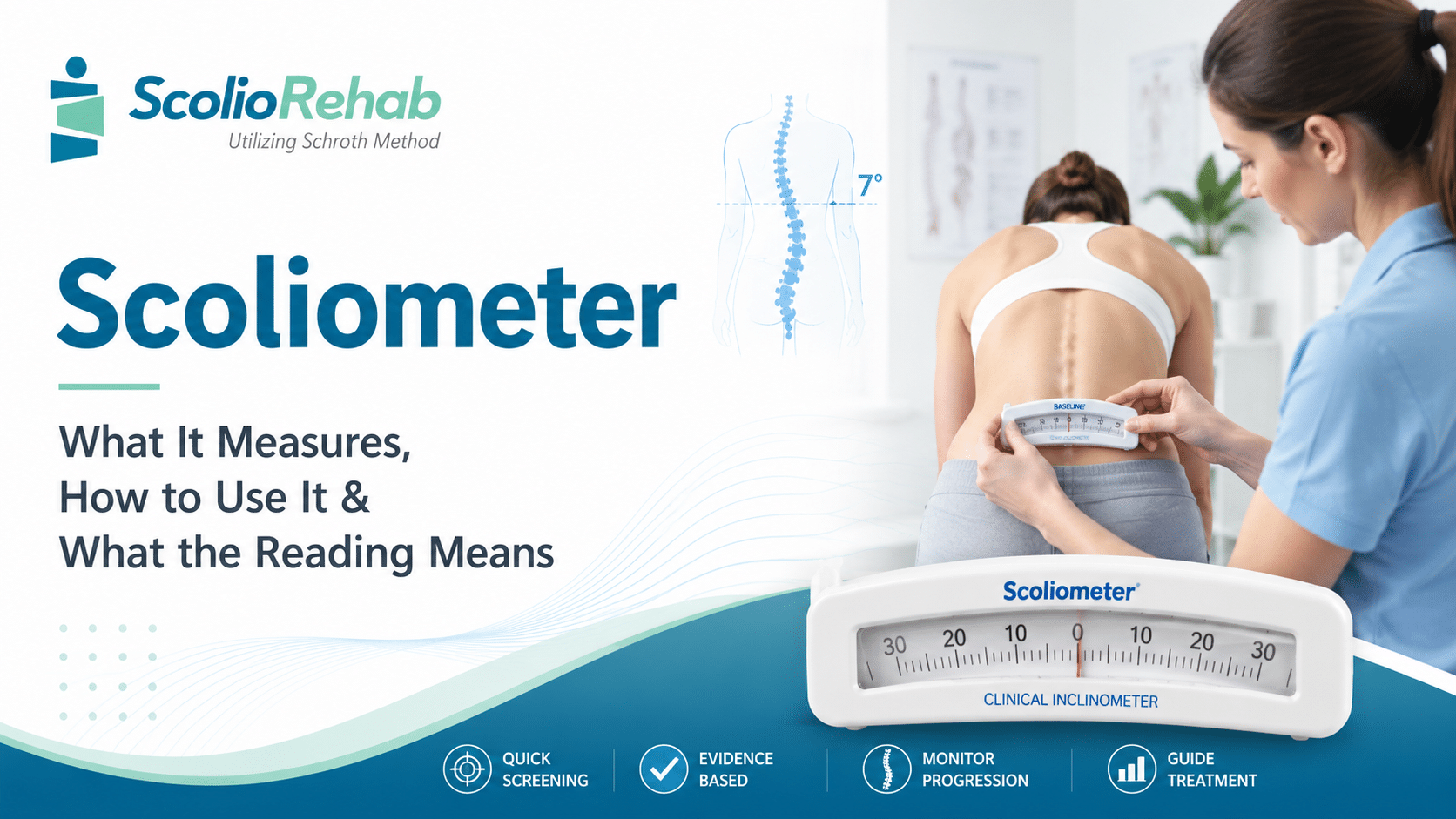
A scoliometer is a non-invasive instrument used to measure the amount of rotation or asymmetry of the trunk.
It looks somewhat like a small level or inclinometer.
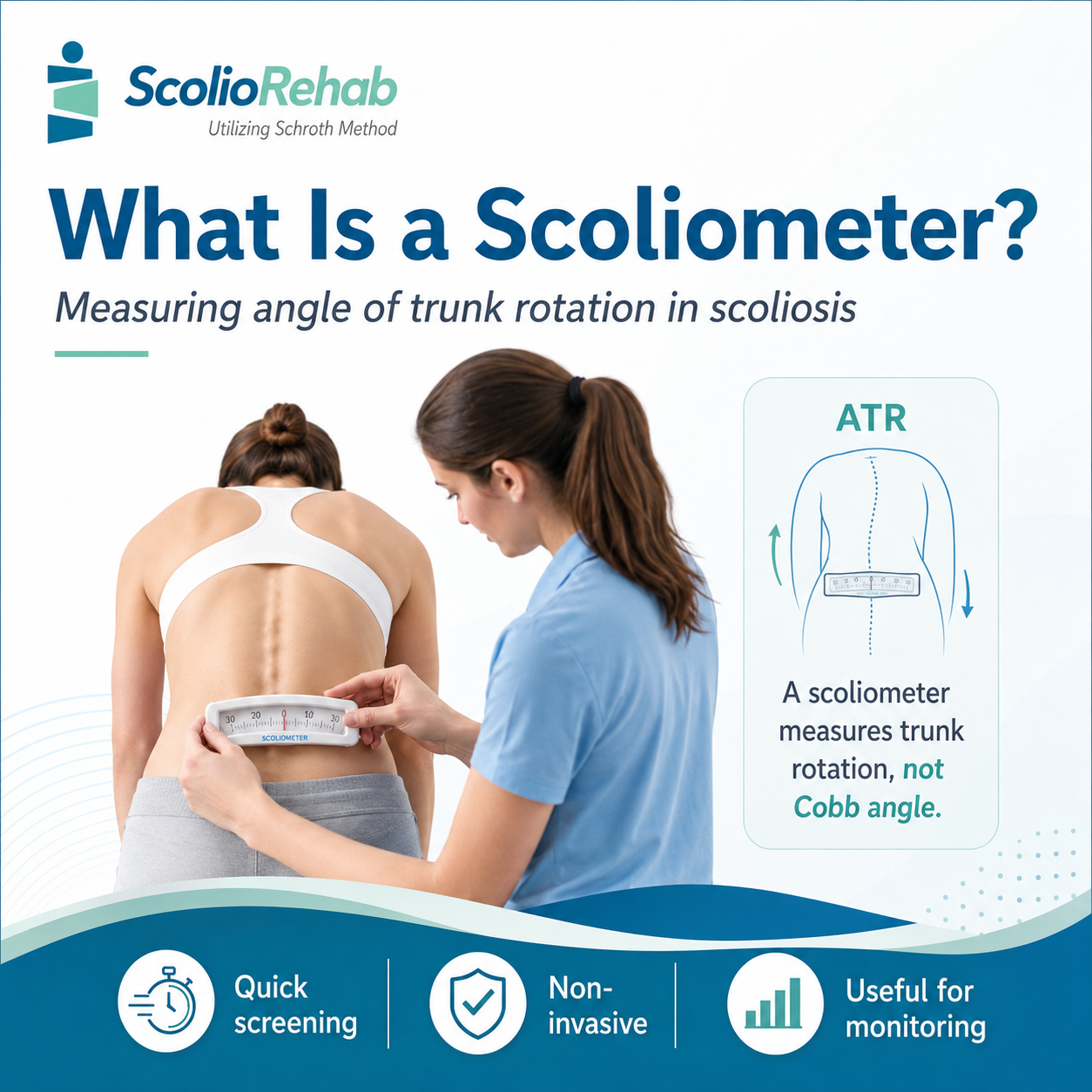
During a scoliosis assessment, the person normally bends forward while the scoliometer is placed across the back. The device then measures the Angle of Trunk Rotation, commonly abbreviated as ATR.
The Scoliosis Research Society describes the measurement as trunk inclination measured across the back while the person is flexed forward.
In simple terms:
A scoliometer tells us how much one side of the trunk rises relative to the other.
This is particularly useful in scoliosis because scoliosis is not simply a sideways bend of the spine.
It is a three-dimensional condition involving both curvature and rotation.
That rotation is what can contribute to the familiar rib hump or unevenness seen when someone with scoliosis bends forward.
Scoliometer vs Cobb Angle: What’s the Difference?
They answer different questions.
A scoliometer measures Angle of Trunk Rotation (ATR), but it does not directly measure the Cobb angle.
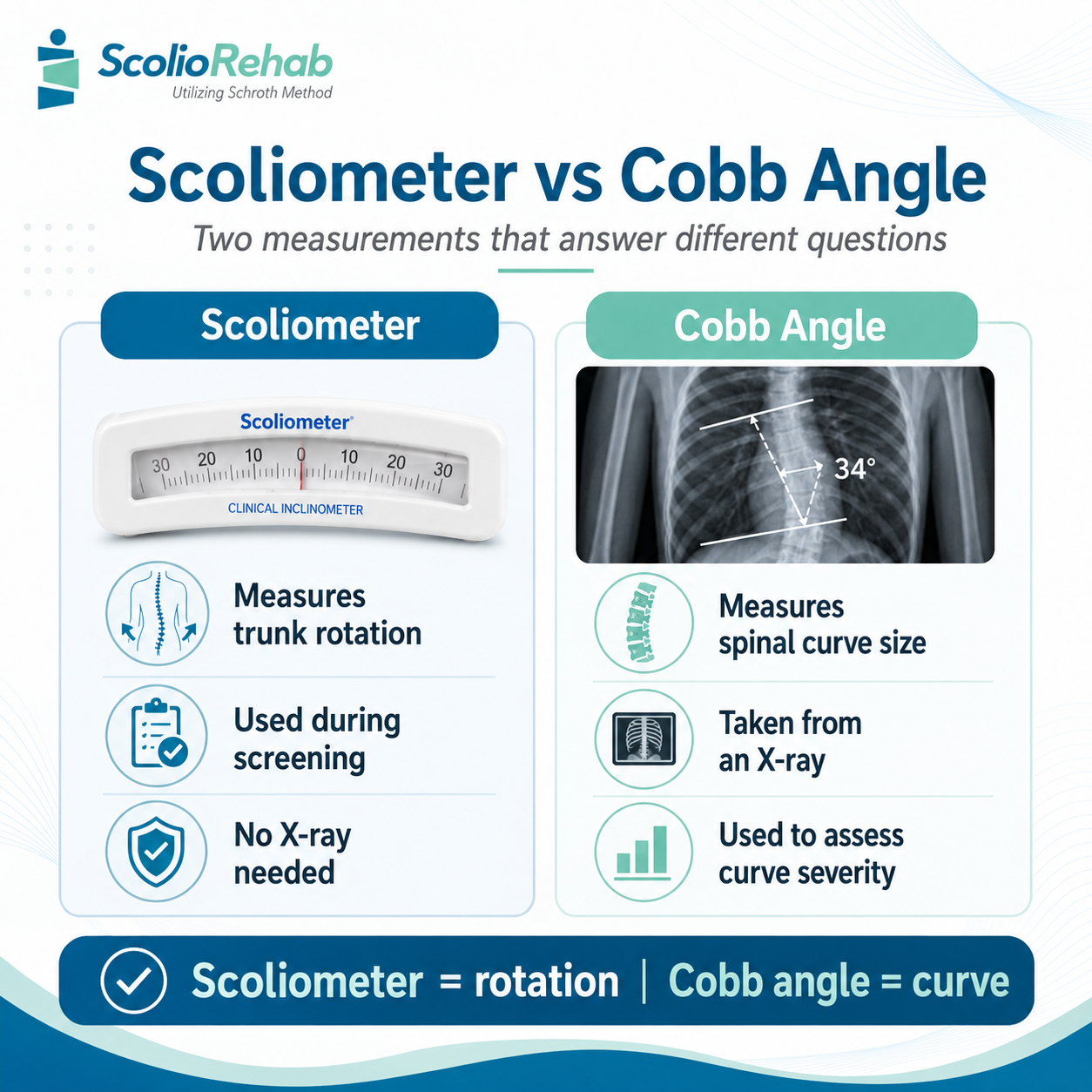
For example, a Scoliometer reading: 7° ATR does not mean Cobb angle: 7°. They are different measurements taken in different ways.
A scoliometer evaluates the external rotational asymmetry of the trunk. The Cobb angle is measured from an X-ray and evaluates the sideways curvature of the spine
| Scoliometer | Cobb Angle | |
|---|---|---|
| Measures | Trunk rotation/asymmetry | Spinal curvature |
| Measurement | Angle of Trunk Rotation (ATR) | Cobb angle |
| Requires X-ray? | No | Yes |
| Commonly used for | Screening and monitoring | Diagnosis and curve severity |
| Typical unit | Degrees | Degrees |
| Measures the same thing? | No | No |
The easiest way to remember it is:
Scoliometer = rotation
Cobb angle = curve
Both can be useful because scoliosis is three-dimensional.
If you want to understand how the actual spinal curve is measured on an X-ray, read our guide to Cobb Angle in Scoliosis.
How is a Scoliometer Used?
A scoliometer is commonly used together with the Adam’s Forward Bend Test.
You may have seen this test before.
The patient stands upright and then bends forward while the examiner looks at the back from behind.
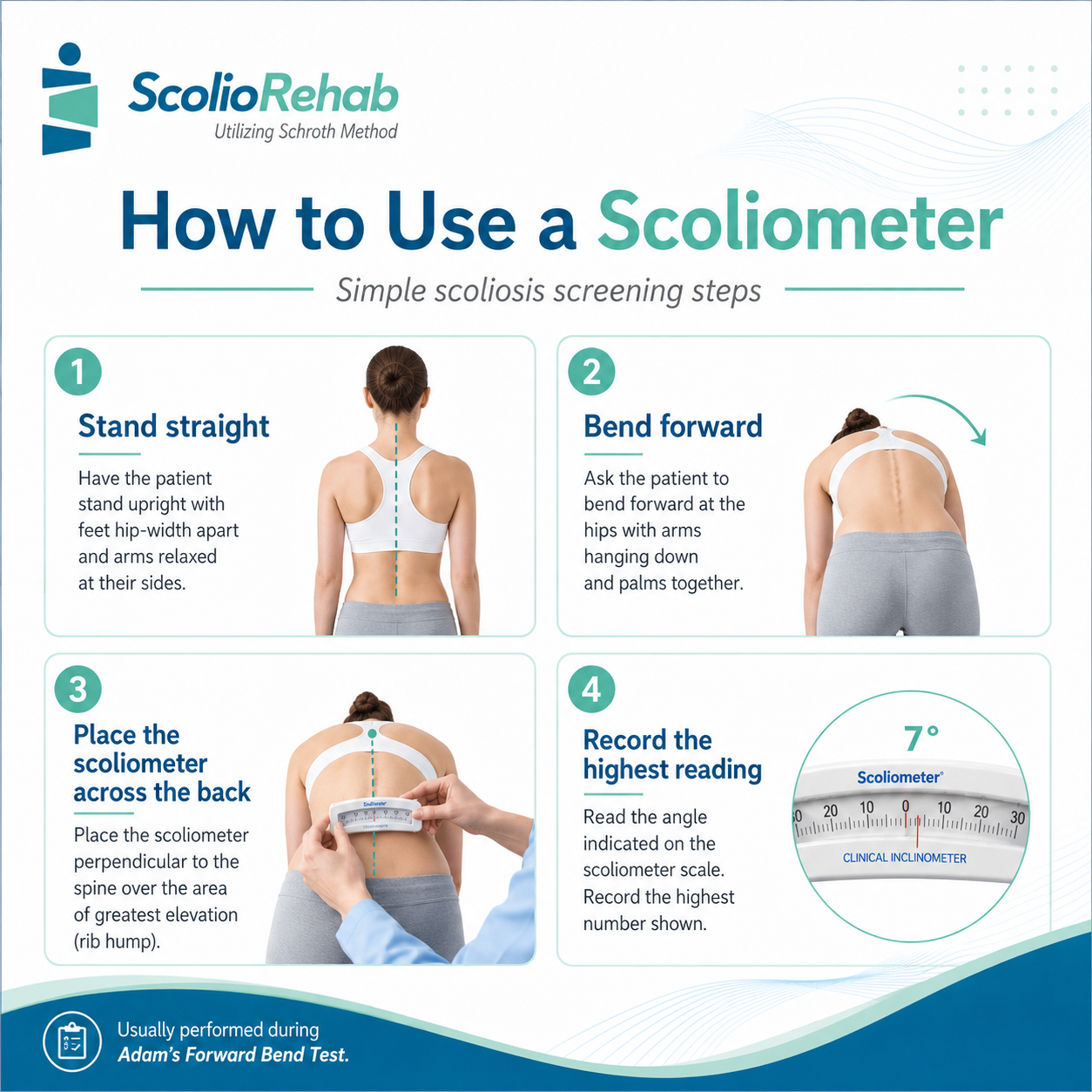
Here is the general process.
Step 1. Stand Straight
The patient starts in a relaxed standing position.
The examiner may first observe whether there are visible signs of asymmetry, such as:
- uneven shoulders
- one shoulder blade appearing more prominent
- uneven waistline
- one hip sitting higher
- trunk shifting to one side
These signs do not automatically confirm scoliosis, but they may indicate that further assessment is useful.
Step 2. Bend Forward
The patient then bends forward at the waist.
The knees are typically kept straight and the arms hang down or the palms are placed together.
This position makes rotational differences in the trunk easier to see.
The forward bend test is widely used as part of scoliosis screening.
Step 3. Place the Scoliometer Across the Back
The examiner places the scoliometer across the back, perpendicular to the spine.
It may be moved progressively along different levels of the back.
This is important because scoliosis can occur in different regions, including the:
- thoracic spine
- thoracolumbar region
- lumbar spine
Step 4. Find the Highest Reading
The examiner looks for the area with the greatest trunk rotation and records the maximum ATR measurement.
The process may be repeated to improve measurement consistency.
Pedi-Scoliometer’s professional guidance similarly recommends measuring through thoracic, thoracolumbar and lumbar areas during forward bending and recording the most significant reading.
What Does a Scoliometer Reading Mean?
You’ll often see readings such as: 2°, 5°, 7°, 10°.
So what do those numbers actually mean?
One commonly cited screening framework classifies ATR approximately like this:
| Scoliometer Reading | General Interpretation |
|---|---|
| 0°–3° | Low trunk rotation |
| 4°–6° | Intermediate asymmetry |
| 7° or higher | More significant trunk rotation that may warrant further assessment |
Research based on Bunnell’s scoliometer screening approach has commonly used ATR ≥7° as a threshold indicating more relevant trunk rotation.
However, the threshold is not universal.
Some screening recommendations use 5° to 7° ATR as a point at which referral for further evaluation or radiography may be considered.
That is why a number on a scoliometer should not be interpreted completely on its own.
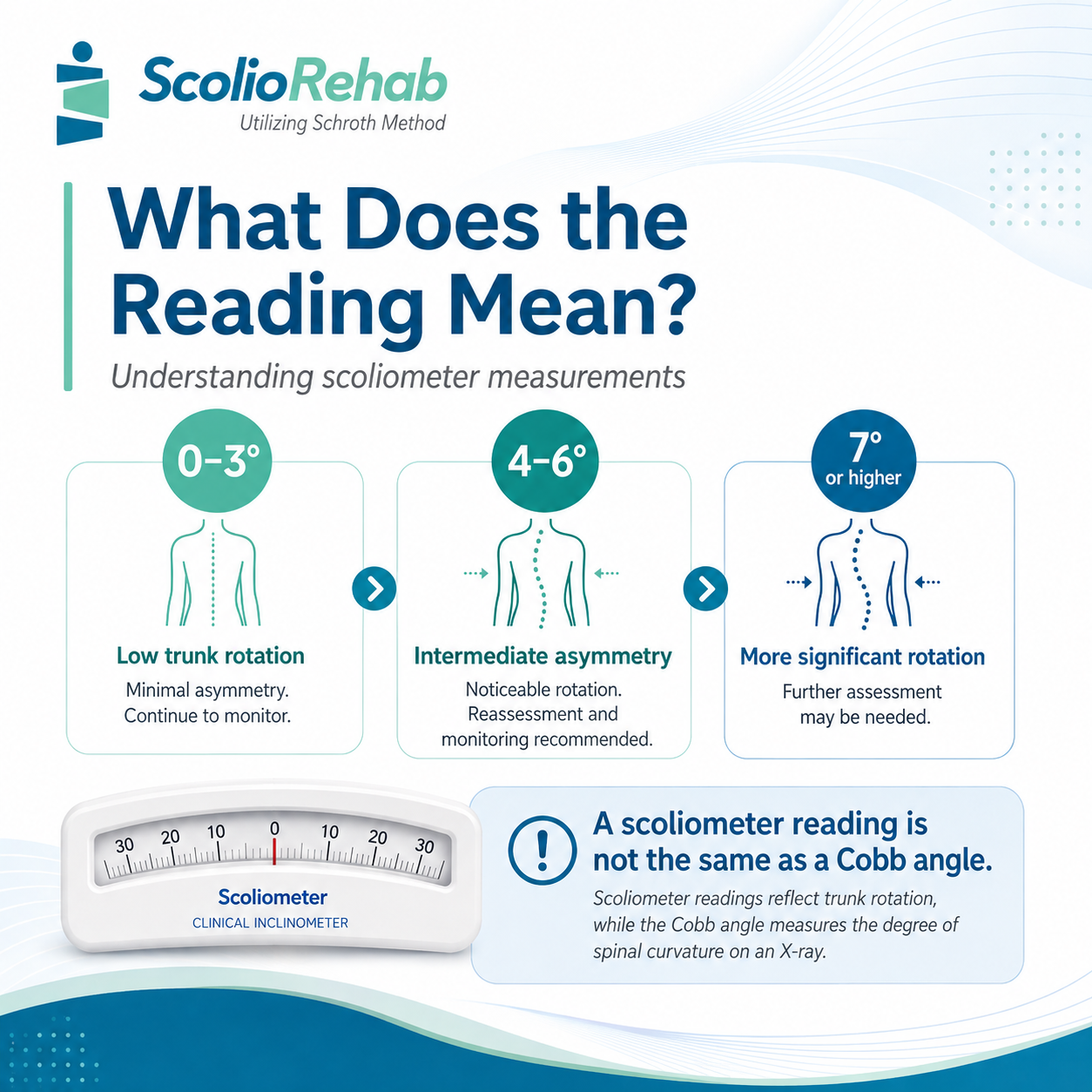
A higher ATR simply suggests that the trunk asymmetry may be significant enough to justify closer investigation.
Think of a scoliometer as a warning indicator, rather than the final diagnosis.
Why is a Scoliometer Useful for Scoliosis?
There are three major reasons.
1. It Is Non-Invasive
No radiation is involved. That makes scoliometer measurement useful when screening children and adolescents.
2. It Can Detect Rotation That Is Difficult to See
Minor changes in trunk rotation may not always be obvious visually. A scoliometer gives the examiner an objective numerical measurement instead of relying entirely on visual judgment. Early research testing the device found scoliometer measurements to have useful reliability for evaluating axial trunk rotation.
3. It Can Help With Monitoring
Someone who already has scoliosis may undergo repeated assessments as they grow. Changes in ATR can provide another piece of information when monitoring the condition between clinical evaluations.
However, a scoliometer should not be used as proof that a Cobb angle has increased or decreased. If meaningful changes are suspected, the clinician may decide whether additional evaluation is necessary.
Can a Scoliometer Detect Scoliosis Without an X-Ray?
It can screen for signs of scoliosis, but it cannot definitively replace X-ray assessment.
Imagine the process like a funnel:
Posture assessment > Adam’s Forward Bend Test > Scoliometer measurement > Further clinical assessment if indicated > X-ray and Cobb angle measurement when appropriate
The Scoliosis Research Society notes that scoliometer measurements may be used during examination, while standing spinal X-rays are used to evaluate and measure the curve using the Cobb method.
So if someone asks: “Can a scoliometer diagnose scoliosis?”
A better answer is: It can help identify scoliosis-related trunk asymmetry, but diagnosis should be based on a complete professional assessment rather than the scoliometer reading alone.
Can You Use a Scoliometer at Home?
Technically, physical scoliometers and smartphone versions are available to consumers.
But there’s a catch.
A measurement is only useful if it is taken consistently.
Differences in:
- how far the person bends
- where the device is positioned
- whether the knees are straight
- where the highest rotation occurs
- how much pressure is placed on the back
can affect the result.
Recent research has also investigated how examination positioning can influence ATR measurements, reinforcing the importance of standardized technique.
If you’re monitoring scoliosis at home, it is better to first have a trained scoliosis clinician or physiotherapist demonstrate exactly how the measurement should be taken.
Otherwise, a change from 5° to 7° may simply reflect different measurement technique rather than actual progression.
Physical Scoliometer vs Scoliometer Online or App
Search for “scoliometer online” and you’ll find smartphone applications designed to imitate a traditional scoliometer.
These apps use the phone’s built-in sensors to estimate trunk rotation.
Some digital systems have also been studied as inexpensive alternatives for scoliosis screening.
Physical scoliometer
Advantages:
- purpose-built instrument
- simple to use
- no battery required for many models
- commonly used in clinical settings
Online Scoliometer app
Advantages:
- convenient
- accessible through a smartphone
- easier for some people to record repeated measurements
The important issue is not whether the device is physical or digital.
It is whether the measurement method is reliable and repeatable.
A smartphone app should not turn your phone into a DIY diagnostic machine.
It is still a screening tool.
Scoliometer Price in Malaysia
If you search for “scoliometer price” or “scoliometer for sale”, you’ll find a wide range of options.
Prices depend on:
- brand
- physical vs digital device
- professional certification
- construction quality
- supplier
- country of manufacture
Professional physical scoliometers may cost significantly more than simple consumer versions or smartphone apps.
For example, one Malaysian retailer currently lists a Baseline Scoliometer at around RM430, although product prices can change over time.
But price should not be the main factor if you’re using the device for actual scoliosis monitoring.
Measurement consistency matters far more than simply purchasing the cheapest available scoliometer.
For parents, it may also be unnecessary to buy one at all unless your clinician recommends home monitoring.
Can Scoliometer Measurements Show Whether Treatment Is Working?
They can provide additional information, but this needs careful interpretation.
Suppose someone’s reading changes:
8° ATR → 5° ATR
That may indicate less visible trunk rotation.
But it does not automatically mean:
the Cobb angle decreased by 3°.
Likewise:
5° ATR → 8° ATR
should not automatically be interpreted as a 3° increase in spinal curvature.
Scoliosis is three-dimensional.
A comprehensive assessment may look at:
- Cobb angle
- Angle of Trunk Rotation
- curve pattern
- posture
- skeletal maturity
- progression over time
- symptoms and function
For adolescents, skeletal maturity is particularly relevant because progression risk can change depending on how much growth remains.
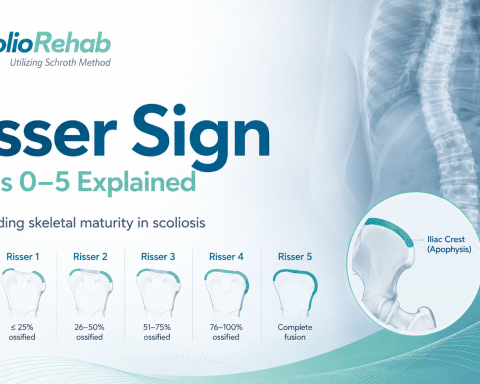
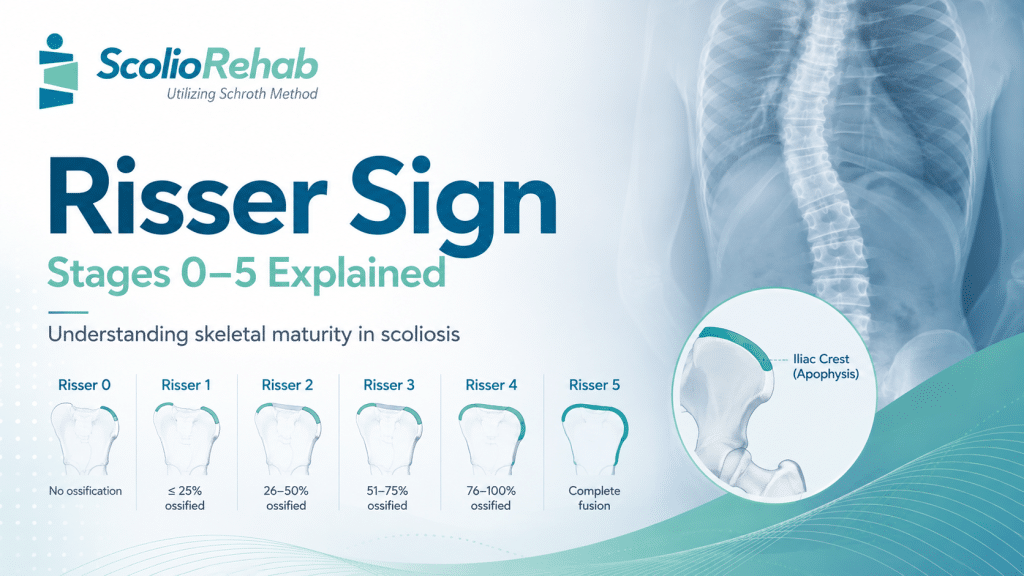
Our guide to the Risser Sign explains how clinicians estimate skeletal maturity from an X-ray.
How Scoliometer Measurement Is Used at ScolioRehab
At ScolioRehab Malaysia, scoliosis assessment looks beyond a single number.
Depending on the individual patient, assessment may include posture, trunk rotation, spinal alignment, existing radiographs, Cobb angle, skeletal maturity and progression history.
For patients requiring conservative scoliosis management, this information can also help guide approaches such as Schroth-based scoliosis rehabilitation and bracing when clinically appropriate.
The goal is not simply to obtain a scoliometer number.
It is to understand what that number means in the context of the entire scoliosis picture.
FAQ
1. What is a normal scoliometer measurement?
Readings of approximately 0° to 3° ATR are generally considered low levels of trunk rotation.
Measurements above this range represent greater asymmetry, while readings around 5° to 7° or higher may prompt further assessment depending on the clinical situation.
2. Is 5 degrees on a scoliometer scoliosis?
Not necessarily. A 5° scoliometer measurement refers to trunk rotation, not Cobb angle.
Scoliosis is conventionally diagnosed when an X-ray shows a spinal Cobb angle greater than 10°.
3. What does 7 degrees on a scoliometer mean?
A reading of 7° means approximately 7° of trunk rotation was detected.
It is commonly used as one threshold at which additional evaluation may be considered, but it does not automatically confirm scoliosis.
4. Can I buy a scoliometer?
Yes. Physical scoliometers are available from medical equipment suppliers, and digital scoliometer apps also exist.
If you intend to monitor scoliosis yourself, ask your clinician to show you the correct measurement method first.
5. Is there an online scoliometer?
There are smartphone apps and digital tools that use a phone’s inclinometer sensors to measure trunk rotation.
They can be convenient for screening or monitoring, but they should not be used to self-diagnose scoliosis.
6. What Is a Baseline Scoliometer?
You may also see searches for Baseline Scoliometer or Baseline Scoliosis Meter.
Baseline is one of the commercially available scoliosis measurement devices.
The device works using essentially the same principle: measuring rotation or asymmetry of the back during spinal assessment.
Its instructions include observing the patient from behind, performing the forward bend position and measuring the area where spinal deformity appears most pronounced.
The key point is that Baseline is a brand, whereas scoliometer is the general category of instrument.
It’s similar to how a particular manufacturer can produce a thermometer, but the word thermometer refers to the instrument itself.
7. What is a Pedi Scoliometer?
Pedi-Scoliometer is another professional inclinometer designed specifically for scoliosis screening and monitoring.
Pedi-Scoliometer is a medical device manufactured by Pedihealth and designed for professional scoliosis screening and monitoring.
Like other scoliometers, it measures Angle of Trunk Rotation in degrees during a forward bending assessment.
8. Does a scoliometer replace an X-ray?
No. A scoliometer is useful because it is quick, non-invasive and involves no radiation, but radiographs remain important when a clinician needs to confirm scoliosis and calculate the Cobb angle.
A Small Tool That Can Reveal Something Your Eyes May Miss
A scoliometer looks surprisingly simple.
But used correctly, it can add useful information to a scoliosis assessment.
It allows clinicians to put a number to trunk rotation instead of relying entirely on visual appearance.
The key is understanding what that number represents.
A scoliometer measures trunk rotation.
It does not directly measure the scoliosis Cobb angle.
And it does not replace a complete scoliosis assessment.
If you or your child has noticeable back asymmetry or an abnormal scoliometer measurement, the next step should not be guessing the Cobb angle from the reading.
The better next step is understanding the whole picture.
At ScolioRehab Malaysia, scoliosis assessment and non-surgical management can include scoliosis-specific rehabilitation, the Schroth Method, and scoliosis bracing where appropriate.
Early detection gives you information. Proper assessment tells you what to do with it. If you have scoliosis, check out our guide on all available scoliosis treatment options in Malaysia.
Medical References
- Scoliosis Research Society. Diagnosing Scoliosis.
The Scoliosis Research Society describes the use of physical examination, scoliometer assessment and standing spinal X-rays as part of scoliosis evaluation. It also distinguishes screening measurements from Cobb angle measurement on radiographs. - Deepak AS, Ong JY, Choon DSK, et al. The Clinical Effectiveness of School Screening Programme for Idiopathic Scoliosis in Malaysia. Malaysian Orthopaedic Journal. 2017;11(1):41–46.
This Malaysian study evaluated 8,966 students aged 13–15 using the forward bend test and scoliometer measurement. An ATR of 5° or more was used as the screening threshold before referral for radiographic Cobb angle assessment. - Amendt LE, Ause-Ellias KL, Eybers JL, et al. Validity and Reliability Testing of the Scoliometer. Physical Therapy. 1990;70(2):108–117.
This study evaluated the validity and inter-rater and intra-rater reliability of the scoliometer for measuring axial trunk rotation in people with idiopathic scoliosis. - Kotwicki T, Kinel E, Stryła W, Szulc A. School Screening for Scoliosis: Can Surface Topography Replace Examination With Scoliometer? Scoliosis. 2012.
This research describes scoliometer-based Angle of Trunk Rotation (ATR) assessment during forward bending and discusses commonly used screening ranges of 0–3°, 4–6° and 7° or greater. - Samuelsson L, Norén L. Trunk Rotation in Scoliosis: The Influence of Curve Type and Direction in 150 Children. Acta Orthopaedica Scandinavica. 1997;68(3):273–276.
The study compared scoliometer ATR readings with Cobb angle measurements and found that their relationship varies depending on the location and direction of the scoliosis curve. This supports the point that a scoliometer reading should not be directly converted into a Cobb angle.