 Dexter Chew
You have your child’s scoliosis X-ray in front of you.
The Cobb angle says 25°.
Then somewhere in the report, you see another number:
Risser 0.
Naturally, the next question is: What does that mean? Is Risser 0 serious?
The Risser sign does not measure how severe scoliosis is. Instead, it gives clinicians an estimate of how much skeletal growth may still be remaining.
And in a growing child or teenager with scoliosis, that information can be extremely important.
A 25° curve in someone who has almost finished growing may behave very differently from the same 25° curve in someone who still has several years of growth ahead.
That is why scoliosis specialists usually do not look at the Cobb angle alone.
What Is the Risser Sign?
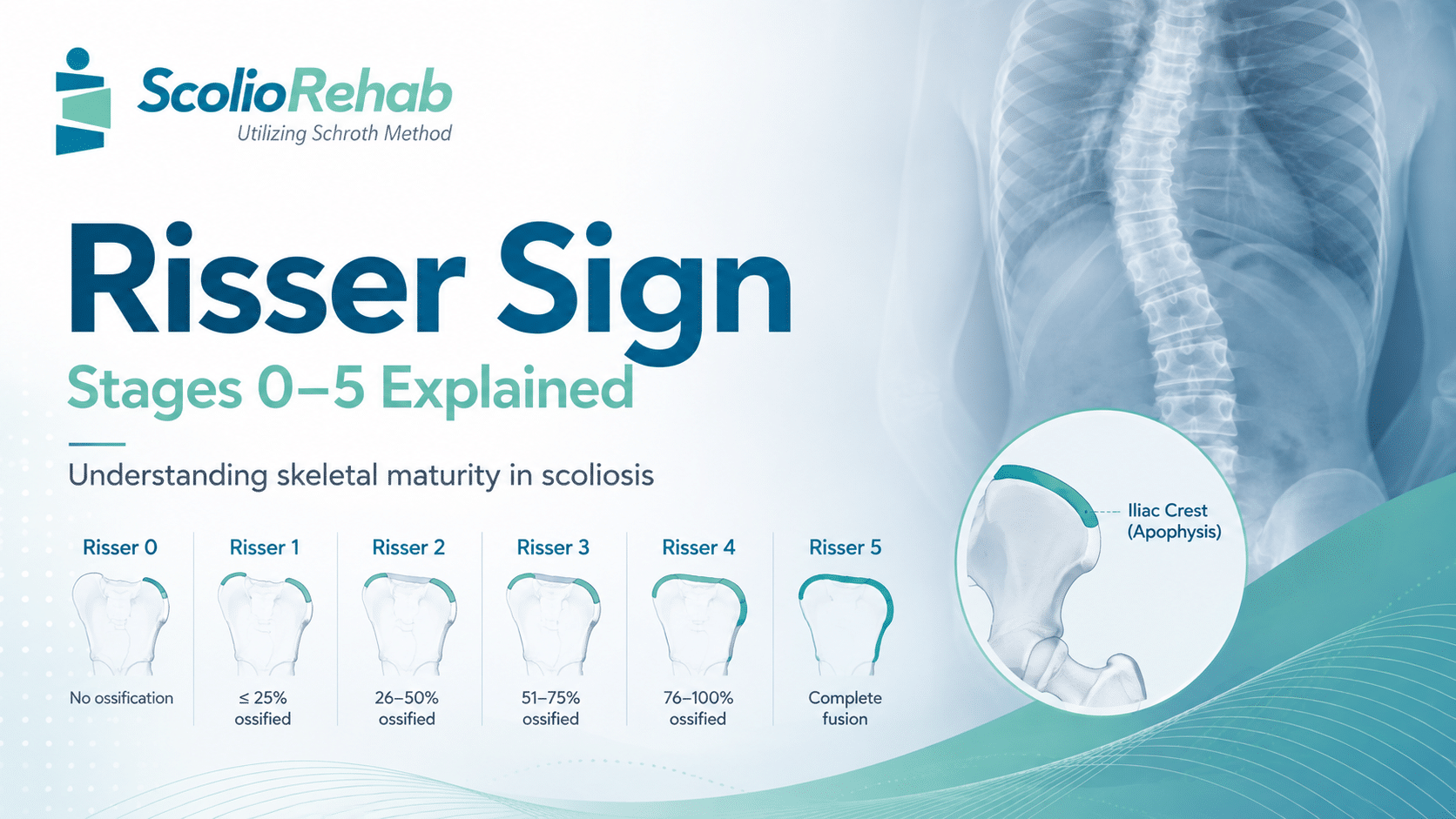
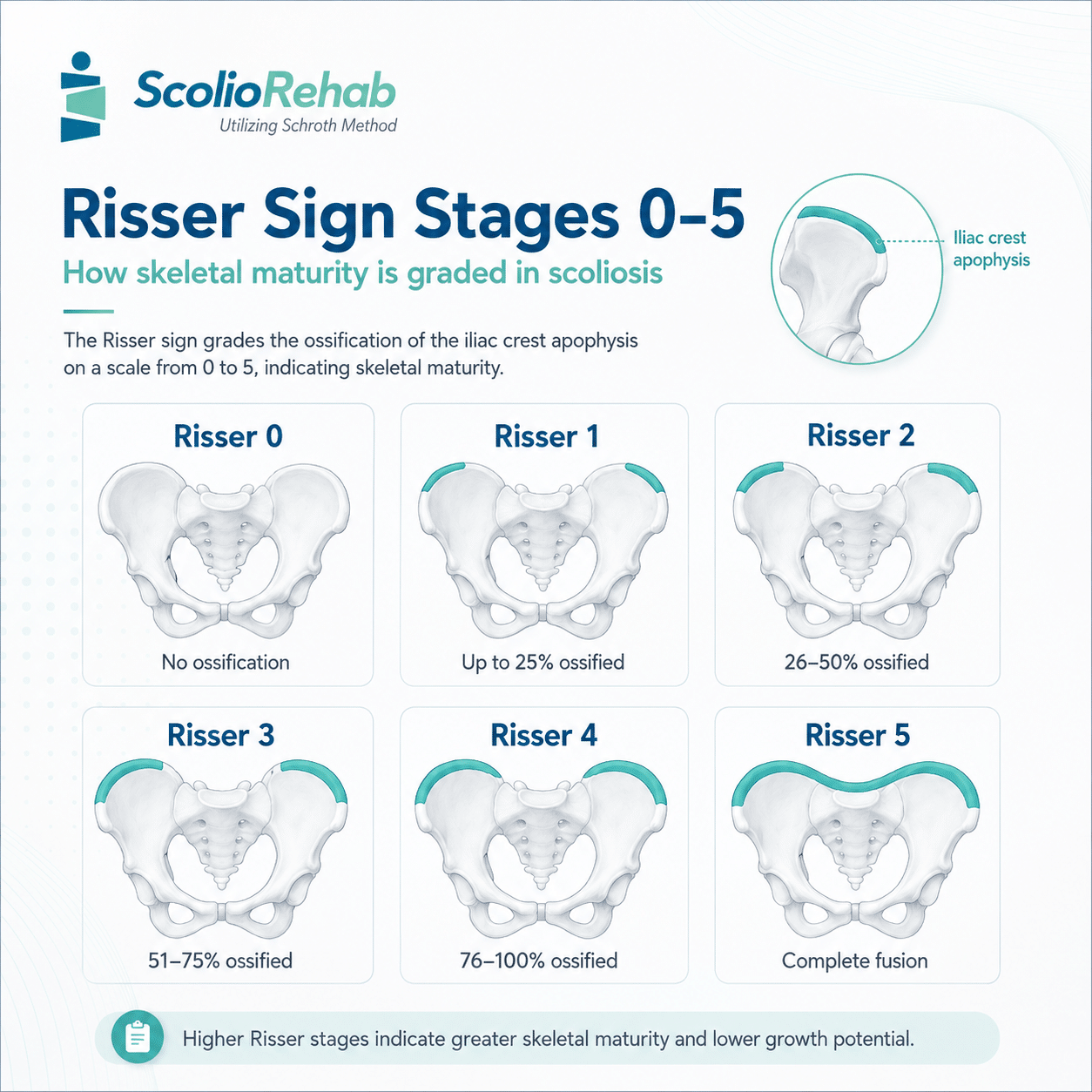
The Risser sign, sometimes called the Risser score, Risser grade or Risser stage, is a radiographic method used to estimate skeletal maturity.
In simple terms, it helps answer: How much growing does this person probably have left?
It is assessed by looking at an area of the pelvis called the iliac crest apophysis on an X-ray.
As a child matures, this area gradually ossifies and eventually fuses with the pelvis. The progress is classified from Risser 0 to Risser 5.
A lower Risser stage generally indicates greater remaining skeletal growth, while a higher Risser stage indicates that skeletal maturity is approaching or has been reached.
Risser Sign at a Glance
| Risser Stage | What Is Seen on the X-ray | General Meaning |
|---|---|---|
| Risser 0 | No visible ossification of the iliac apophysis | Significant growth may still remain |
| Risser 1 | About 25% ossification | Early skeletal maturation |
| Risser 2 | About 50% ossification | Growth is continuing |
| Risser 3 | About 75% ossification | Moving closer to skeletal maturity |
| Risser 4 | Iliac apophysis is fully ossified but not completely fused | Most skeletal growth is approaching completion |
| Risser 5 | Complete fusion with the ilium | Skeletal maturity has generally been reached |
This table describes the commonly used US Risser classification. A slightly different French classification also exists, particularly in how the intermediate stages are divided.
Why Does the Risser Sign Matter in Scoliosis?
Because scoliosis and growth are closely connected.
Adolescent idiopathic scoliosis often progresses most rapidly during periods of rapid growth. Once skeletal maturity is reached, the risk of rapid growth-related progression generally decreases.
This means two teenagers with exactly the same Cobb angle may have very different levels of progression risk.
Imagine two patients who both have a 25° scoliosis curve.
The first patient is Risser 0 and still growing rapidly.
The second patient is Risser 4 and approaching skeletal maturity.
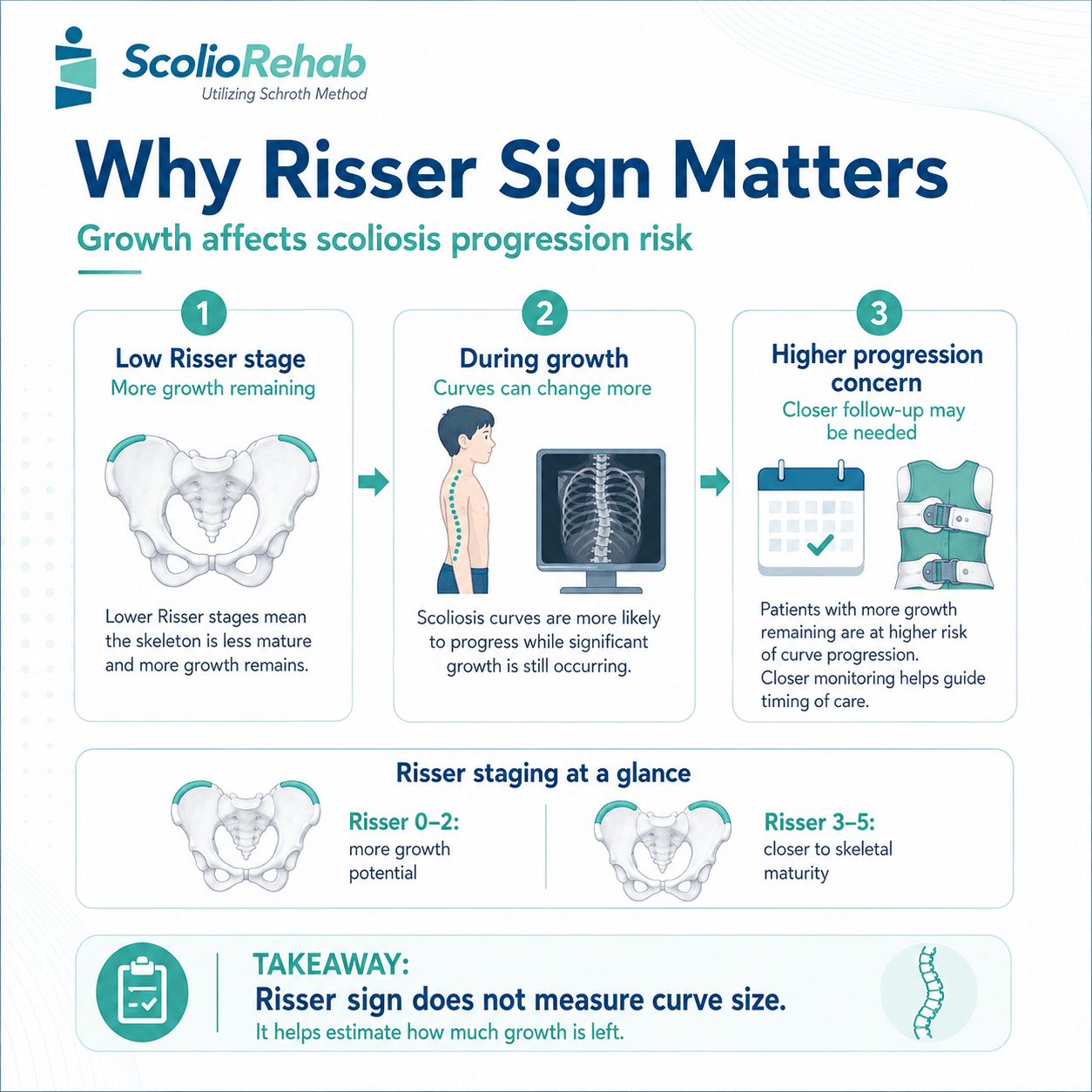
Their X-rays may show the same Cobb angle today, but their remaining growth potential is different.
The Risser 0 patient generally has more time left for the spine to grow, which also means there may be more opportunity for the curve to change.
This is why understanding both Cobb angle and Risser sign gives a much clearer picture than looking at either number alone.
Cobb Angle vs Risser Sign: What Is the Difference?
This is one of the most important distinctions for parents to understand.
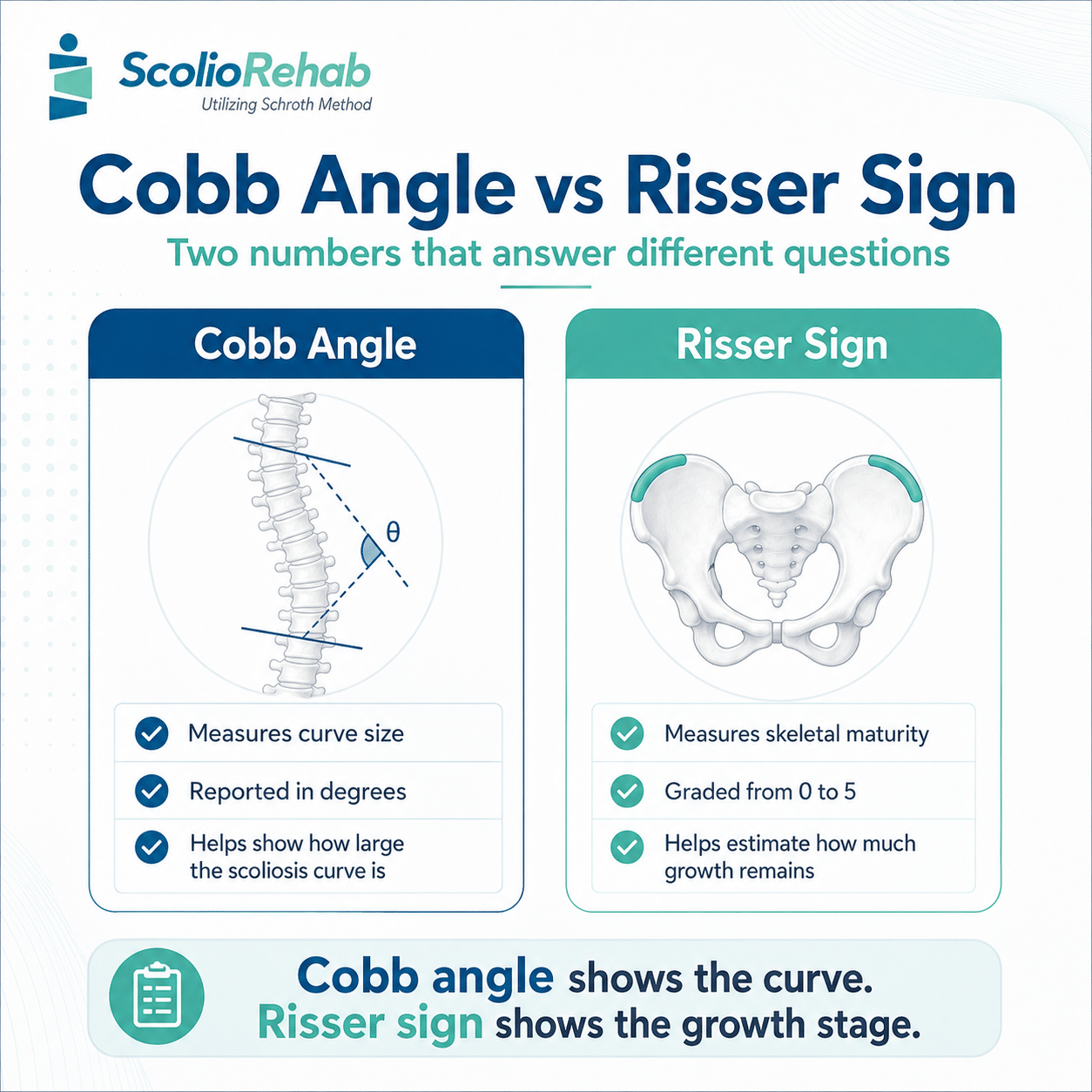
The Cobb angle measures the size of the scoliosis curve.
The Risser sign estimates skeletal maturity.
Think of it this way:
Cobb angle = How big is the curve now?
Risser sign = How much growth may still be left?
Together, they help clinicians estimate how closely scoliosis should be monitored and whether more active management may need to be considered.
For example, a smaller curve does not automatically mean there is nothing to worry about if the patient is still at an early stage of growth.
Likewise, a higher Cobb angle should not be interpreted without considering age, skeletal maturity, progression history and the patient’s overall condition.
If you are unfamiliar with how spinal curves are measured, our guide to Cobb angle in scoliosis explains the measurement in more detail.
What Does Risser 0 Mean?
Risser 0 means that ossification of the iliac crest apophysis is not yet visible on the X-ray.
For parents, this is often the stage that causes the most concern.
But Risser 0 does not mean the scoliosis is severe.
It simply suggests that the patient is skeletally immature and potentially has substantial growth remaining.
This matters because scoliosis has a greater opportunity to progress while the body is growing.
Research has identified low skeletal maturity, including low Risser stages, as one of several factors associated with a higher risk of scoliosis progression. Curve magnitude remains another major factor.
So if someone is Risser 0 with scoliosis, the useful question is not:
“Is Risser 0 bad?”
The better question is:
“What is the Cobb angle, how quickly is the child growing, and has the curve been changing?”
That gives a much more meaningful picture.
What Does Risser 1 Mean?
At Risser 1, ossification has begun along approximately the first quarter of the iliac crest in the commonly used US system.
The patient is still growing.
For adolescents with scoliosis, this remains an important period for monitoring because meaningful growth potential may still be present.
A low Risser stage combined with a larger curve or documented progression may lead clinicians to monitor the scoliosis more closely or consider whether active management is appropriate.
What Does Risser 2 Mean?
Risser 2 generally corresponds to ossification progressing through approximately half of the iliac apophysis.
The patient is further along in skeletal development than at Risser 0 or 1, but growth is not yet complete.
This is one reason Risser stage is commonly considered when discussing scoliosis bracing.
The Scoliosis Research Society notes that bracing is generally used in growing patients with moderate scoliosis, with the purpose of preventing the curve from becoming larger during growth.
However, a Risser number alone should never be used to decide whether someone needs a brace.
The Cobb angle, recent progression, age, remaining growth, curve pattern and other maturity indicators all matter.
What Does Risser 3 Mean?
At Risser 3, approximately three quarters of the iliac apophysis has ossified in the US classification.
The patient is moving closer towards skeletal maturity.
Does that mean the scoliosis can no longer progress?
No.
This is an important misconception.
Although progression risk generally decreases as skeletal maturity approaches, research has shown that some patients can still experience progression at Risser 3 and beyond. Risser staging is useful, but it does not perfectly predict what an individual scoliosis curve will do.
This is why suddenly stopping follow-up simply because someone has reached Risser 3 may not be appropriate without considering the entire clinical picture.
What Does Risser 4 Mean?
Risser 4 generally means that ossification has extended across the iliac crest, although complete fusion has not yet occurred.
At this stage, the patient is approaching skeletal maturity and much of the rapid adolescent skeletal growth has usually passed.
The risk of growth-related curve progression is generally lower than it would be at Risser 0 or 1.
However, Risser 4 does not automatically mean:
“The scoliosis cannot change anymore.”
Larger curves, progression history, remaining growth and other individual factors still matter.
What Does Risser 5 Mean?
Risser 5 represents complete fusion of the iliac apophysis with the ilium and generally indicates skeletal maturity.
In simple language:
The major period of skeletal growth has essentially finished.
This significantly changes the way scoliosis is evaluated.
For adolescents, much of the concern during Risser 0 to 3 is whether rapid growth could contribute to further progression.
At Risser 5, that particular growth-related risk is greatly reduced.
But this does not mean scoliosis suddenly disappears or that every curve becomes permanently stable.
Larger scoliosis curves can still require long-term monitoring, and adults with scoliosis may experience other issues such as pain, stiffness, muscular imbalance or degenerative changes.
Does a Low Risser Score Mean Scoliosis Will Get Worse?
Not necessarily.
This is where overly simplified information online can become misleading.
A lower Risser stage tells us that more growth is likely remaining. It does not tell us with certainty that a particular scoliosis curve will progress.
Progression risk is influenced by several factors, including:
- Cobb angle and curve magnitude
- Skeletal maturity
- Age
- Growth velocity
- Whether the curve has already progressed
- Curve pattern and location
- Menarche status in girls
- Other skeletal maturity measurements
Research reviewing thousands of patients has found curve magnitude and skeletal maturity among the important predictors of progression.
In other words, Risser sign is one piece of the puzzle, not the entire puzzle.
Why Risser 0 Can Be Tricky
There is another detail that many basic Risser sign articles leave out.
Risser 0 covers a relatively wide period of development.
A child who is about to enter a rapid growth spurt and another adolescent who is further through puberty may both still be classified as Risser 0.
Their actual remaining growth potential may not be identical.
This is one limitation of relying only on the Risser sign.
Research has pointed out that Risser staging is not particularly precise at identifying the exact timing of peak height velocity, which is an important period when assessing scoliosis progression risk.
That is why clinicians may consider other indicators alongside Risser stage.
Risser Sign vs Sanders Stage
Parents researching scoliosis may also come across something called the Sanders Maturity Scale.
Both Risser and Sanders staging are used to assess skeletal maturity, but they look at different areas.
Risser staging looks at development around the pelvis.
Sanders staging evaluates skeletal maturity using an X-ray of the hand.
The Sanders system can provide additional information about skeletal growth, particularly around the adolescent growth spurt.
This does not mean the Risser sign is useless. It remains widely used because the pelvis is often already visible on the same spinal X-ray taken to assess scoliosis.
Instead, think of skeletal maturity as something that may be estimated using several pieces of information rather than relying blindly on one number.
How Can the Risser Sign Affect Scoliosis Treatment?
There is no universal treatment prescribed simply because someone is Risser 0, 2 or 4.
Treatment decisions are based on the combination of the curve and the patient.
For a teenager who is still growing, clinicians may be particularly interested in preventing progression before skeletal maturity.
Depending on the individual case, management may involve observation and follow-up, scoliosis-specific rehabilitation such as the Schroth Method, or bracing when clinically appropriate.
The Scoliosis Research Society describes bracing as a commonly used treatment for growing patients with moderate scoliosis, with the main goal of preventing further curve progression during growth.
At ScolioRehab, skeletal maturity is therefore considered together with factors such as the Cobb angle, curve pattern, posture, symptoms and progression history when understanding the patient’s scoliosis.
Risser Sign and Scoliosis Bracing
The relationship between growth and bracing is especially important.
A scoliosis brace does not simply “push a crooked spine straight.”
One of its major goals during adolescence is to control the curve while the patient continues growing.
This is why skeletal maturity matters.
If substantial growth is still remaining, there is more time during which the scoliosis could progress, but there is also a meaningful period in which appropriately selected conservative management can be applied.
The Scoliosis Research Society generally recommends bracing for curves above approximately 25° but below about 45° to 50° in someone who is still growing. Exact recommendations depend on the individual patient.
For patients who require bracing, factors such as skeletal maturity, curve type, flexibility, brace design and compliance can all influence the management plan.
You can learn more about ScolioRehab’s Gensingen Brace by Dr. Weiss (GBW) and how bracing may be combined with scoliosis-specific rehabilitation.
Does Risser Sign Matter for Adults With Scoliosis?
Usually, it is much more relevant during childhood and adolescence.
Risser staging is primarily useful because it helps estimate skeletal maturity.
Once someone has reached full skeletal maturity, the question is no longer how much adolescent growth remains.
For adults, scoliosis assessment tends to focus more on the Cobb angle, curve type, symptoms, posture, function, progression and age-related changes.
This is why seeing a Risser score on a teenager’s X-ray may significantly affect the clinical discussion, while it is usually much less important when evaluating an adult with scoliosis.
Can You Determine Your Own Risser Stage?
Not accurately by looking at your body, height or posture.
Risser stage is determined from imaging of the pelvis.
You also should not assume skeletal maturity simply because a teenager has reached a certain age or because they appear to have stopped growing.
Puberty and skeletal development vary considerably between individuals.
If Risser staging is relevant to the scoliosis assessment, it should be interpreted by a healthcare professional together with the rest of the clinical and radiographic information.
What Should Parents Ask After Seeing a Risser Score?
Instead of focusing only on whether the Risser number is “good” or “bad,” parents can have a much more useful discussion by asking:
- What is the current Cobb angle?
- Is my child still growing rapidly?
- Has the curve changed compared with the previous X-ray?
- How much progression risk is there at this stage of growth?
- Does the scoliosis need monitoring only, or should active treatment be considered?
- Would scoliosis-specific exercises or bracing be appropriate?
Those questions connect the Risser sign to what actually matters: understanding what the scoliosis may do next.
The Number That Makes More Sense When Combined With Another Number
The easiest way to remember the Risser sign is this:
Cobb angle tells us about the curve.
Risser sign tells us about growth.
Neither should be interpreted completely on its own.
A teenager with a moderate scoliosis curve and substantial growth remaining may require a very different management strategy from someone with the same curve who has already reached skeletal maturity.
That is why proper scoliosis assessment looks beyond a single number on an X-ray.
If your child has recently been diagnosed with scoliosis in Malaysia and you have been given a Cobb angle or Risser stage that you do not understand, a scoliosis assessment can help put those numbers into context.
At ScolioRehab, our team focuses on non-surgical scoliosis management through personalised rehabilitation, the Schroth Method and scoliosis bracing when appropriate.
Understanding the curve is the first step.
Understanding how much growth remains can help determine what should happen next.