 Dexter Chew
When someone is diagnosed with scoliosis, one of the first terms they may hear is Cobb angle. For many patients and parents, this number can feel confusing at first. Some may be told the curve is 15 degrees, 25 degrees, or 40 degrees, but they are not always sure what that actually means.
The Cobb angle is one of the most commonly used measurements to estimate the severity of a scoliosis curve. It helps clinicians understand how much the spine is curving and whether the curve needs monitoring, further assessment, or a more active management plan.
In simple terms, the Cobb angle gives a clearer picture of the spinal curve. Instead of relying only on posture changes seen from the outside, it provides a measurable number based on an X-ray.
This article explains what Cobb angle means, how it is measured, and why it matters in scoliosis monitoring.
What Is Cobb Angle?
Cobb angle is a measurement used to describe the degree of sideways curvature in the spine.
In scoliosis, the spine does not appear straight when viewed from the back. It curves sideways, and in some cases, the spine may also rotate. The Cobb angle helps measure how large that curve is.
For example, a small curve may be measured at around 10 to 20 degrees, while a larger curve may measure 40 degrees or more.
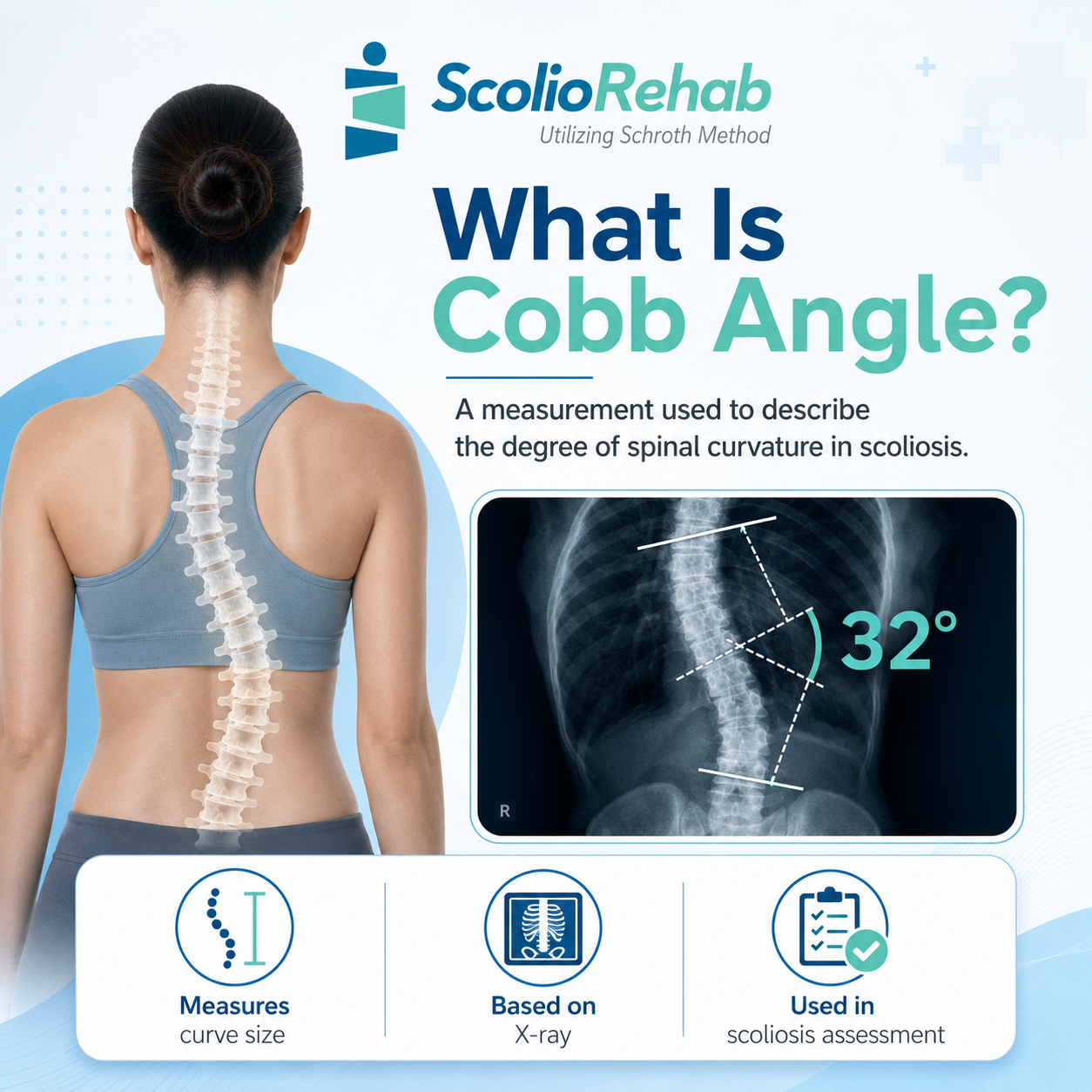
A higher Cobb angle generally means a larger spinal curve. However, the number alone does not tell the full story. Age, growth stage, curve pattern, posture, symptoms, and progression over time are also important.
For a more general overview of scoliosis itself, you can read our guide on scoliosis condition.
How Is Cobb Angle Measured?
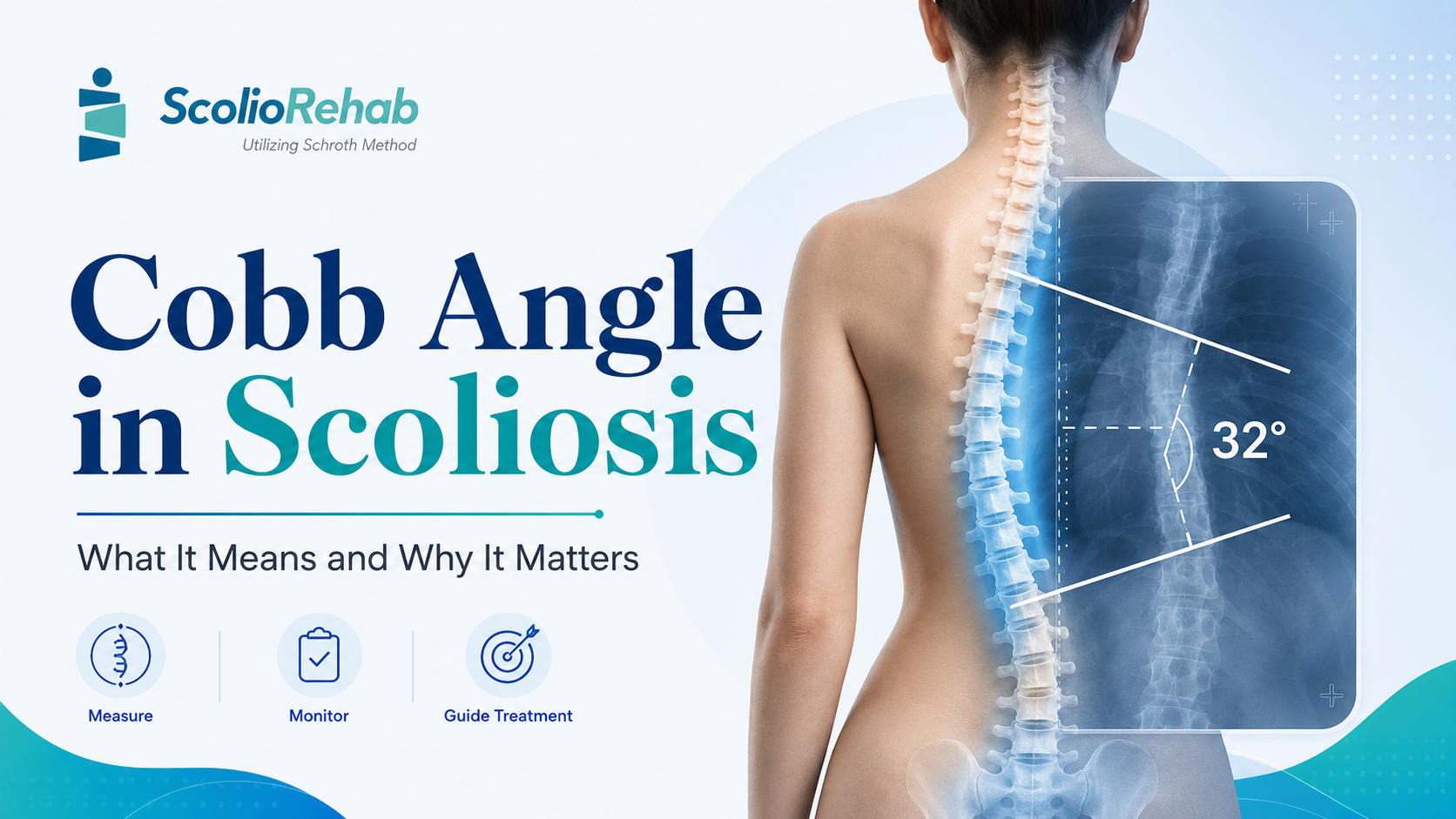
Cobb angle is usually measured from a standing spinal X-ray.
The clinician identifies the most tilted vertebra at the top of the curve and the most tilted vertebra at the bottom of the curve. Lines are drawn along these vertebrae, and the angle between them is measured.
This angle becomes the Cobb angle.
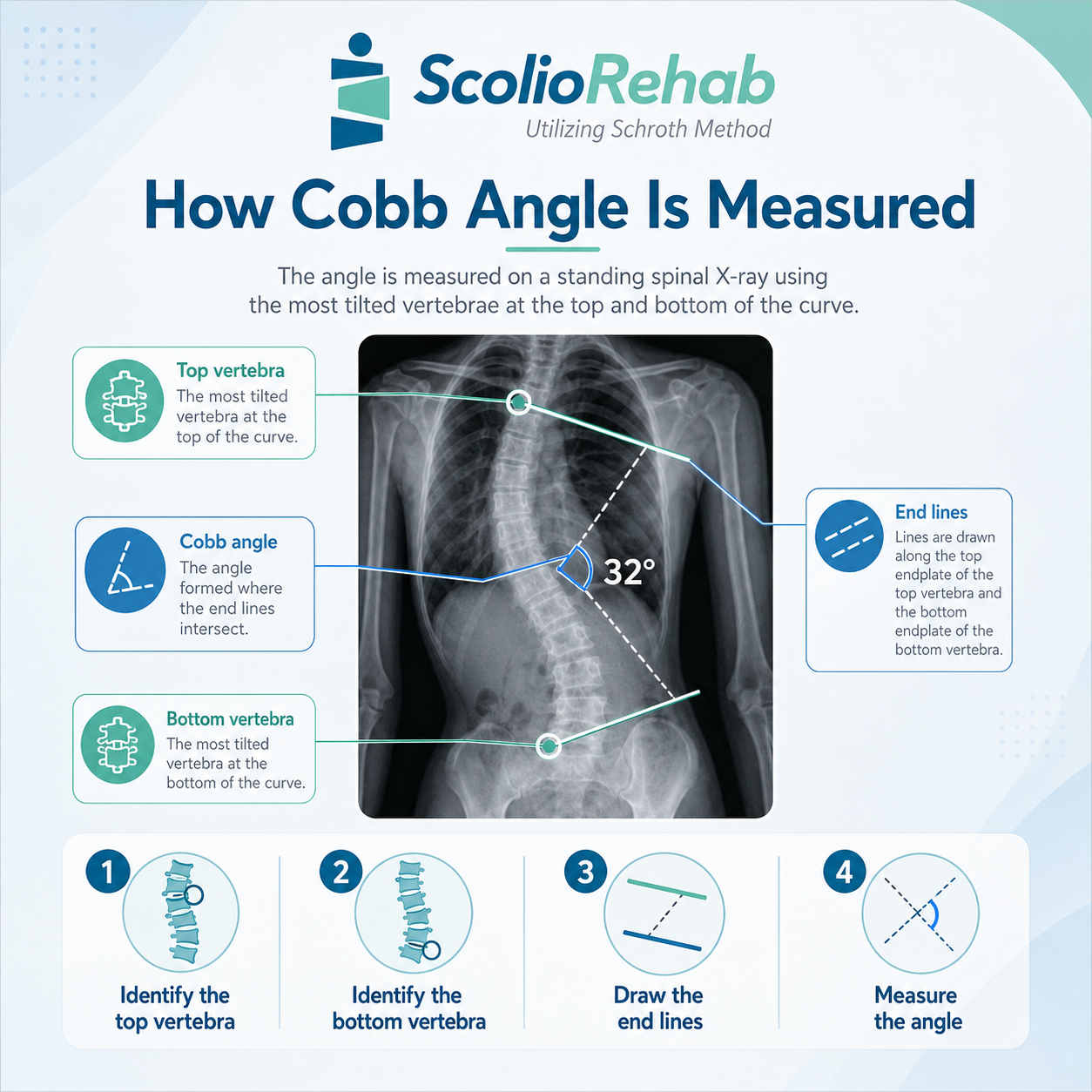
The measurement helps show the size of the spinal curve in degrees. It is commonly used to track scoliosis over time, especially in children and teenagers who are still growing.
X-rays are important because posture alone cannot accurately measure the curve. A person may appear slightly uneven from the outside, but the X-ray gives a clearer view of the actual spinal alignment.
Why Cobb Angle Matters
Cobb angle matters because it helps guide how scoliosis is monitored and managed.
Without a measurement, scoliosis assessment can become too vague. A patient may be told they have a “mild” or “serious” curve, but without a number, it is difficult to track whether the curve is changing over time.
The Cobb angle gives a baseline.
Once the baseline is known, future X-rays can be compared to see whether the curve remains stable or progresses. This is especially important during growth periods, when curves may change more quickly.
For patients and parents, the Cobb angle also helps create a clearer conversation. Instead of guessing from posture alone, the care plan can be discussed based on a measurable finding.
What Do Different Cobb Angle Ranges Mean?
Cobb angle ranges are often used to estimate scoliosis severity.
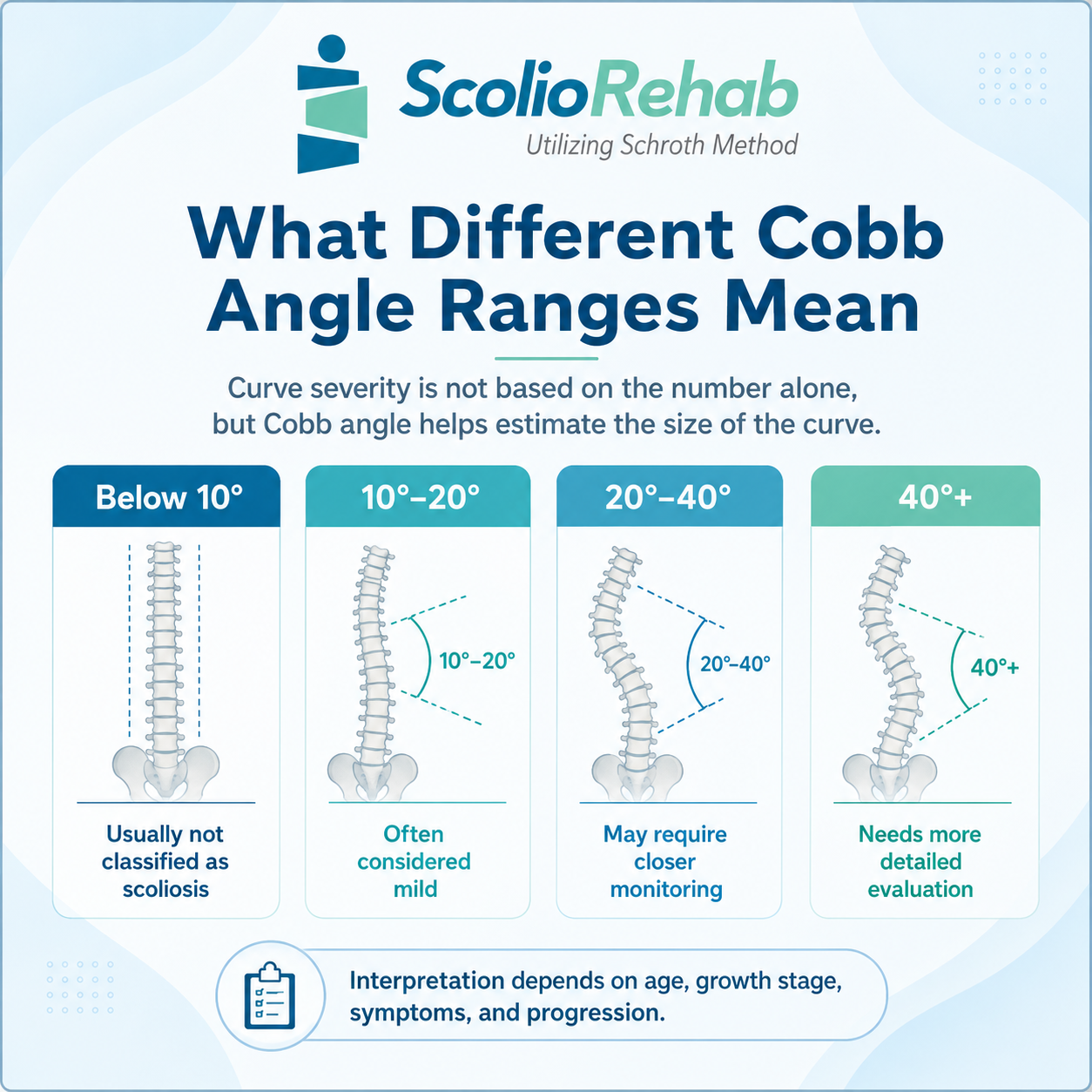
Although exact recommendations may vary depending on the patient, a general way to understand the ranges is:
- Around 10 degrees or more is commonly used as the threshold for scoliosis
- Smaller curves are often considered mild
- Moderate curves may need closer monitoring or active management
- Larger curves may require more detailed evaluation
It is important not to panic based only on the number. A 20-degree curve in a growing child may be viewed differently from a 20-degree curve in an adult whose spine has remained stable for years.
That is why Cobb angle should always be interpreted together with the patient’s age, growth stage, symptoms, curve pattern, and progression risk.
Is a Higher Cobb Angle Always Worse?
A higher Cobb angle usually means a larger spinal curve, but it does not automatically mean the patient will have severe pain or major limitations.
Some patients with larger curves may experience surprisingly little discomfort. Others with smaller curves may feel stiffness, muscle tightness, or posture-related discomfort.
This is why scoliosis should not be judged by the Cobb angle alone.
The measurement is important, but it is only one part of the full clinical picture. Posture, spinal rotation, muscle imbalance, daily function, and patient concerns also matter.
Cobb Angle and Curve Progression
One of the most important uses of Cobb angle is monitoring progression.
Progression means the curve is increasing over time. This is a major concern in growing children and teenagers, especially during growth spurts.
If the Cobb angle increases between follow-up X-rays, it may suggest that the curve is progressing. In this case, closer monitoring or a more active care plan may be considered.
If the Cobb angle remains stable, the approach may be different.
This is why regular follow-up can be important for younger patients. Scoliosis is not only about the number on one X-ray. It is also about how that number changes over time.
Cobb Angle and Growth Stage
Growth stage plays a major role in scoliosis monitoring.
A teenager who is still growing may have a higher risk of curve progression compared with an adult whose growth has already stopped. This is why clinicians often consider both Cobb angle and skeletal maturity when assessing scoliosis.
In simple terms, the same Cobb angle may carry different meaning depending on whether the patient is still growing.
For example, a moderate curve in a young teenager may need closer monitoring because there is still time for the curve to progress. In an adult, the same curve may be more stable, although symptoms and function still need to be considered.
Can Cobb Angle Change Over Time?
Yes, Cobb angle can change over time.
In some patients, the curve remains stable. In others, especially during growth periods, the curve may increase. This is why scoliosis monitoring is usually done over time rather than through a single assessment.
Changes in Cobb angle help clinicians understand whether the scoliosis is stable or progressing.
However, small differences between X-rays should be interpreted carefully. Measurement variation can happen depending on positioning, image quality, and how the angle is measured.
This is another reason why scoliosis should be assessed by someone experienced in reading and monitoring spinal curves.
Does Cobb Angle Decide the Treatment?
Cobb angle helps guide treatment planning, but it does not decide everything by itself.
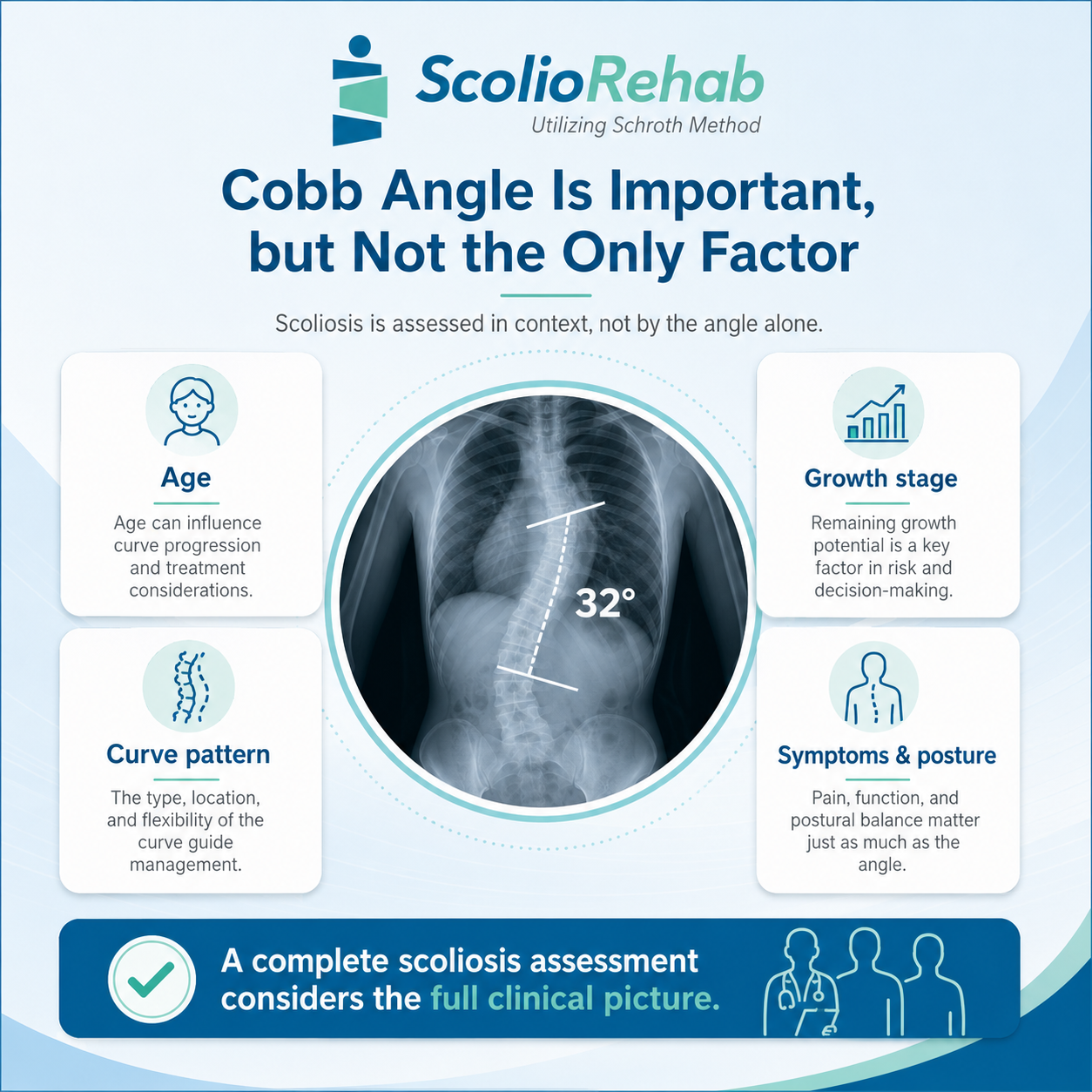
A complete scoliosis assessment usually considers:
- Cobb angle
- Age
- Growth stage
- Curve pattern
- Curve location
- Spinal rotation
- Posture changes
- Symptoms
- Progression risk
- Patient goals
This is why two patients with the same Cobb angle may receive different recommendations.
For example, one patient may need monitoring, while another may need a more active approach because of growth stage or curve progression.
If you have already been diagnosed and want to understand possible care options, our page on scoliosis treatment options explains the available approaches in more detail.
Why Parents Should Understand Cobb Angle
For parents, understanding Cobb angle can make scoliosis follow-up less confusing.
When a child or teenager is diagnosed, parents often want to know whether the curve is mild, whether it may worsen, and what should be done next.
Cobb angle provides a starting point for that discussion.
It helps parents ask better questions, such as:
- What is the current curve degree?
- Is the curve mild, moderate, or severe?
- Is my child still growing?
- Has the curve changed since the last X-ray?
- How often should the curve be monitored?
- What signs should we watch for?
These questions are more useful than simply asking whether scoliosis is “bad” or “not bad.”
Common Misunderstandings About Cobb Angle
There are a few common misunderstandings patients may have.
“If the angle is small, I don’t need to care.”
A smaller curve may still need monitoring, especially if the patient is still growing. Mild does not always mean it should be ignored.
“If the angle is high, surgery is the only option.”
A higher Cobb angle does require proper evaluation, but treatment decisions depend on the full clinical picture. It should not be judged by one number alone.
“The angle must reduce for treatment to be successful.”
In many scoliosis cases, success may also mean stabilizing the curve, improving posture, reducing discomfort, improving function, or preventing progression. Curve reduction is not the only possible goal.
“Posture photos can replace X-rays.”
Posture photos can help show visible changes, but they cannot accurately measure Cobb angle. X-rays remain important for measuring the spinal curve.
Final Thoughts
Cobb angle is one of the most important measurements used in scoliosis assessment. It helps show the size of the spinal curve and provides a baseline for monitoring changes over time.
However, Cobb angle should not be viewed in isolation. The number is important, but it must be interpreted together with age, growth stage, symptoms, posture, curve pattern, and progression risk.
For patients and parents, understanding Cobb angle can make scoliosis feel less confusing. It helps turn a visual posture concern into a measurable finding that can be monitored and discussed properly.
If you or your child has been given a Cobb angle measurement, the next step is to understand what that number means in context—not to panic, and not to ignore it.