 Angie Lee
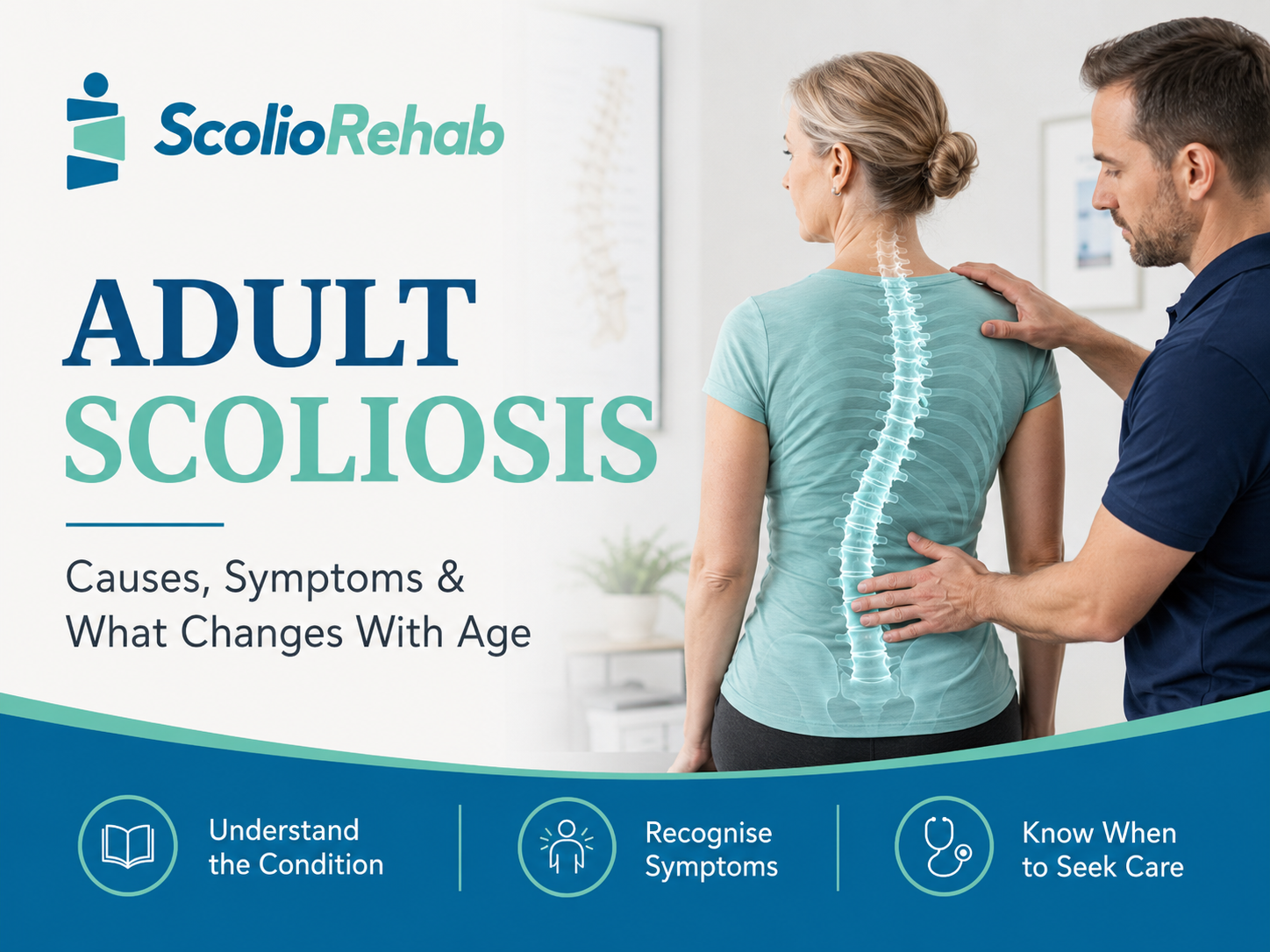
You may have known about your scoliosis since you were a teenager.
Or perhaps you reached adulthood without ever being told that your spine was curved, only to discover it after developing back discomfort or having an X-ray for another reason.
Both situations can happen.
Adult scoliosis is not one single condition with one predictable outcome.
For some people, it is an adolescent curve that remains present after skeletal maturity.
For others, the spinal curve develops later as discs, joints and other structures in the spine change with age.
And importantly:
Having scoliosis as an adult does not automatically mean that your spine will continue getting worse or that you will eventually need surgery.
The more useful questions are:
- What type of adult scoliosis do you have?
- Is the curve stable or changing?
- Is it affecting your posture or balance?
- Are there symptoms such as pain, stiffness or nerve irritation?
- How is it affecting your everyday life?
Understanding those factors gives a much clearer picture than looking at the Cobb angle alone.
What Is Adult Scoliosis?
Adult scoliosis refers to a sideways spinal curvature present after skeletal maturity.
The Scoliosis Research Society classifies adult idiopathic scoliosis as scoliosis found in patients older than 18.
However, adult scoliosis can reach adulthood through different pathways.
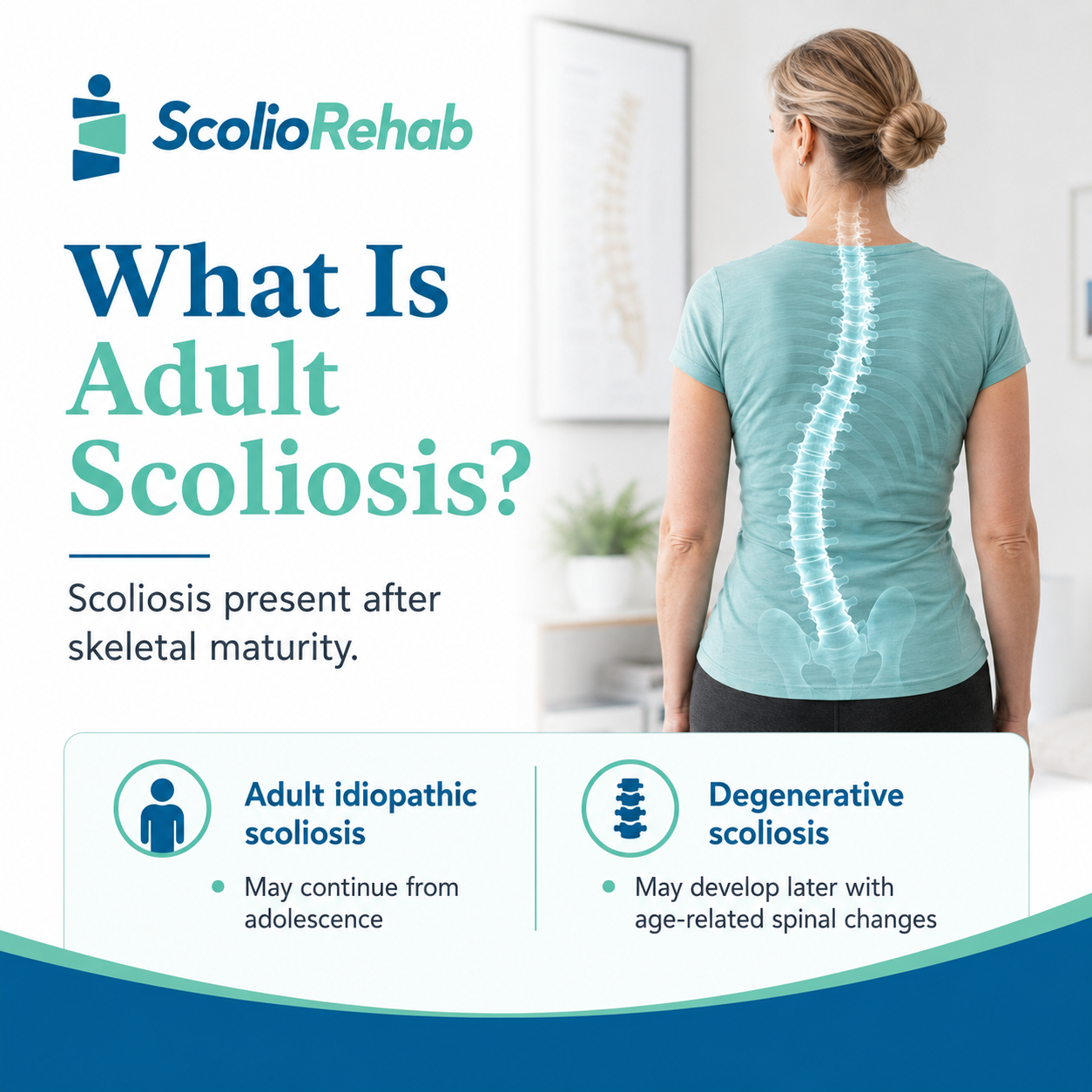
The two situations most people encounter are:
1. Scoliosis That Started Earlier in Life
Some adults developed idiopathic scoliosis during adolescence and simply carried the curve into adulthood.
They may have:
- Known about the scoliosis since their teenage years
- Been monitored when younger
- Received treatment previously
- Had a mild curve that required little intervention
- Only rediscovered the condition years later
This is often referred to as adult idiopathic scoliosis.
2. Scoliosis That Develops in Adulthood
Other people did not have a significant scoliosis curve when they were younger.
Instead, the curvature develops gradually later in life as age-related changes affect the spine.
This is commonly called adult degenerative scoliosis or de novo degenerative scoliosis.
The Scoliosis Research Society describes this form as developing in adults as discs and facet joints degenerate and disc spaces can collapse unevenly.
The difference matters because an adult who has lived with scoliosis since adolescence may have a different spinal history from someone developing a new curve because of degeneration.
If you are looking for a basic explanation of scoliosis itself and its different forms, start with our guide: What is Scoliosis?
Adult Idiopathic Scoliosis vs Degenerative Scoliosis
These terms are easy to mix up.
The simplest distinction is:
| Adult idiopathic scoliosis | Adult degenerative scoliosis |
|---|---|
| Usually began during adolescence | Develops later in adulthood |
| Curve was present before skeletal maturity | Curve arises with age-related spinal changes |
| May have been known for many years | May be discovered for the first time in adulthood |
| Symptoms can develop even after years of stability | Degeneration, imbalance or nerve compression may contribute to symptoms |
Neither type automatically tells us how severe the symptoms will be.
Some adults with significant curves function very well.
Others with smaller curves may experience considerable discomfort because pain can also come from discs, joints, muscles or irritated nerves rather than from the Cobb angle alone.
That is why adult scoliosis should not be reduced to:
“How many degrees is the curve?”
What Happens to Scoliosis as You Get Older?
This is usually the biggest concern:
“Will my scoliosis get worse with age?”
The answer is:
It can, but not every adult scoliosis curve progresses significantly.
Growth-related progression is no longer the main issue once skeletal maturity has been reached.
Instead, adult scoliosis can be influenced by factors such as:
- Existing curve magnitude
- Disc degeneration
- Facet joint degeneration
- Changes in spinal alignment
- Loss of muscle strength or conditioning
- Bone health
- Changes in spinal balance
- Other age-related spinal conditions
Degeneration does not always occur evenly.
If one side of a disc loses height differently from the other side, the spinal segment may gradually become more tilted or rotated.
Over time, these changes can contribute to a scoliosis curve or alter an existing one.
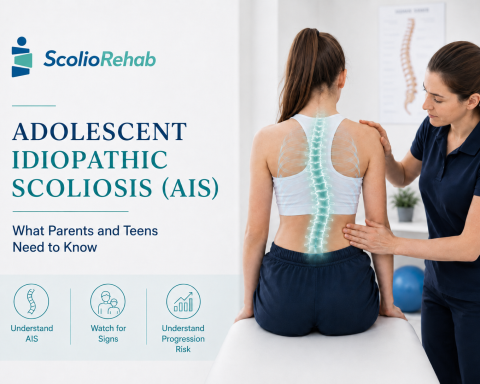
This is one reason adult scoliosis should be looked at differently from adolescent idiopathic scoliosis.
For teenagers, remaining growth is a major concern.
For adults, symptoms, function, degeneration and spinal balance become much more important.
Does Adult Scoliosis Always Cause Back Pain?
No.
Some adults with scoliosis experience very little discomfort.
Others develop:
- Lower or middle back pain
- Muscle tightness
- Fatigue after prolonged standing
- Stiffness
- Uneven muscular loading
- Difficulty maintaining certain positions
- Reduced tolerance for walking or standing
- Postural discomfort
Your scoliosis curve is therefore not automatically the sole cause of every episode of back pain.
Pain can come from several structures within and around the spine.
This distinction matters because treating adult scoliosis is not simply about trying to make an X-ray look straighter.
For many adults, improving movement, function, muscular control and comfort may be equally important.
If pain is the main reason you are seeking help, see our dedicated guide to Scoliosis Pain Management.
That page should remain the main ScolioRehab resource for the pain-management topic rather than repeating the entire subject here.
Can Adult Scoliosis Affect the Nerves?
Sometimes.
Age-related changes in the spine can reduce the space available around spinal nerves.
Conditions such as disc degeneration, bone overgrowth and spinal stenosis may contribute to nerve compression. NIAMS explains that spinal stenosis occurs when spaces within the spine narrow and place pressure on neural structures.
When nerves are involved, symptoms can be different from ordinary muscular back discomfort.
They may include:
- Pain travelling into the buttock or leg
- Numbness
- Tingling
- Weakness
- Reduced walking tolerance
- Symptoms that worsen with certain standing or walking positions
AAOS also notes that scoliosis can sometimes be associated with pain, weakness or numbness in the legs when nerve pressure is involved.
These symptoms deserve appropriate medical assessment rather than assuming they are simply normal consequences of having scoliosis.
Why Does My Posture Look Different as I Get Older?
Adults sometimes say:
“I’ve always had scoliosis, but I look more crooked now.”
This does not necessarily mean there has been a dramatic increase in the Cobb angle.
Visible posture can also be influenced by:
- Trunk shift
- Pelvic position
- Spinal rotation
- Muscle imbalance
- Loss of spinal flexibility
- Changes in the discs
- Forward or sideways imbalance
- Changes elsewhere in the spine
You may notice:
- One shoulder appearing higher
- One hip appearing more prominent
- The waist becoming increasingly uneven
- The trunk shifting to one side
- Clothing sitting unevenly
- Difficulty standing upright comfortably
- The body appearing more forward-bent
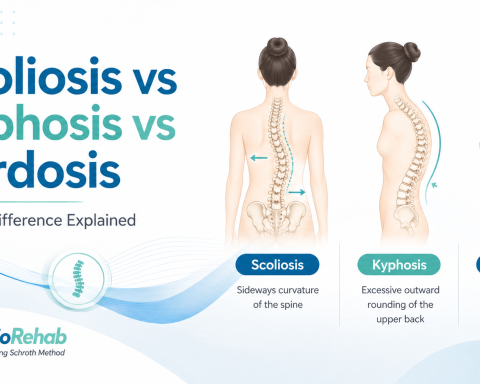
Adult spinal alignment is therefore not only about the curve when viewed from the front or back.
How the body balances from side to side and front to back can also matter.
Can Scoliosis Suddenly Develop in Adulthood?
A true degenerative scoliosis curve usually develops progressively rather than appearing overnight.
However, someone may feel as though their scoliosis appeared suddenly because it was only discovered after:
- Back pain began
- Their posture visibly changed
- An X-ray was taken
- They noticed uneven hips or shoulders
- A healthcare practitioner pointed it out
It is also possible that a mild curve was already present for many years without being diagnosed.
This is why an adult scoliosis assessment should consider both the current X-ray and the person’s history.
If previous spinal X-rays exist, comparing them can be especially useful.
A single X-ray tells us what the spine looks like today.
Previous imaging can help answer another important question:
Has anything actually changed?
How Is Adult Scoliosis Assessed?
Assessment usually begins with understanding the person rather than immediately focusing on one measurement.
A practitioner may consider:
- When the scoliosis was first diagnosed
- Whether previous X-rays exist
- Current symptoms
- Activities that aggravate or relieve symptoms
- Standing posture
- Spinal and trunk mobility
- Body balance
- Neurological symptoms
- Functional limitations
- The spinal curve seen on imaging
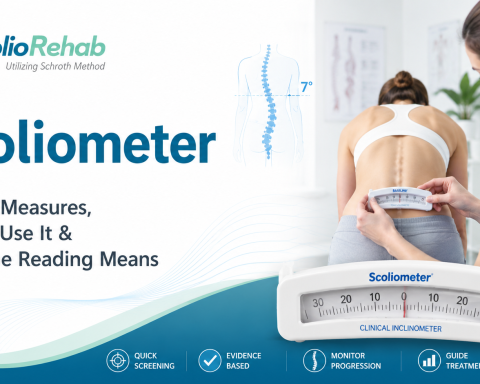
Standing X-rays may be used to evaluate spinal alignment and measure the curve.
One of the best-known measurements is the Cobb angle.
The Cobb angle describes the magnitude of the scoliosis curve.
But in adults, the Cobb angle should not automatically be treated as a pain score.
A higher Cobb angle does not guarantee severe pain.
A smaller Cobb angle does not guarantee that the person will be symptom-free.
The number needs context.
Why the Risser Sign Is Less Important for Adults
If you have read about scoliosis online, you may have encountered terms such as:
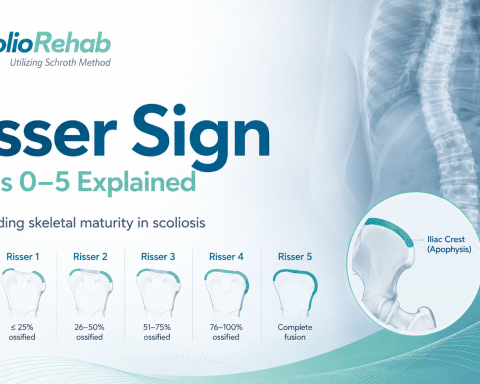
Risser 0, Risser 3 or Risser 5.
The Risser sign estimates skeletal maturity and is particularly useful when evaluating children and adolescents who are still growing.
Once adulthood and skeletal maturity have been reached, the main question is no longer:
“How much growth remains?”
Instead, assessment becomes more focused on:
- Current curve magnitude
- Symptoms
- Function
- Progression
- Degenerative changes
- Spinal balance
This is why Risser staging plays a very different role in an adult than it does in a teenager with scoliosis.
Does a Bigger Cobb Angle Mean More Pain?
Not necessarily.
This is one of the easiest scoliosis assumptions to get wrong.
Two adults can have similar Cobb angles but completely different experiences.
One may remain active with minimal discomfort.
Another may struggle with standing, walking or prolonged sitting.
Pain can be influenced by more than the scoliosis curve itself, including:
- Disc degeneration
- Joint changes
- Muscle fatigue
- Reduced mobility
- Nerve irritation
- Physical conditioning
- Other spinal conditions
The goal of assessment is therefore not simply to label a curve as mild, moderate or severe.
It is to understand:
What is actually limiting this person?
Can Adult Scoliosis Be Corrected?
The word “corrected” needs to be used carefully.
An adult spine has completed skeletal growth, so the objectives are not identical to those used when managing a growing adolescent.
Depending on the individual, conservative rehabilitation may instead focus on areas such as:
- Postural control
- Movement efficiency
- Muscular balance
- Spinal mobility
- Strength and endurance
- Symptom management
- Function during daily activities
It would be misleading to promise that every adult scoliosis curve can simply be exercised back to a perfectly straight spine.
The goal should be based on the person’s actual condition rather than an unrealistic promise.
For adults interested specifically in exercise-based scoliosis rehabilitation, our dedicated pages explain the approaches in more depth:
This article intentionally does not duplicate those treatment pages.
Is the Schroth Method Only for Teenagers?
No.
Scoliosis-specific exercise can also be used with adults, although the goals may differ from those of a teenager who is still growing.
For an adolescent, management may place significant emphasis on controlling progression during growth.
For an adult, priorities may include:
- Postural awareness
- Movement strategies
- Muscle endurance
- Function
- Symptom management
- Maintaining physical capacity
ScolioRehab’s existing physiotherapy service specifically provides scoliosis-focused physiotherapy for both adolescents and adults.
Does Every Adult With Scoliosis Need Treatment?
No.
Finding scoliosis on an X-ray does not automatically mean active treatment is required.
An adult with:
- Minimal symptoms
- Good function
- A stable curve
- No significant neurological concerns
may have very different needs from someone experiencing progressive imbalance, persistent pain or nerve symptoms.
Management should be driven by the person’s clinical picture, not by fear of the word scoliosis.
Likewise, waiting until daily function becomes severely affected before seeking assessment may make the situation harder to understand.
The sensible middle ground is:
Know what your spine is doing, understand your symptoms, and respond according to the actual findings.
What Can Conservative Management Do for Adult Scoliosis?
Many adults are managed without surgery.
Conservative care may involve exercise, rehabilitation and other approaches depending on the source of symptoms and the individual’s condition. AAOS notes that most scoliosis patients are treated nonsurgically and that scoliosis-specific exercise may be useful for some patients experiencing back pain.
At ScolioRehab, the detailed treatment options are covered separately because each has a different purpose.
When Is Surgery Considered for Adult Scoliosis?
Having adult scoliosis does not automatically mean surgery is necessary.
The Scoliosis Research Society states that surgical treatment for adult scoliosis is generally reserved for situations involving factors such as failure of reasonable conservative measures, disabling back or leg pain, spinal imbalance, major functional restriction or substantially reduced quality of life.
Surgical decisions are complex and should be discussed with an appropriately qualified spinal specialist.
ScolioRehab focuses on non-surgical scoliosis management.
When symptoms or findings suggest that surgical or specialist medical assessment is appropriate, conservative care should not be presented as a replacement for necessary medical evaluation.
When Should an Adult With Scoliosis Seek Medical Assessment?
Not every episode of back stiffness is an emergency.
However, some symptoms deserve more urgent medical attention.
Seek appropriate medical evaluation if scoliosis is associated with:
- New or progressive leg weakness
- Significant numbness or tingling
- Difficulty walking that is getting worse
- Severe or rapidly worsening pain
- Significant changes in balance
- New bowel or bladder dysfunction
- Symptoms developing after significant trauma
- Other unusual neurological symptoms
Nerve-related symptoms may indicate that something beyond muscular scoliosis discomfort needs to be assessed.
Adult Scoliosis Is Different From Adolescent Scoliosis
This distinction is important.
In adolescent idiopathic scoliosis:
Remaining skeletal growth is a major consideration because curves may progress during growth.
In adult scoliosis:
Skeletal growth has finished.
The clinical discussion shifts more toward:
- Symptoms
- Degeneration
- Function
- Postural balance
- Neurological involvement
- Changes over time
- Quality of life
That is why an adult with a 30° curve should not automatically be managed using exactly the same logic as a teenager with a 30° curve.
If you are researching scoliosis for a child or teenager, see our dedicated guide of Adolescent Idiopathic Scoliosis.
Medical References
- Scoliosis Research Society: Adult and idiopathic scoliosis information
- American Academy of Orthopaedic Surgeons: Scoliosis and nonsurgical treatment information
- National Institute of Arthritis and Musculoskeletal and Skin Diseases: Spinal stenosis and spine health information