 Dexter Chew
You receive an X-ray report and notice an unfamiliar word:
Dextroscoliosis or Levoscoliosis
Despite how technical it sounds, the term itself describes something quite straightforward.
Dextroscoliosis means that a scoliosis curve is convex toward the right side of the body. Its opposite is levoscoliosis, where the curve is convex toward the left.
Cleveland Clinic describes dextroscoliosis and levoscoliosis in the same way, based on the direction of the spinal curve.
But there is an important distinction:
The direction of the curve does not tell you how severe the scoliosis is.
A report saying “dextroscoliosis” is therefore only one piece of information about the spine.
If you are unfamiliar with scoliosis itself, ScolioRehab’s guide to what scoliosis is explains the condition, common signs and causes in more detail.
Dextroscoliosis vs Levoscoliosis
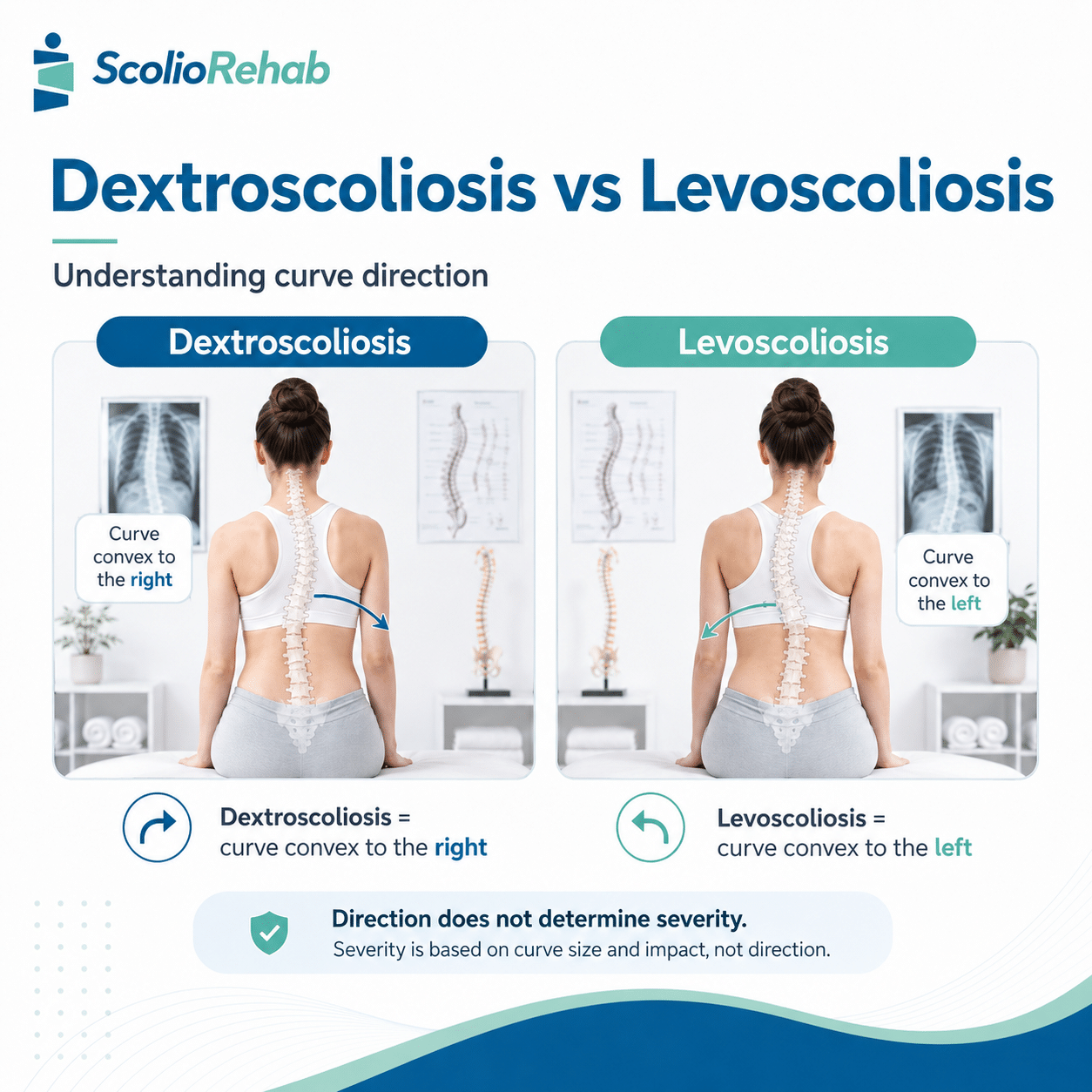
The easiest way to understand the two terms is by looking at the direction of the curve.
| Dextroscoliosis | Levoscoliosis | |
|---|---|---|
| Direction | Curves to the right | Curves to the left |
| Convex side | Right | Left |
| Can occur in thoracic spine | Yes | Yes |
| Can occur in lumbar spine | Yes | Yes |
| Indicates severity | No | No |
So if an X-ray report says thoracic dextroscoliosis, it means there is a right-convex curve primarily affecting the thoracic portion of the spine.
If it says lumbar dextroscoliosis, the right-sided curve is primarily in the lower back.
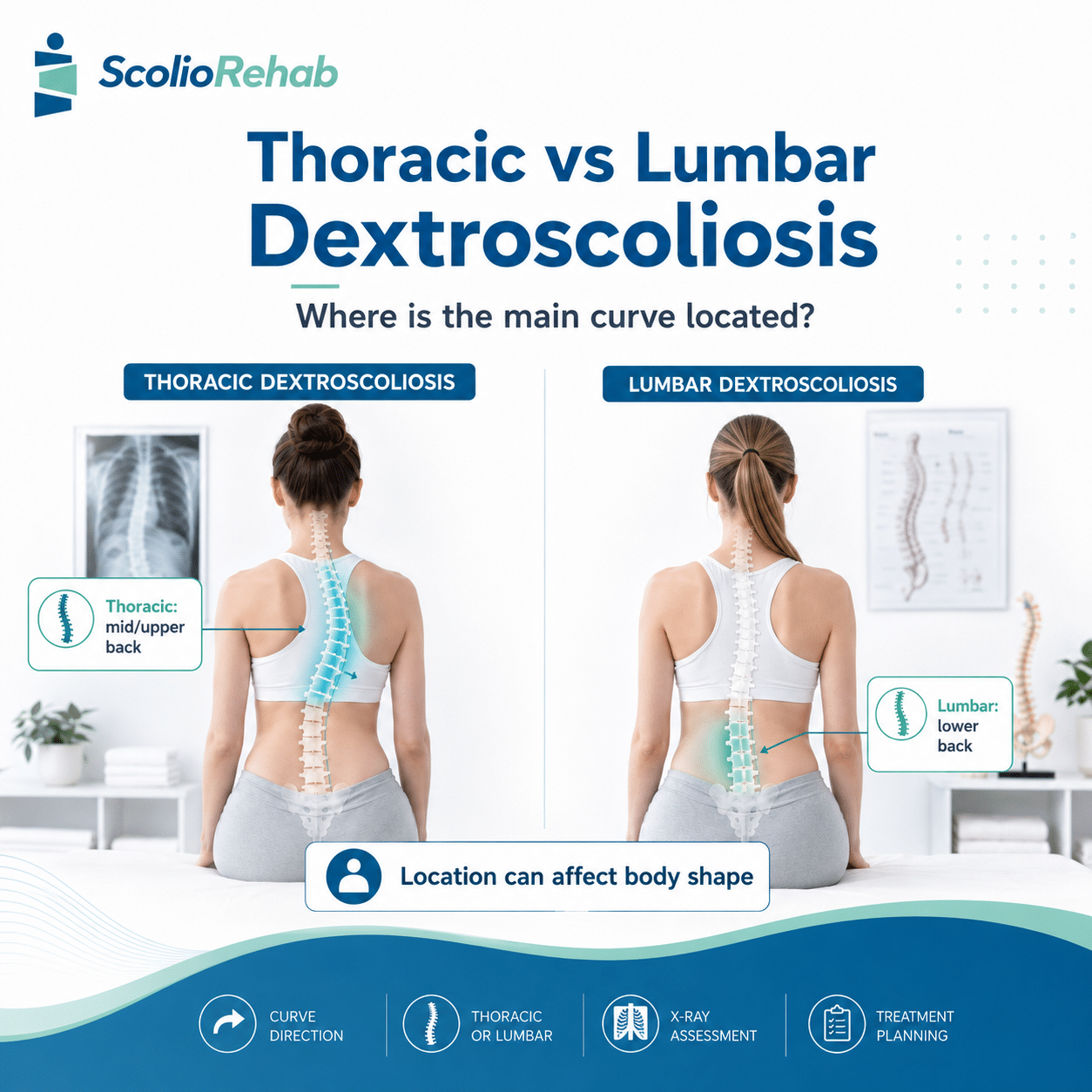
The words dextro and levo simply help describe the curve’s direction.
They are not separate diseases.
What Is Thoracic Dextroscoliosis?
The thoracic spine is the middle and upper portion of the back where the ribs attach.
Thoracic dextroscoliosis therefore means that the main thoracic curve is convex toward the right.
Right thoracic curves are a commonly recognised pattern in idiopathic scoliosis.
Because scoliosis also involves rotation rather than being purely a sideways bend, a thoracic curve may be accompanied by visible changes such as uneven shoulders, a prominent shoulder blade or greater prominence on one side of the rib cage.
The Scoliosis Research Society includes uneven shoulders, trunk shift and rib prominence among the physical findings that may be seen during scoliosis assessment.
However, appearance alone cannot tell you how large the curve is.
A noticeable difference in the shoulders or ribs does not automatically mean the person has severe scoliosis.
What Is Lumbar Dextroscoliosis?
Lumbar dextroscoliosis describes a right-convex curve primarily affecting the lower portion of the spine.
Because the lumbar spine does not attach to the rib cage, the visible changes may differ from those seen with thoracic scoliosis.
A lumbar curve may be associated with differences around the waist, pelvis or overall alignment of the trunk.
But again, the word “dextroscoliosis” only tells us the direction and location.
It does not explain why the curve developed or whether treatment is required.
This distinction becomes particularly important in adults because scoliosis found later in life can have a different history from scoliosis that began during adolescence. ScolioRehab discusses those differences separately in its guide to adult scoliosis.
Can You Have Dextroscoliosis and Levoscoliosis Together?
Yes.
A person can have more than one spinal curve.
For example, the thoracic spine may curve toward the right while the lumbar region curves toward the left.
This creates the familiar S-shaped scoliosis pattern.
So an X-ray report could describe:
Thoracic dextroscoliosis + lumbar levoscoliosis
within the same person.
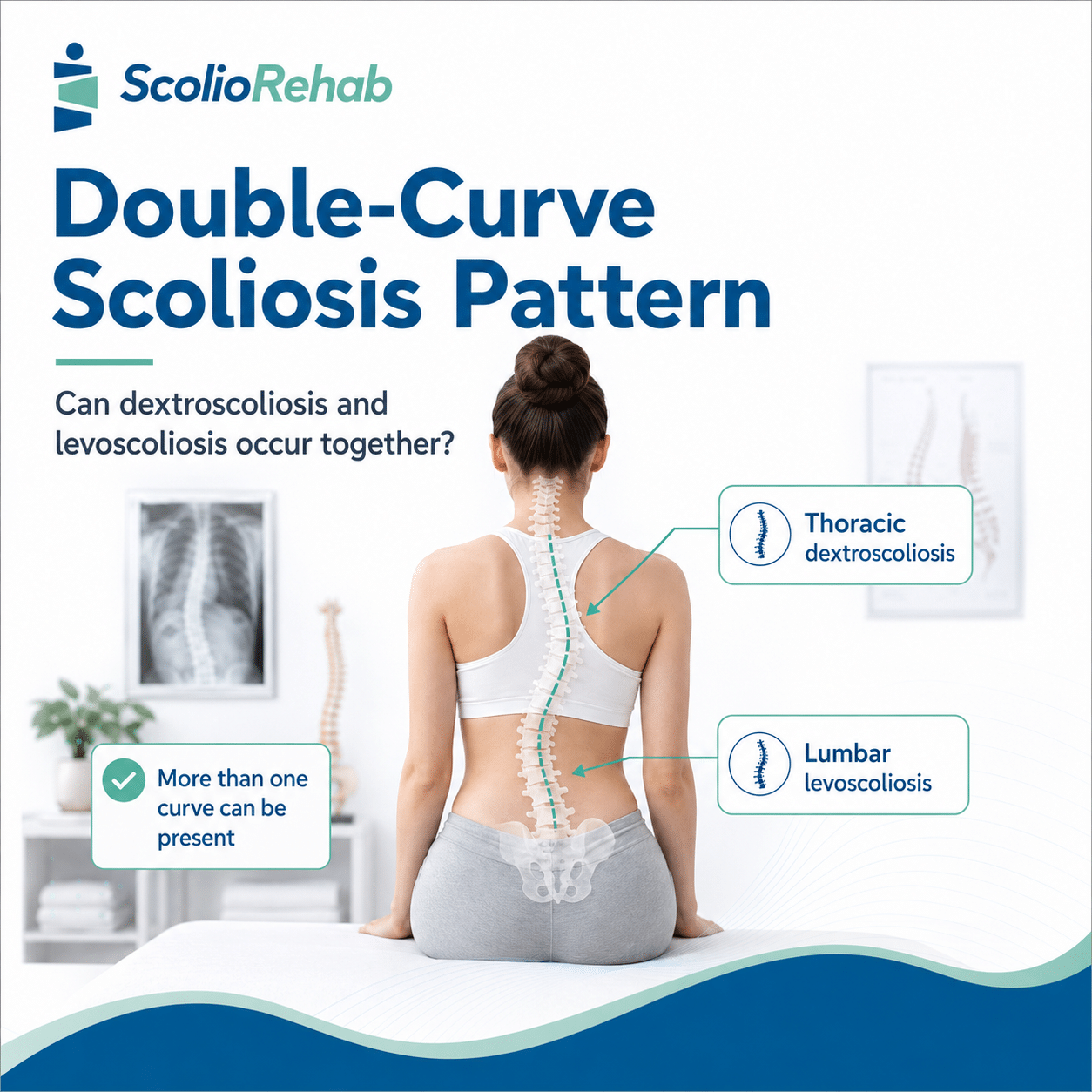
This is why describing scoliosis simply as “curving to the right” can sometimes be incomplete. The entire spinal pattern needs to be considered.
Is Dextroscoliosis Worse Than Levoscoliosis?
No. The direction alone does not determine severity.
A much more useful piece of information is the size of the curve.
For example:
15° right thoracic curve
and
40° right thoracic curve
are both dextroscoliosis, but they are clearly not the same situation.
The size of a scoliosis curve is generally measured on an X-ray using the Cobb angle. The Scoliosis Research Society uses a curvature greater than 10 degrees as part of the radiographic definition of scoliosis. Scoliosis Research Society: Diagnosing Scoliosis
If your report contains a number such as 15°, 25° or 40°, ScolioRehab’s dedicated guide to the Cobb Angle in scoliosis explains what that measurement means.
I would not try to interpret Cobb angles in detail on this page because Cobb Angle already has its own dedicated article.
Should You Worry About a Dextroscoliosis Finding?
Seeing an unfamiliar medical term on an X-ray report can make the finding sound more alarming than it actually is.
The word dextroscoliosis itself does not tell you whether the condition is mild, severe, stable or progressing.
Instead, useful questions include:
- Where is the curve located?
- What is the Cobb angle?
- Is there one curve or several?
- Is the patient still growing?
- Has the curve changed compared with an earlier X-ray?
- Are there symptoms or noticeable changes in body alignment?
For children and teenagers, growth is particularly relevant because scoliosis can change while the skeleton is still developing.
For adults, symptoms, spinal balance and age-related changes may become more important considerations.
The interpretation therefore needs context rather than simply seeing the word “dextro” and assuming something is wrong.
Does Dextroscoliosis Need Treatment?
Not because it curves to the right.
Treatment decisions are based on the whole scoliosis picture, not whether the curve is dextro or levo.
Some smaller, stable curves may only need monitoring. Other situations may require more active management depending on the curve magnitude, age, remaining growth, progression and individual circumstances.
ScolioRehab already covers those decisions in depth in its guide to scoliosis treatment in Malaysia.
For patients who are suitable for conservative management, options may include scoliosis-specific rehabilitation or bracing depending on the individual situation.
The key point is that treatment should respond to the actual curve pattern, rather than simply prescribing generic exercises because the spine curves to the right.
One Word on the X-Ray Does Not Tell the Whole Story
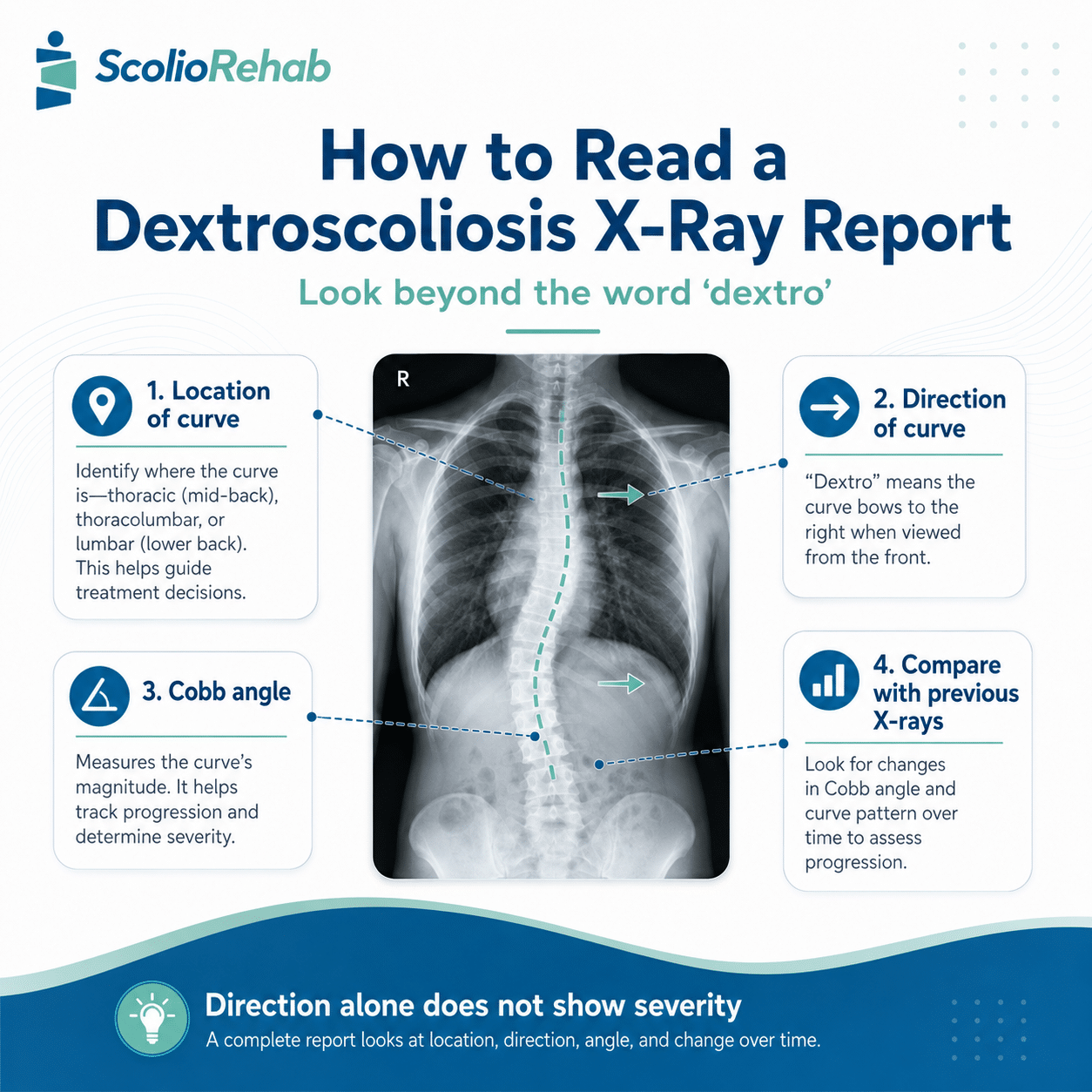
If your X-ray report says dextroscoliosis, the simplest interpretation is:
Your scoliosis curve is convex toward the right.
That is useful information, but it is not the complete diagnosis.
The location and size of the curve, whether another curve is present, remaining growth and changes over time usually tell us much more about the significance of the finding.
So rather than asking:
“Is dextroscoliosis bad?”
a more useful question is:
“What does this particular curve mean for me?”
If you or your child has received an X-ray report showing dextroscoliosis and the terminology is unclear, a scoliosis assessment can help put the curve direction and other findings into the correct context.