 Lim Shu Jiann , SBP Practitioner
Search for scoliosis exercises online and you will find countless routines promising to straighten the spine, improve posture or “fix” scoliosis.
The difficult part is knowing what actually makes sense.
A person with a right thoracic curve does not have exactly the same spinal pattern as someone with a lumbar curve or double curve. Age, flexibility, symptoms and the amount of spinal rotation can also differ.
This is why scoliosis exercise should not be reduced to one universal stretch or strengthening routine.
Exercise can be useful, but the purpose of the exercise matters just as much as the exercise itself.
Can Exercise Improve Scoliosis?
Exercise can play an important role in scoliosis management, but expectations need to be realistic.
A structural scoliosis curve cannot simply be guaranteed to disappear because someone performs a particular exercise every day.
That does not mean exercise is useless.
Depending on the individual and type of programme, exercise may help improve strength, mobility, postural control, muscular endurance, body awareness and physical function.
Research has also investigated physiotherapeutic scoliosis-specific exercises (PSSE) as part of conservative scoliosis management. A recent systematic review found improvements in outcomes including Cobb angle and trunk rotation among adolescents with idiopathic scoliosis, although the authors also noted limitations in the available evidence.
The important distinction is between general exercise and exercise specifically designed around scoliosis.
General Exercise vs Scoliosis-Specific Exercise
Normal physical activity remains valuable for people with scoliosis.
Walking, cycling, swimming, recreational sports, resistance training and general mobility work can help maintain fitness and keep the body active.
Having scoliosis does not automatically mean someone needs to stop exercising.
But general exercise and scoliosis-specific rehabilitation have different purposes.
A normal strengthening programme may aim to make the trunk, hips and legs stronger. A cardiovascular workout may improve fitness. Mobility exercises may help someone feel less stiff.
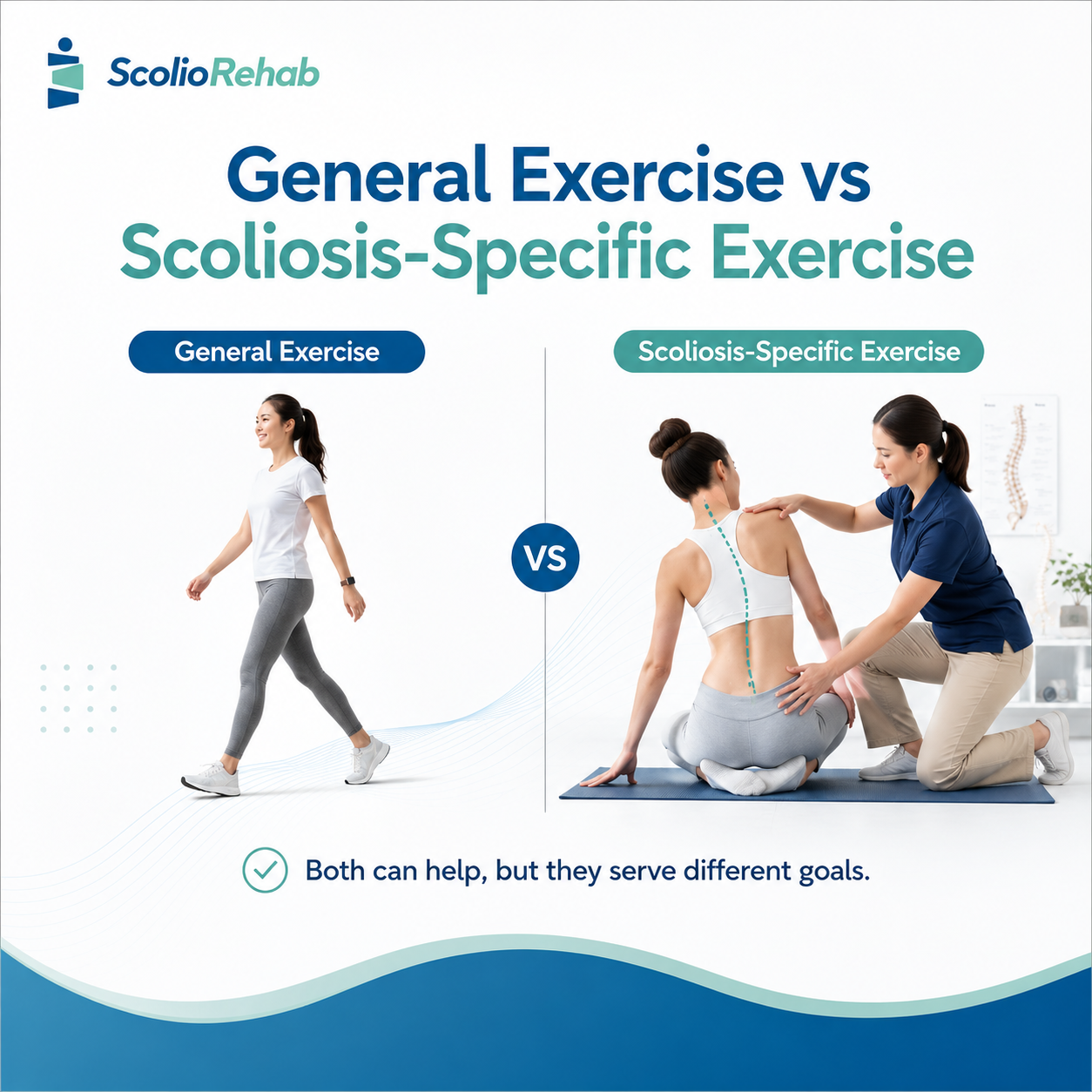
Scoliosis-specific exercises go a step further by considering the individual’s three-dimensional curve pattern.
This may include the location and direction of the curve, trunk rotation, body asymmetry, breathing mechanics and how the person actively positions the body.
The Scoliosis Research Society describes common principles of physiotherapeutic scoliosis-specific exercise as including self-correction, elongation and integration of corrected posture into everyday activities.
That is why simply searching YouTube for “best scoliosis exercise” cannot provide the same level of individualisation.
What Types of Exercise Can Be Useful for Scoliosis?
There is no single exercise that deserves the title “best exercise for scoliosis.”
Instead, different forms of exercise serve different purposes.
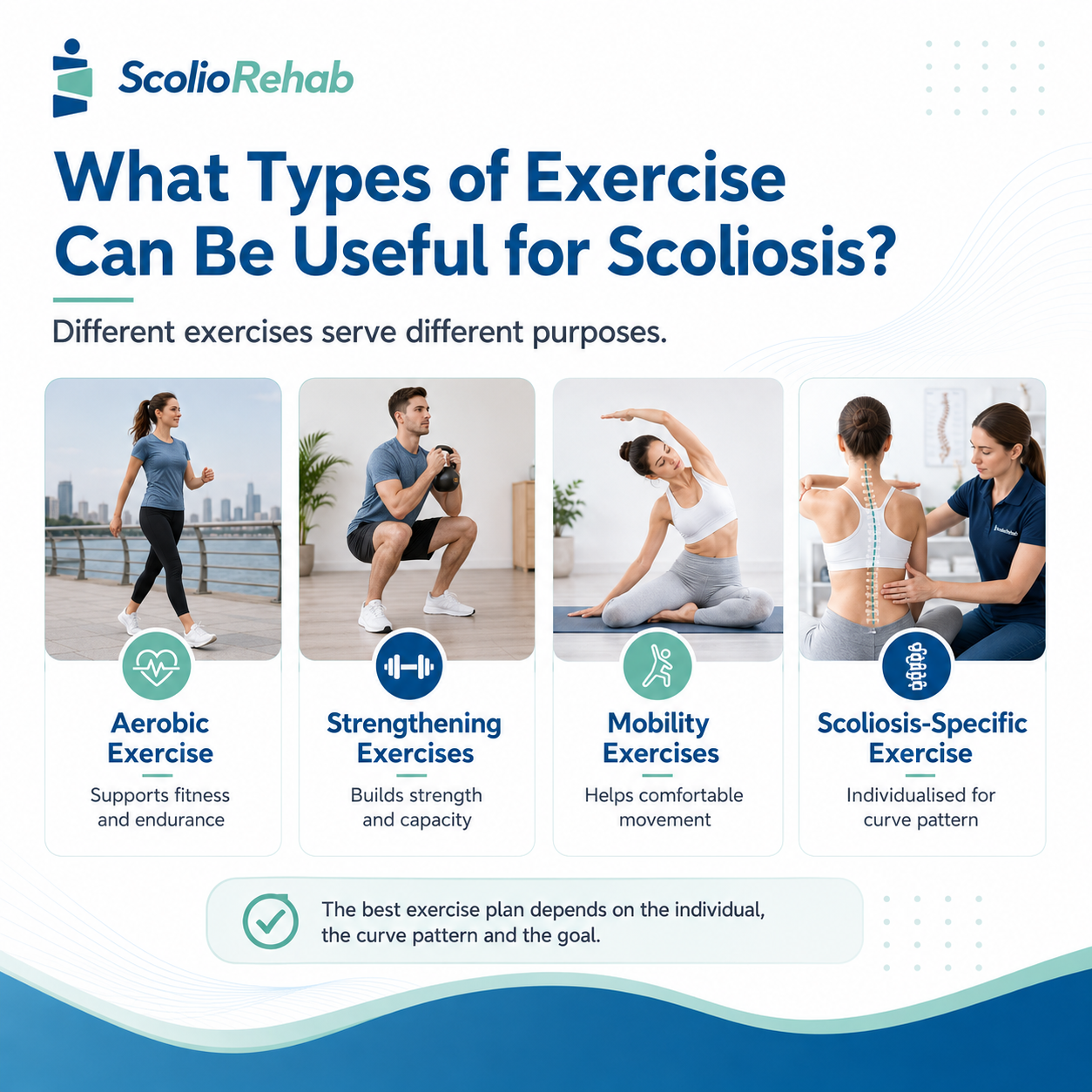
Aerobic exercise such as walking, cycling or swimming can help maintain cardiovascular fitness and general conditioning.
Strengthening exercises can build muscular capacity around the trunk, hips and the rest of the body. A stronger body may tolerate everyday activity better, but simply having a strong core does not automatically correct a scoliosis curve.
Mobility exercises can be useful when certain areas feel stiff or restricted. The goal should be purposeful movement rather than aggressively stretching whichever side feels tight.
Breathing exercises can also play a more specialised role in scoliosis rehabilitation, particularly where the thoracic curve and rib cage are involved.
Then there are scoliosis-specific corrective exercises, where the movement is selected according to the person’s individual curve pattern rather than using the same routine for everyone.
This last category is where approaches such as the Schroth Method become relevant.
Why Does the Curve Pattern Matter?
Consider two people who both have scoliosis.
The first person has a right thoracic curve.
The second has a left lumbar curve.
Giving both people exactly the same corrective movement simply because they both have “scoliosis” ignores a major part of their condition.
Even two people with apparently similar curves can have different levels of rotation, flexibility, compensation and body balance.
This is one reason scoliosis-specific exercise is designed around the individual, rather than only around the diagnosis.
If you are still trying to understand what type of spinal curve you have, ScolioRehab’s guide to what scoliosis is explains the basic curve patterns and signs in more detail. The dedicated page should own that information rather than repeating the full explanation here.
Can You Do Scoliosis Exercises at Home?
Yes, home exercise can be useful.
The important difference is how the programme was chosen.
There is a big difference between learning exercises that have been selected for your curve and then practising them independently at home, versus finding several unrelated scoliosis exercises online and combining them yourself.
Home practice is often valuable because consistency matters.
But corrective exercise is easier to perform correctly when you first understand what position you are trying to achieve and why.
For general exercise, the same principle applies: build activity gradually and pay attention to how your body responds.
If you want a deeper discussion of activities and habits that may need modification, ScolioRehab already covers that separately in What to Avoid If You Have Scoliosis. There is no reason to duplicate that entire topic here.
Where Does the Schroth Method Fit In?
The Schroth Method is different from a generic back-exercise programme because it was developed specifically for scoliosis.
The approach considers the three-dimensional shape of the trunk and uses individualised postural correction, movement and breathing principles.
At ScolioRehab, Schroth Best Practice is used as a scoliosis-specific exercise approach, with programmes adapted to the individual’s curve rather than giving every patient the same routine.
This does not mean that every activity outside Schroth is pointless.
General exercise and scoliosis-specific exercise can complement each other because they are trying to achieve different things.
One can support overall strength and fitness, while the other specifically addresses the person’s scoliosis pattern.
Can Scoliosis Exercises Be Done Without Pain?
Exercise should not need to be aggressively painful to be useful.
Feeling muscular effort or fatigue during an unfamiliar exercise can be normal. Sharp pain, worsening neurological symptoms or persistent discomfort is different and should not simply be pushed through.
The goal is not to force the spine into a position.
Good rehabilitation should help the person understand and control their body more effectively.
This is particularly important for people who have avoided movement after being diagnosed with scoliosis because they are afraid that normal activity will somehow worsen their curve.
Scoliosis should not automatically create fear of exercise.
How Often Should Scoliosis Exercises Be Done?
There is no useful universal rule such as “20 minutes every day works for everyone.”
Frequency depends on the type of exercise, the person’s condition, goals and programme.
A general fitness programme will have a different schedule from scoliosis-specific rehabilitation.
What matters more is having a programme that can be performed correctly and consistently.
Doing a complicated routine intensely for one week and then abandoning it is unlikely to be more useful than a realistic programme that becomes part of everyday life.
There Is No Single Best Exercise for Every Scoliosis Curve
If you are looking for one exercise that everyone with scoliosis should perform, there isn’t one.
The better starting point is identifying what you want exercise to achieve.
Someone wanting better general fitness may need a very different programme from a growing teenager undergoing scoliosis-specific rehabilitation.
The important thing is not to fear movement, but also not to assume that every exercise labelled “for scoliosis” on the internet is automatically appropriate for your particular curve.
When more structured management is needed, exercise may form one part of a broader approach. ScolioRehab’s overview of scoliosis treatment in Malaysia explains those options separately without turning this exercise article into another treatment page.