 Lim Shu Jiann , SBP Practitioner
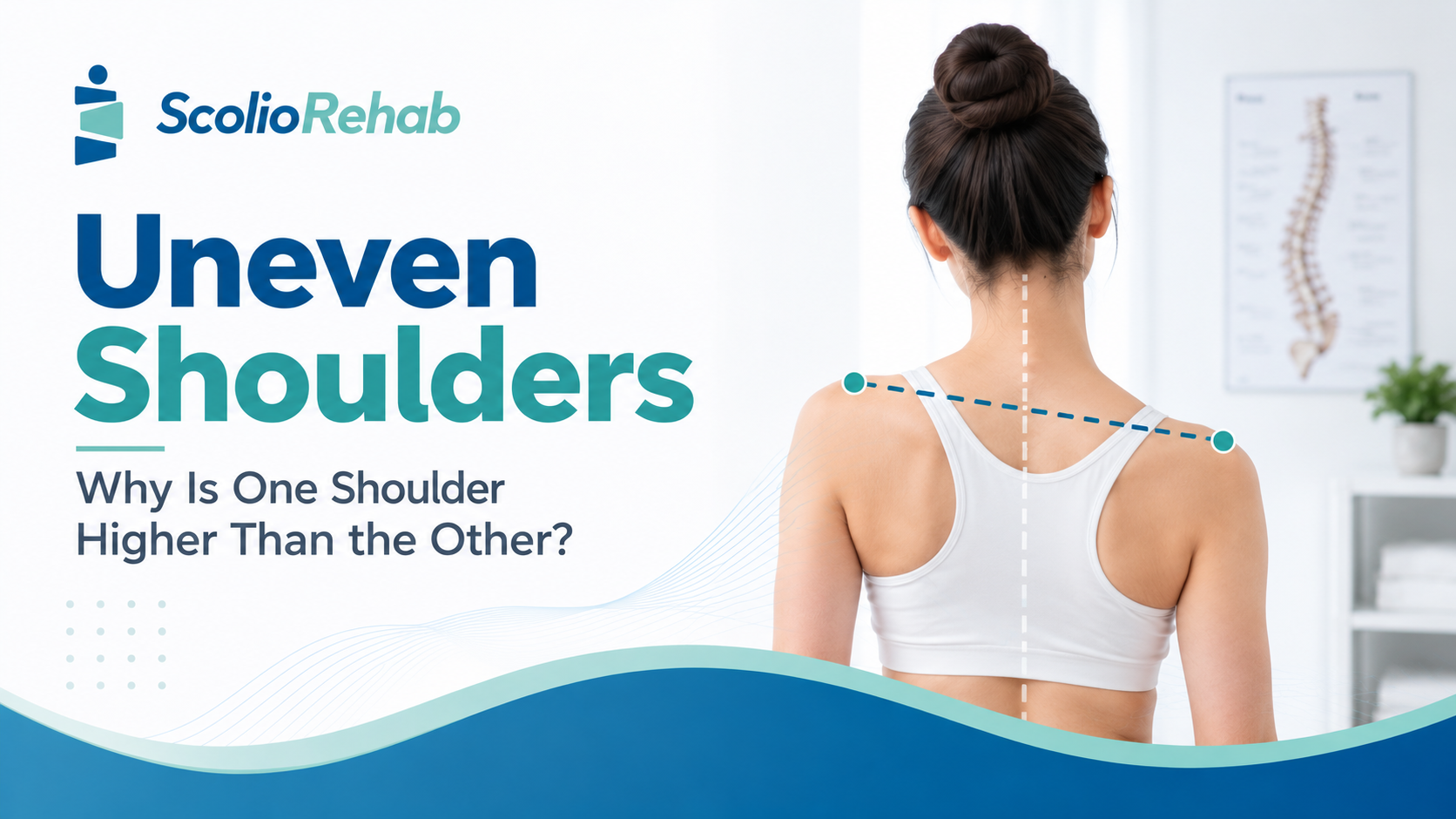
Have you ever looked in the mirror and noticed that one shoulder seems higher than the other?
Maybe your shirt keeps slipping toward one side. Perhaps one shoulder looks raised in photographs, or someone has pointed out that your shoulders don’t seem perfectly level.
Naturally, you might wonder: Is this just my posture, or could something be wrong with my spine?
The good news is that uneven shoulders aren’t always a sign of a serious condition. Small differences in body alignment are common, and our bodies aren’t perfectly symmetrical.
However, a noticeable or increasing difference in shoulder height can sometimes be associated with muscle-related problems, differences in joint positioning, or spinal conditions such as scoliosis.
The important thing is understanding why your shoulders look uneven before trying to correct them.
In this article, we’ll explore seven possible causes of uneven shoulders, how to check for visible asymmetry, exercises that may help in certain cases, and when you should consider a professional assessment.
What Are Uneven Shoulders?
Uneven shoulders, sometimes called shoulder height asymmetry, describe a difference in the visible height or position of the left and right shoulders.
When standing naturally, you might notice:
- Your right shoulder appears higher than your left.
- Your left shoulder sits noticeably lower.
- One shoulder looks more rounded or raised.
- Your shirt neckline sits unevenly.
- One shoulder blade appears more prominent.
- Your upper body seems to lean slightly toward one side.
These differences aren’t necessarily caused by the shoulder joints themselves.
Your shoulder position is influenced by several structures, including your spine, shoulder blades, rib cage, muscles, and the position of your trunk.
For example, one shoulder may appear higher because of how the shoulder blade rests against the rib cage. In another person, the difference may be related to a spinal curve.
Uneven shoulders are a physical observation, not a diagnosis.
That distinction matters because the best approach depends on what’s causing the asymmetry.
7 Possible Causes of Uneven Shoulders
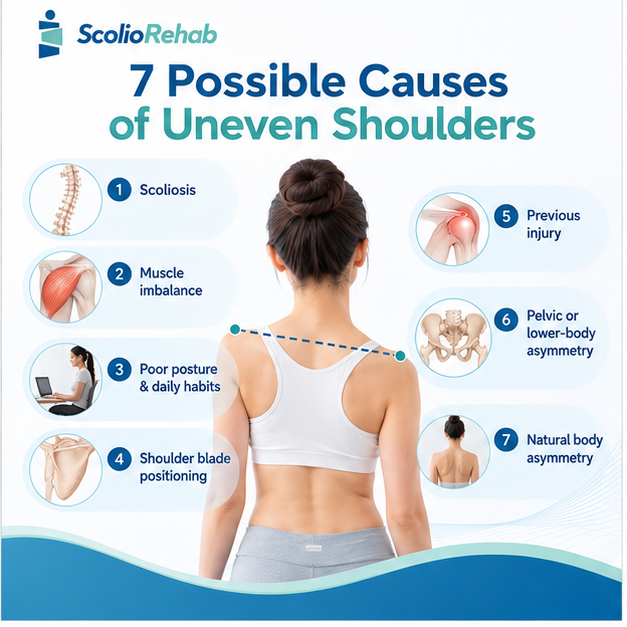
1. Scoliosis
Scoliosis is one of the important spinal conditions to consider when someone has noticeably uneven shoulders.
It involves a three-dimensional spinal deformity, including sideways curvature and rotation of the spine.
Depending on the curve pattern and the way the body compensates, scoliosis may cause one shoulder to sit higher than the other.
Other visible signs can include:
- One shoulder blade sticking out more prominently.
- An uneven waistline.
- One hip appearing higher than the other.
- The body leaning toward one side.
- One side of the rib cage appearing more prominent.
Interestingly, scoliosis doesn’t always cause pain.
Some children and teenagers first discover the condition because their parents notice uneven shoulders or changes in how their school uniform fits.
The NHS identifies uneven shoulders as one of the common visible signs of scoliosis.
However, having one shoulder higher than the other doesn’t automatically mean you have scoliosis.
A proper spinal examination is necessary to determine whether a structural curve is present.
If you’d like to understand the condition in more detail, read our guide on what scoliosis is, its causes, and early signs.
2. Muscle Strength and Movement Differences
Your neck, upper back, and shoulder muscles play important roles in supporting and moving your shoulders.
These include:
- Upper trapezius
- Middle and lower trapezius
- Levator scapulae
- Rhomboids
- Serratus anterior
Differences in muscle strength, flexibility, or movement control may affect how the shoulders and shoulder blades are positioned.
For example, one shoulder may appear elevated during certain movements because of how the surrounding muscles are working.
However, you cannot reliably diagnose a specific muscle as weak or tight just by looking at shoulder height.
A clinician may need to assess muscle strength, mobility, and movement patterns to determine whether they contribute to the difference.
3. Everyday Posture and Movement Habits
Think about how you spend your day.
Do you regularly hold your phone on the same side? Lean on one elbow while working? Carry a bag over one shoulder?
These habits may influence muscle activity, comfort, and the way you position your shoulders throughout the day.
For some people, shoulder asymmetry changes noticeably when they relax, move, or adjust their position.
This may suggest that at least part of the difference is flexible rather than fixed.
However, habitual posture should not automatically be blamed for permanent shoulder asymmetry.
There is no single perfect posture that everyone must maintain.
More importantly, poor posture does not cause adolescent idiopathic scoliosis.
If the difference between your shoulders is persistent, it’s worth considering other possible causes instead of assuming you simply need to stand straighter.
4. Shoulder Blade Positioning
Your shoulder blades, or scapulae, sit against the back of your rib cage.
They move whenever you raise your arms, reach forward, or perform other upper-body movements.
Sometimes, differences in how the shoulder blades move or rest can make the shoulders appear uneven.
A condition known as scapular dyskinesis describes altered movement or positioning of the shoulder blade.
Possible signs include:
- One shoulder blade appearing more prominent.
- Different shoulder movements between the two sides.
- Discomfort during overhead activities.
- Reduced shoulder strength or control.
- A winging appearance around the shoulder blade.
Scapular movement differences can occur for several reasons, including pain, muscle dysfunction, injury, or nerve-related problems.
A visible shoulder blade difference does not automatically mean you have scoliosis.
It also doesn’t necessarily require treatment if you have no symptoms or functional limitations.
5. Previous Shoulder or Collarbone Injury
Have you experienced a shoulder injury in the past?
Injuries involving the collarbone, shoulder joint, or surrounding structures may sometimes change how the shoulder sits.
Examples include:
- A previous collarbone fracture.
- Shoulder dislocation.
- Acromioclavicular joint injury.
- Persistent shoulder stiffness.
- Injury-related muscle weakness.
In some cases, the difference in shoulder height or contour may remain visible even after the original injury has healed.
If you notice uneven shoulders following an injury, particularly with pain or reduced movement, a healthcare professional should assess the affected structures.
6. Pelvic or Lower-Body Asymmetry
Your shoulders don’t function independently from the rest of your body.
The pelvis, trunk, and spine all contribute to maintaining balance during standing.
For example, differences in hip height, leg length, or trunk positioning may be accompanied by changes in the appearance of the shoulders.
A person with lateral pelvic tilt may appear to have one hip higher than the other.
Depending on how the spine and trunk adapt, the upper body may also look asymmetrical.
However, this relationship isn’t always straightforward.
A tilted pelvis doesn’t necessarily cause uneven shoulders, and shoulder height alone cannot establish a problem with the pelvis.
7. Natural Body Asymmetry
Not every difference in shoulder height has a medical explanation.
Our bodies are naturally asymmetrical.
Your dominant arm, muscle development, anatomical structure, and habitual movements can contribute to small differences between the two sides.
Someone who regularly plays a one-sided sport, for example, may develop differences in strength and muscle size.
These differences aren’t automatically harmful.
If your shoulders have always looked slightly uneven, you have no discomfort, and the difference isn’t progressing, it may simply reflect normal variation.
However, significant or increasing asymmetry is worth checking, particularly in growing children and teenagers.
Why Is My Right Shoulder Higher Than My Left?
This is one of the most common questions people ask about uneven shoulders.
The short answer is that the side that’s higher doesn’t tell you the underlying cause.
For example, a higher right shoulder might be associated with the way your shoulder blade is positioned, a previous injury, muscular activity, or spinal alignment.
It doesn’t necessarily mean your right shoulder muscles are tighter or that your spine curves in a particular direction.
Similarly, having a higher left shoulder doesn’t automatically point to a specific scoliosis pattern.
Even among people diagnosed with scoliosis, visible shoulder height depends on several factors, including the location and shape of spinal curves and how the body compensates.
This is why clinicians don’t diagnose scoliosis simply by comparing the height of the shoulders.
They assess the spine, rib cage, trunk, pelvis, and overall body alignment together.
How to Check for Uneven Shoulders at Home
You don’t need special equipment to notice visible differences in shoulder height.
A simple observation may help you decide whether further assessment is worth considering.
However, home checks cannot confirm or rule out scoliosis.
Step 1: Stand Naturally in Front of a Mirror
Stand with your feet comfortably apart and your arms relaxed.
Avoid deliberately pulling your shoulders backward or trying to stand unusually straight.
Look at whether one shoulder consistently appears higher.
Step 2: Check Your Shoulder Blades
If possible, ask someone to observe your back while you stand naturally.
Notice whether one shoulder blade appears more prominent.
Also look at whether your shoulder blades sit at noticeably different heights.
Step 3: Observe Your Waist and Hips
Shoulder height is only one part of the picture.
Look for other visible differences, such as:
- One hip appearing higher.
- An uneven waistline.
- The trunk leaning toward one side.
- Clothing hanging unevenly.
These signs can occur for several reasons but may justify a closer look at spinal alignment.
Step 4: Understand the Forward Bend Test
Healthcare professionals commonly use the Adam’s forward bend test during scoliosis screening.
During this test, the person bends forward while the examiner observes the back for differences in rib or trunk prominence.
A clinician may also use a scoliometer to measure trunk rotation.
You can learn more about this screening instrument in our article on what a scoliometer measures and how it works.
Important: The forward bend test is a screening tool, not a definitive diagnosis. A positive observation may require further assessment, and a normal-looking back does not completely rule out a spinal curve.
Uneven Shoulders vs Scoliosis: What’s the Difference?
It’s easy to confuse the two because uneven shoulders can be one of the visible signs of scoliosis.
However, they aren’t the same thing.
| Uneven Shoulders | Scoliosis |
|---|---|
| A visible difference in shoulder height or position | A structural spinal condition involving curvature and rotation |
| May be related to muscles, shoulder joints, posture, or spinal alignment | Involves the spine itself |
| May change with position or movement | Structural curves generally do not disappear simply by changing posture |
| Does not automatically require treatment | May require monitoring, rehabilitation, bracing, or surgery depending on the case |
| Can occur without spinal deformity | May cause uneven shoulders, hips, waistline, or rib prominence |
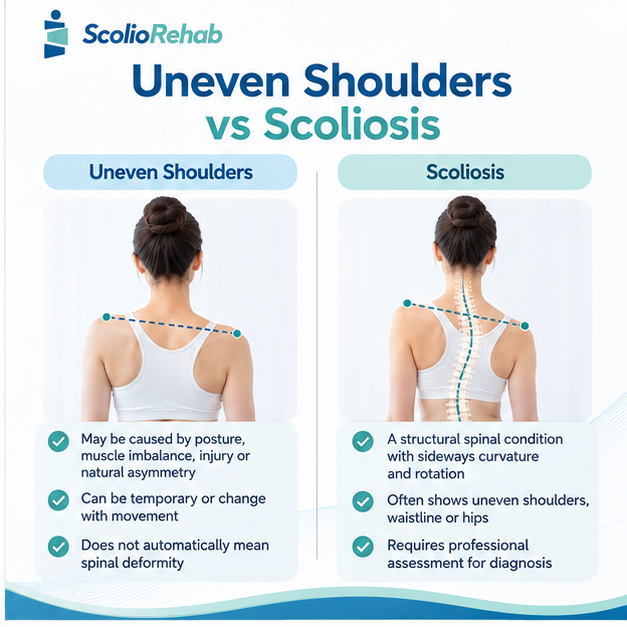
The American Academy of Orthopaedic Surgeons notes that shoulder asymmetry is one of the physical signs clinicians look for during scoliosis assessment.
If scoliosis is suspected, an appropriate clinical examination and, when indicated, spinal X-rays can help confirm the diagnosis and measure the curve using the Cobb angle.
Can Uneven Shoulders Be Fixed?
Sometimes, yes, but the answer depends entirely on the cause.
For example, if shoulder asymmetry is associated with reduced movement control, muscle weakness, or a previous injury, a tailored rehabilitation programme may help improve function and sometimes the visible appearance.
However, if the difference comes from a structural spinal curve, simply stretching one shoulder or strengthening the other is unlikely to correct the underlying condition.
It is also important to remember that not every uneven shoulder needs fixing.
For someone without pain, functional limitations, or significant underlying abnormalities, treatment may not be necessary.
The goal should be to identify whether there is a meaningful problem and address it appropriately.
What If Scoliosis Is the Cause?
Management depends on factors such as:
- Age and remaining growth.
- Cobb angle and curve pattern.
- Risk of curve progression.
- Symptoms and functional limitations.
- Overall health and individual needs.
Depending on the clinical situation, management may involve observation, scoliosis-specific physiotherapy, bracing, or specialist surgical consultation.
At ScolioRehab, non-surgical rehabilitation can include exercises and movement strategies tailored to the patient’s individual scoliosis curve.
For more information, explore our scoliosis treatment options in Malaysia.
4 Exercises That May Help With Shoulder Control and Mobility
If your shoulder asymmetry is associated with muscle weakness, stiffness, or movement-control differences, appropriate exercises may help.
However, these exercises are not guaranteed to make both shoulders level, and they are not designed to correct structural scoliosis.
Choose comfortable movements and seek professional advice if you experience persistent pain, numbness, or weakness.
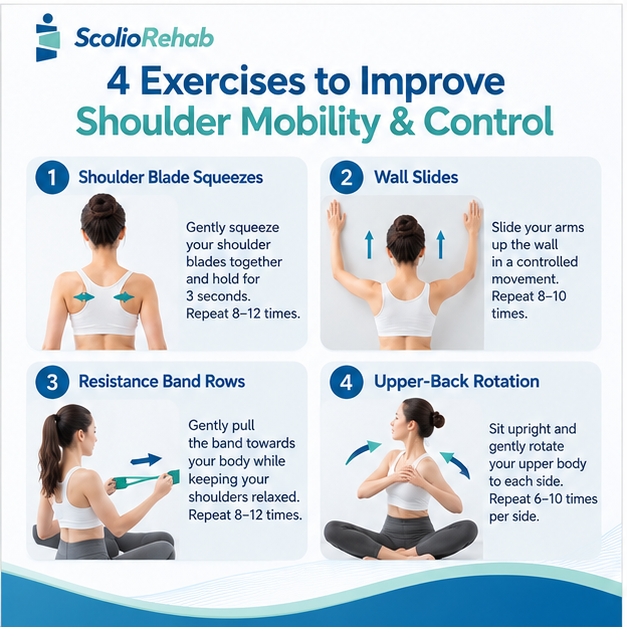
1. Shoulder Blade Squeezes
Purpose: Improve awareness and control of the muscles around the shoulder blades.
How to do it:
- Sit or stand comfortably.
- Keep your shoulders relaxed.
- Gently draw your shoulder blades toward each other.
- Hold for approximately three seconds.
- Relax slowly.
Try 8–12 repetitions.
Avoid shrugging your shoulders upward or forcing them into an exaggerated position.
2. Wall Slides
Purpose: Encourage shoulder mobility and coordinated shoulder-blade movement.
How to do it:
- Stand facing a wall.
- Place your forearms or hands against the wall.
- Slowly slide your arms upward within a comfortable range.
- Avoid forcing the movement if you feel pain.
- Return to the starting position.
Perform 8–10 controlled repetitions.
3. Resistance Band Rows
Purpose: Strengthen muscles involved in upper-back and shoulder movement.
How to do it:
- Secure a resistance band to a stable anchor.
- Hold the band with both hands.
- Pull your elbows gently backward.
- Keep your neck relaxed.
- Return slowly to the starting position.
Try 8–12 repetitions using a manageable resistance.
4. Gentle Upper-Back Rotation
Purpose: Improve thoracic mobility.
How to do it:
- Sit upright in a comfortable position.
- Cross your arms loosely over your chest.
- Gently rotate your upper body toward one side.
- Return to the centre.
- Repeat toward the opposite side.
Move slowly and stay within a pain-free range.
A reminder: Exercises should be selected based on an individual’s symptoms and assessment findings. If you have diagnosed scoliosis, generic symmetrical exercises may not address your specific spinal curve.
Our guide to scoliosis exercises and why curve patterns matter explains this distinction in more detail.
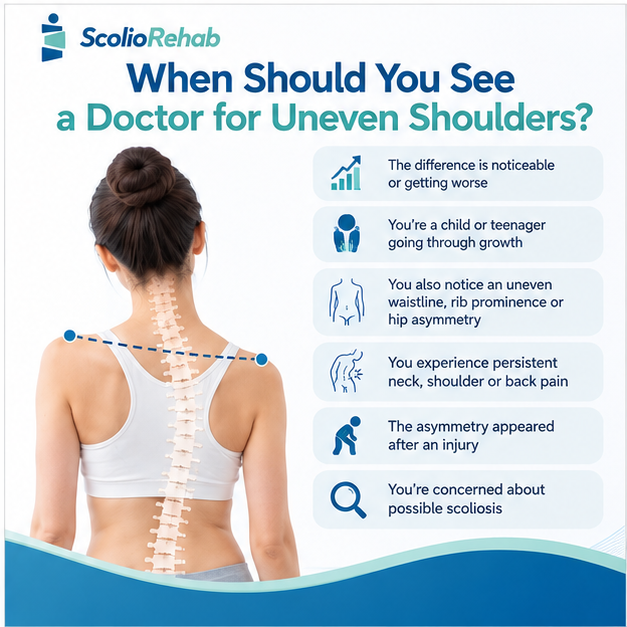
When Should You See a Doctor About Uneven Shoulders?
A small difference in shoulder height isn’t usually an emergency.
However, consider a professional assessment if:
- One shoulder is noticeably higher than the other and the difference persists.
- The asymmetry is becoming more obvious over time.
- Your child develops uneven shoulders during a growth spurt.
- One shoulder blade or rib cage appears more prominent.
- You notice an uneven waistline or hips.
- You experience persistent shoulder, neck, or back discomfort.
- The difference appeared after an injury.
For children and teenagers, assessment is particularly important because some scoliosis curves can progress during periods of rapid growth.
The NHS advises seeking a medical assessment when scoliosis is suspected.
Seek urgent medical attention for sudden shoulder asymmetry accompanied by substantial weakness, new numbness, severe pain after injury, or other acute neurological symptoms.
How Is Uneven Shoulder Alignment Assessed?
A professional assessment is more detailed than simply checking whether your shoulders look level in a mirror.
Depending on your symptoms, a clinician may evaluate:
Shoulder and Shoulder Blade Movement
How the shoulders and shoulder blades move during everyday activities.
Muscle Strength and Mobility
Whether weakness, stiffness, or restricted movement contributes to the asymmetry.
Spinal and Trunk Alignment
Whether there are signs of a spinal curve, trunk rotation, or uneven rib prominence.
Pelvic Position
Whether there are relevant differences in hip height, leg length, or standing alignment.
Scoliosis Screening
A forward bend test and, when appropriate, a scoliometer measurement.
If structural scoliosis is suspected, a medical professional may recommend standing spinal X-rays to confirm the diagnosis and assess curve magnitude.
Not everyone with uneven shoulders requires imaging.
The decision depends on the examination findings, symptoms, and clinical suspicion.
Uneven Shoulders and Scoliosis Assessment in Malaysia
If you’ve noticed persistent shoulder asymmetry, especially alongside an uneven waistline, prominent shoulder blade, or trunk imbalance, understanding the underlying cause is the most useful next step.
At ScolioRehab, our focus is on scoliosis assessment and non-surgical spinal rehabilitation.
For individuals with scoliosis-related asymmetry, the assessment may consider spinal curve pattern, trunk rotation, postural control, movement, and functional limitations.
When clinically appropriate, scoliosis-specific physiotherapy may be part of a personalised rehabilitation programme.
Not every uneven shoulder is related to scoliosis, and not every individual requires scoliosis-specific treatment.
Frequently Asked Questions About Uneven Shoulders
Is it normal to have uneven shoulders?
Yes. Small differences in shoulder height are common and may reflect natural body asymmetry. However, persistent or increasing differences, particularly with other spinal asymmetry signs, should be assessed.
Why is my left shoulder higher than my right?
Possible explanations include differences in shoulder-blade positioning, muscle activity, previous injury, or spinal alignment. The side that is higher does not reliably identify the underlying cause.
Does having uneven shoulders mean I have scoliosis?
No. Uneven shoulders are one possible sign of scoliosis, but they can occur for several other reasons. A proper assessment is required to determine whether scoliosis is present.
Can poor posture cause uneven shoulders?
Your habitual positions and movements may affect how your shoulders appear temporarily. However, poor posture isn’t the cause of adolescent idiopathic scoliosis, and persistent shoulder asymmetry shouldn’t automatically be blamed on posture.
Can sleeping on one side cause uneven shoulders?
There is limited evidence that sleeping on one side permanently changes shoulder height. Sleeping position may influence temporary stiffness or discomfort, but persistent asymmetry should be evaluated based on its underlying cause.
Can exercises fix uneven shoulders?
Exercises may improve strength, mobility, or movement control when these factors contribute to the asymmetry. However, exercise cannot be assumed to correct structural differences or scoliosis.
How can I tell if my uneven shoulders are caused by scoliosis?
Look for additional signs such as an uneven waistline, prominent ribs, or one shoulder blade sticking out more than the other. These signs are not diagnostic, so clinical examination and appropriate imaging may be necessary.
Should I be worried if my child’s shoulders are uneven?
Not necessarily, but persistent asymmetry in a growing child or teenager deserves medical attention, particularly if the difference is increasing or other signs of scoliosis are present.
Is one shoulder higher because I carry a heavy bag?
Carrying a bag on one side may temporarily affect shoulder position or cause discomfort. However, it doesn’t automatically explain persistent shoulder asymmetry and does not cause adolescent idiopathic scoliosis.
Final Thoughts: Uneven Shoulders Aren’t Always Just a Posture Problem
Noticing that one shoulder sits higher than the other can be unsettling, especially when you don’t know why it’s happening.
But remember, the human body isn’t perfectly symmetrical.
For some people, the difference may be related to normal anatomical variation or the way their muscles and shoulder blades move.
For others, uneven shoulders may be an early visible sign of a spinal condition such as scoliosis.
The goal isn’t to force both shoulders into a perfectly straight line. It’s to understand whether the difference reflects a condition that needs attention.
If your shoulder asymmetry is persistent, becoming more noticeable, or accompanied by other changes in spinal alignment, seeking a professional assessment can provide clarity and help determine the appropriate next steps.
Medical References
- NHS — Scoliosis: Symptoms and Diagnosis
- American Academy of Orthopaedic Surgeons — Idiopathic Scoliosis in Children and Adolescents
- American Academy of Orthopaedic Surgeons — Introduction to Scoliosis
- MedlinePlus — Scoliosis
- NHS Inform — About Scoliosis
Medical disclaimer: This article is for educational purposes and does not replace professional medical advice, diagnosis, or treatment. Consult a qualified healthcare professional if you have concerns about shoulder asymmetry, pain, or spinal alignment.