 Dexter Chew
When most people first hear about scoliosis, they think of the spine bending sideways.
That is understandable, but it is only part of the story.
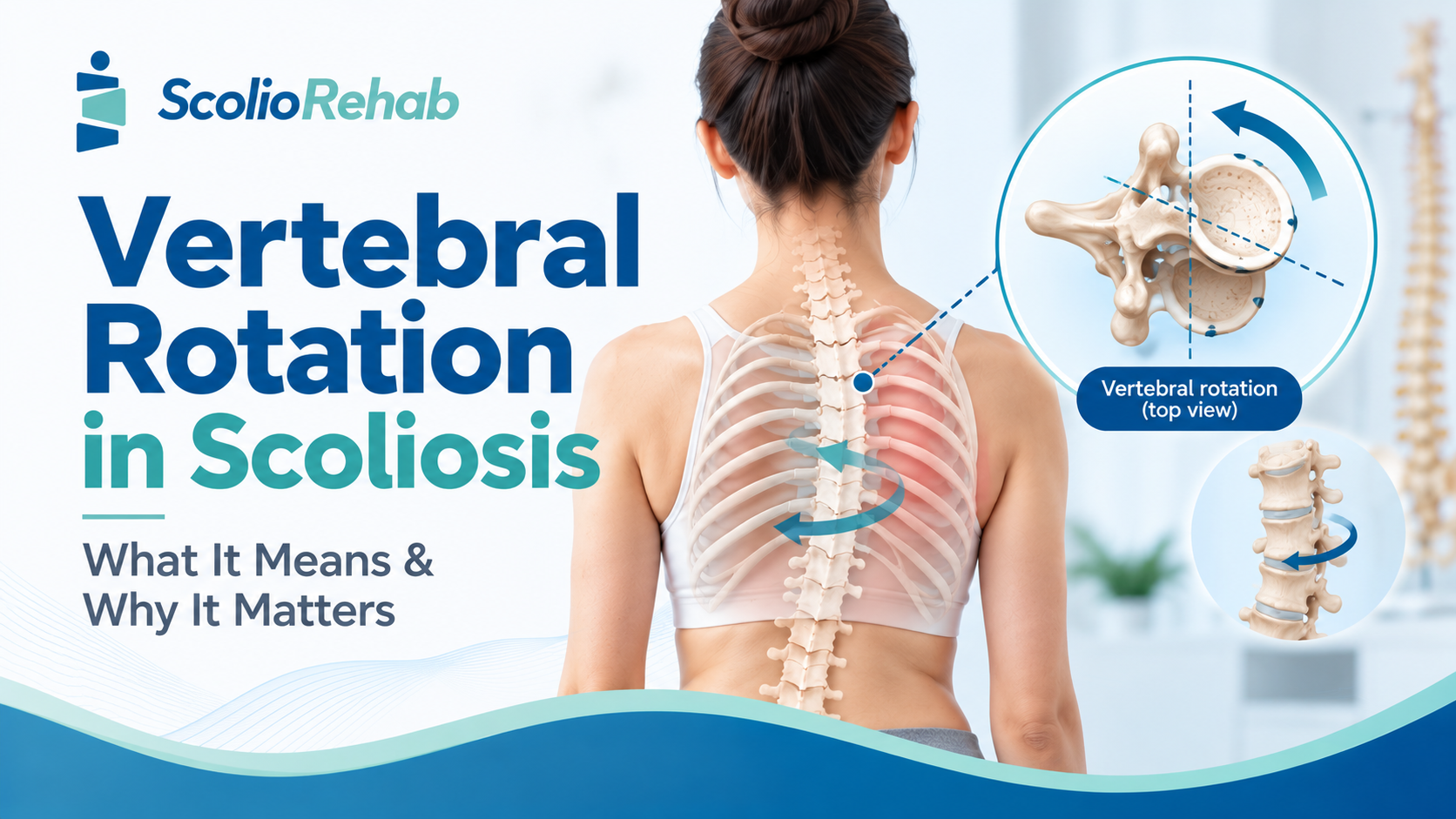
Scoliosis is not just a side-to-side curve. It is a three-dimensional spinal deformity, which means the spine may also rotate or twist. This twisting is called vertebral rotation.
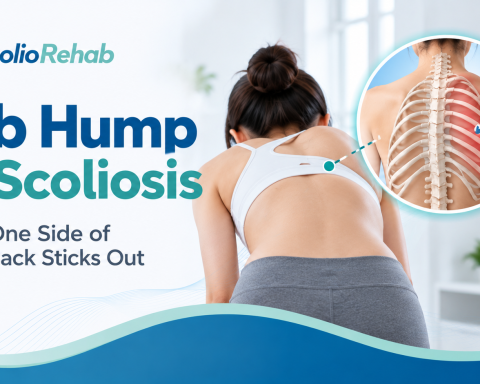
It is one of the key reasons scoliosis can change how the body looks from the outside. Uneven shoulders, a rib hump, trunk asymmetry, and waist imbalance often do not come from the sideways curve alone. They are strongly influenced by spinal rotation as well.
So what exactly is vertebral rotation, how is it measured, and why does it matter?
Let’s break it down in simple language.
What Is Vertebral Rotation?
Vertebral rotation means that one or more vertebrae in the spine twist around their vertical axis.
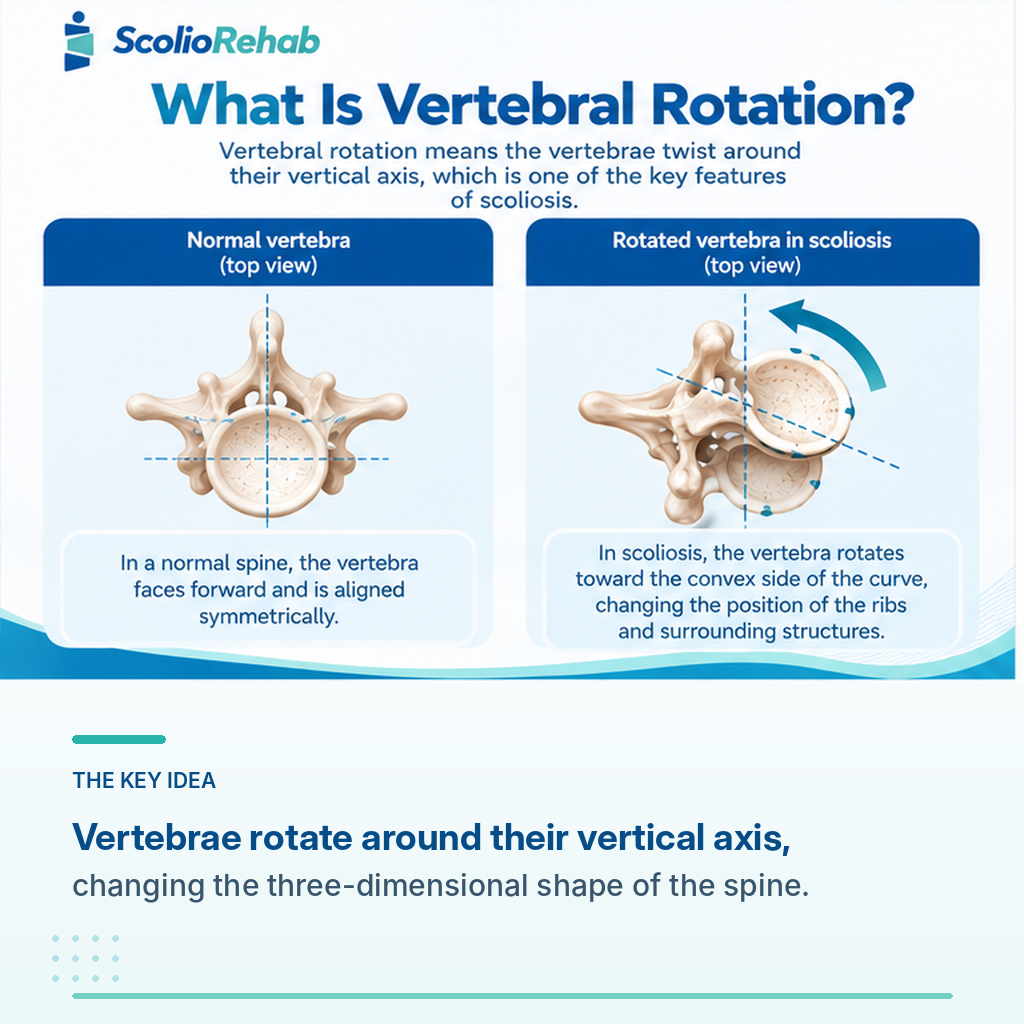
In a normal spine, the vertebrae are generally aligned so that they face forward in a balanced way. In scoliosis, however, some vertebrae may rotate as the curve develops.
This means the spine is not only curving sideways, but also turning.
That is why scoliosis is considered a 3D condition:
- Frontal plane: the sideways curve seen on X-ray
- Sagittal plane: the front-to-back curves of the spine
- Transverse plane: the rotational or twisting component
The rotational part is especially important because it helps explain why scoliosis often causes visible body asymmetry.
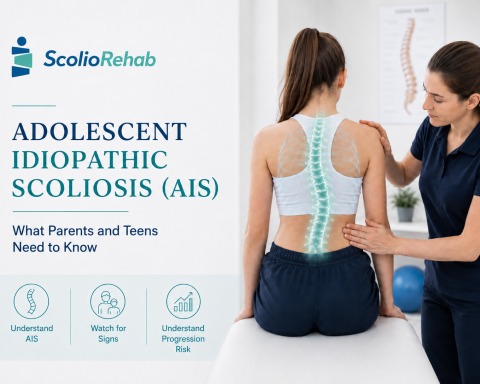
If you are new to the topic, our page on what scoliosis is explains the condition more broadly.
Why Does Vertebral Rotation Happen in Scoliosis?
In scoliosis, the vertebrae do not simply drift sideways like stacked blocks. As the curve develops, the vertebrae may also rotate toward the convex side of the curve.
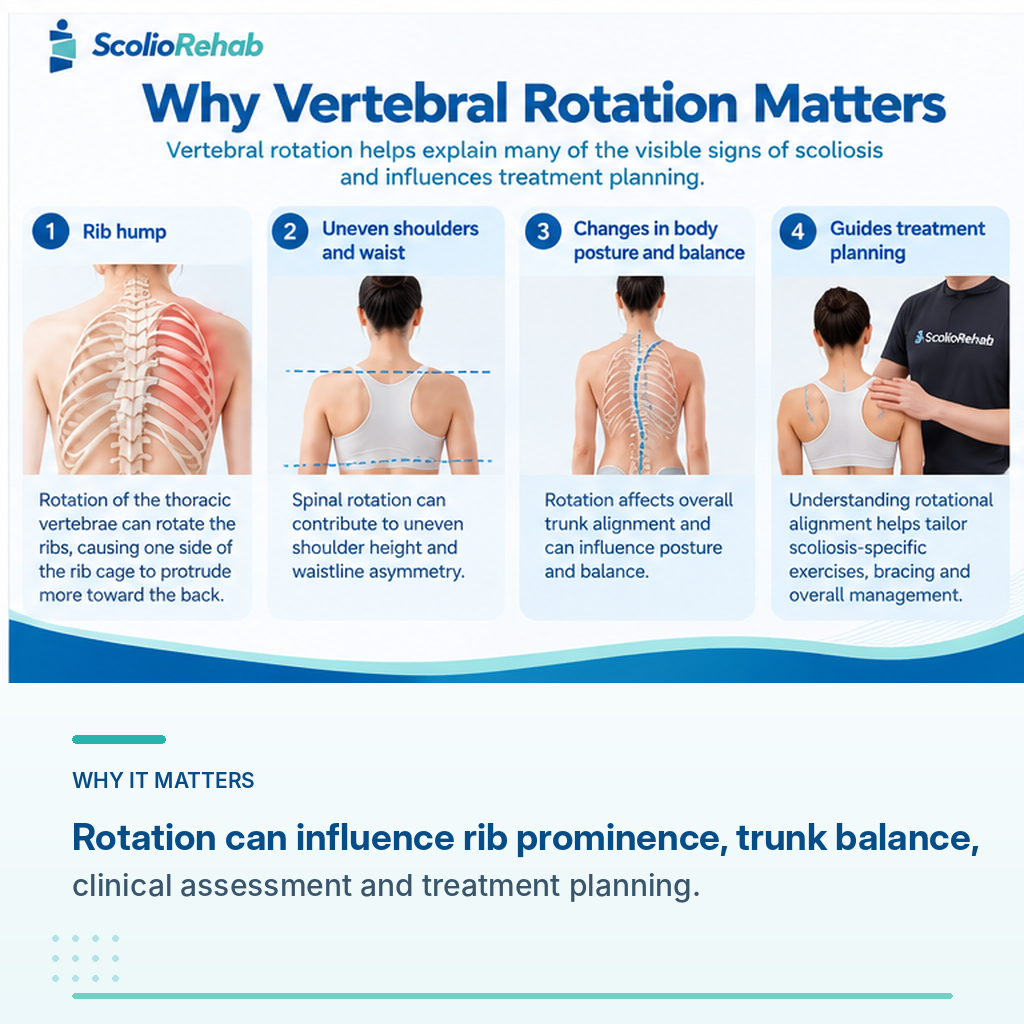
Because the ribs attach to the thoracic vertebrae, this rotation can also change the position of the rib cage.
That is one of the reasons people with scoliosis may develop:
- a rib hump
- uneven shoulders
- one shoulder blade appearing more prominent
- waist asymmetry
- visible trunk imbalance
In other words, vertebral rotation is a major reason why scoliosis changes body shape.
The Scoliosis Research Society describes scoliosis as a rotational spinal deformity, not just a lateral curve.
Vertebral Rotation vs Cobb Angle: What’s the Difference?
This is a very important distinction.
Many patients and parents assume the Cobb angle tells the full story. It does not.
Cobb Angle
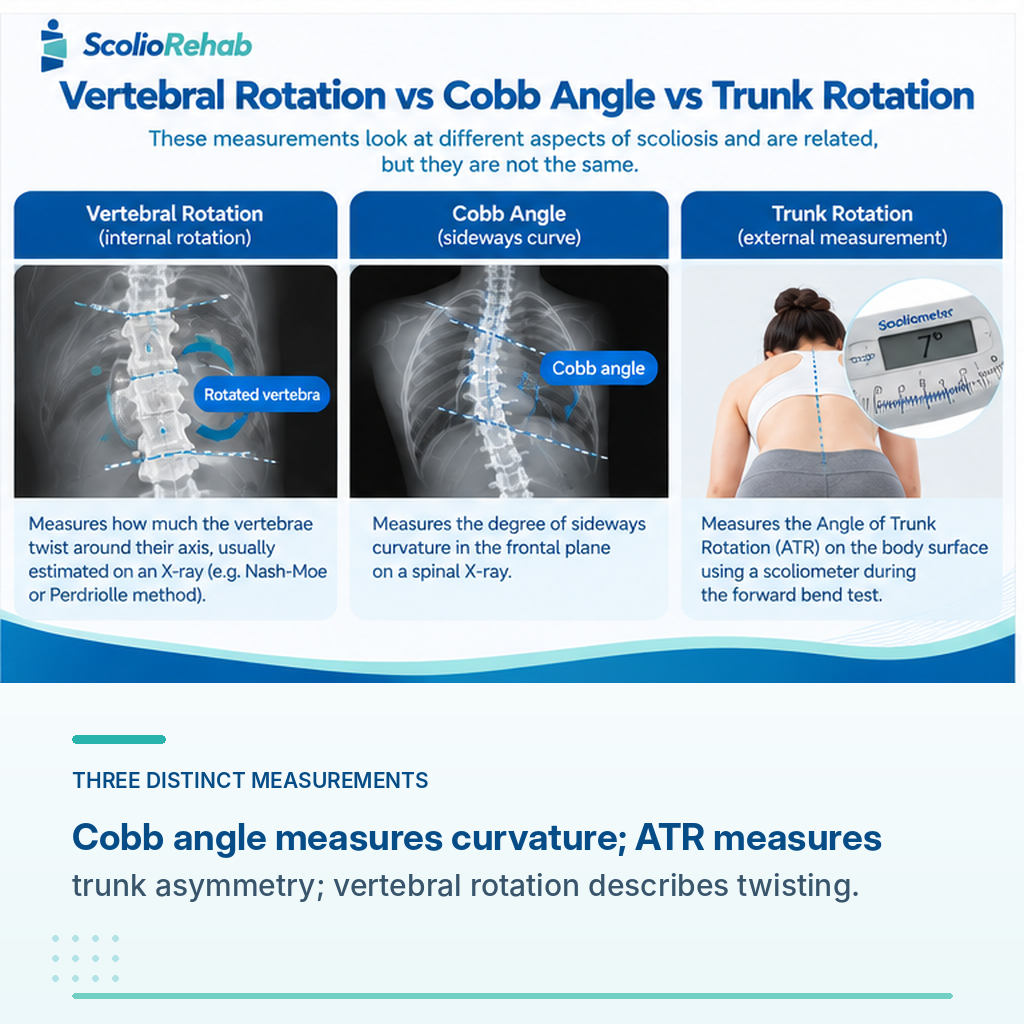
The Cobb angle measures the degree of sideways curvature on an X-ray.
It tells us how large the curve is in the frontal plane.
Vertebral Rotation
Vertebral rotation describes how much the vertebrae twist around their axis.
It tells us about the rotational component of scoliosis.
So, a person can have:
- a moderate Cobb angle with noticeable rib prominence
- or a larger Cobb angle with less obvious rib hump
Why? Because curve size and rotation are related, but they are not identical.
Two patients can have the same Cobb angle but look quite different externally.
That is why scoliosis assessment should not rely on the Cobb angle alone.
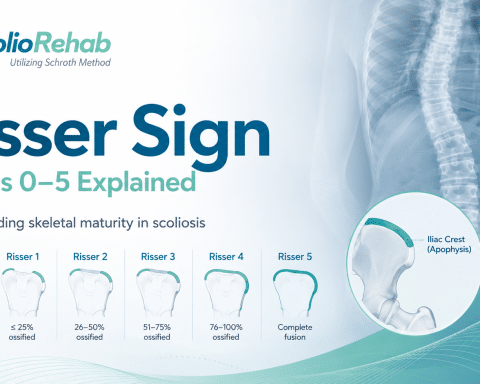
If you want to understand curve measurement in more detail, read our guide to the Cobb angle in scoliosis.
Vertebral Rotation vs Trunk Rotation
This is another area that often causes confusion.
Vertebral Rotation
This refers to the actual twisting of the vertebrae inside the body.
Trunk Rotation
This refers to the visible or measurable rotational asymmetry seen on the body surface, often during the forward bend test.
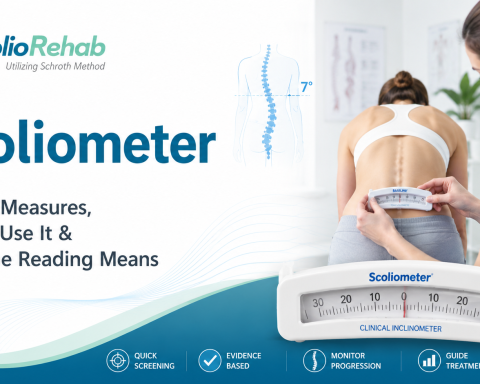
Clinicians commonly use a scoliometer to measure the Angle of Trunk Rotation (ATR).
That is useful, but it is not the same as directly measuring vertebral rotation on an X-ray.
So:
- vertebral rotation = internal structural twisting
- trunk rotation = external body asymmetry measurement
They are related, but they are not interchangeable.
For more on external screening, see our article on the scoliometer.
Why Does Vertebral Rotation Matter?
You may be wondering, “If the vertebrae rotate, why does that matter beyond the X-ray?”
It matters for several reasons.
1. It influences body appearance
Vertebral rotation is a major reason why scoliosis causes asymmetry that people can actually see.
This includes:
- rib hump
- uneven shoulders
- a prominent shoulder blade
- trunk shift
- uneven waistline
This is why a person’s appearance cannot be judged by Cobb angle alone.
2. It helps explain rib hump formation
In thoracic scoliosis, vertebral rotation can rotate the attached ribs, making one side of the rib cage protrude more toward the back.
This creates the rib hump that is often seen during the forward bend test.
Our rib hump article explains this visible sign in more detail.
3. It can influence treatment planning
Because scoliosis is three-dimensional, treatment should not focus only on the sideways curve.
In scoliosis-specific rehabilitation, clinicians often consider:
- curve pattern
- spinal rotation
- trunk asymmetry
- postural balance
- breathing mechanics
- growth stage
This is one reason why general symmetrical exercises are not always enough for scoliosis management.
4. It helps track the structural nature of scoliosis
A spine that is simply “leaning” is different from a spine that is structurally twisted.
Rotation helps confirm that scoliosis is more than a postural habit.
That is one reason why rotational findings are clinically meaningful.
How Is Vertebral Rotation Measured?
Vertebral rotation is most commonly assessed through imaging, especially spinal X-rays.
There are several methods used to estimate or grade rotation.
1. Visual and Clinical Assessment
Before looking at an X-ray, clinicians often first notice clues suggesting rotation, such as:
- rib prominence on forward bending
- uneven shoulders
- asymmetrical trunk shape
- one shoulder blade appearing more prominent
These signs do not directly measure vertebral rotation, but they may raise suspicion.
2. Scoliometer and Angle of Trunk Rotation
A scoliometer is often used during the Adam’s Forward Bend Test.
It measures the Angle of Trunk Rotation (ATR).
This does not directly measure vertebral rotation, but it helps estimate surface asymmetry that may be caused by spinal rotation.
It is a useful screening tool, especially in scoliosis assessment, but it is not the definitive method for determining how much the vertebrae themselves have rotated.
3. X-ray-Based Methods
When clinicians want to assess vertebral rotation more directly, they often refer to X-ray-based grading methods.
Nash-Moe Method
The Nash-Moe method is a commonly used radiographic grading system.
It estimates vertebral rotation by looking at how the pedicles appear on an AP spinal X-ray.
As the vertebra rotates, the position of the pedicles appears to shift.
This method is practical and widely known, but it is an estimate rather than a perfect measurement.
Perdriolle Torsion Meter
The Perdriolle method uses a special torsion meter placed over the X-ray to estimate vertebral rotation more precisely.
It has been used in scoliosis research and specialist assessment, although it is less commonly discussed in general patient education.
CT Scan
A CT scan can provide more detailed information about vertebral rotation.
However, it is not routinely used for standard scoliosis follow-up because of factors such as:
- higher radiation exposure
- higher cost
- lack of necessity in many routine cases
In everyday clinical practice, standing X-rays remain far more common.
Research comparing rotation measurement methods has shown that these techniques vary in accuracy and practicality, which is why vertebral rotation is often discussed in combination with other clinical findings rather than as a single isolated number.
Can Vertebral Rotation Be Reduced?
This is where expectations need to be realistic.
In some cases, aspects of trunk asymmetry and rotational presentation may improve, but complete correction cannot be guaranteed.
The answer depends on factors such as:
- age
- skeletal maturity
- flexibility of the curve
- size of the scoliosis curve
- type of treatment used
- degree of structural change already present
Scoliosis-Specific Physiotherapy
Scoliosis-specific physiotherapy may aim to address the three-dimensional nature of scoliosis, including rotation.
This may involve:
- postural correction
- breathing-based strategies
- elongation and de-rotation principles
- improved trunk control
- movement retraining
The goal is not merely to “stand straighter,” but to improve alignment, function, and awareness of the curve pattern.
At ScolioRehab, this is part of the logic behind physiotherapy for scoliosis.
Schroth Method
The Schroth Method is one of the best-known scoliosis-specific approaches.
It is designed around the three-dimensional nature of scoliosis, including vertebral rotation and rib cage asymmetry.
Depending on the individual curve pattern, Schroth-based rehabilitation may aim to improve:
- rotational awareness
- trunk symmetry
- breathing mechanics
- postural control
You can read more in our guide to the Schroth Method.
Bracing
In growing children and adolescents, scoliosis bracing may be recommended in suitable cases to reduce the risk of progression.
Modern brace concepts often take rotational alignment into account, not just lateral curvature.
That said, bracing is not appropriate for everyone.
Surgery
In severe or progressive scoliosis, surgery may be considered.
Surgical correction can address both curvature and rotation to some degree, although the exact outcome depends on the case.
A perfectly symmetrical spine or body shape cannot always be guaranteed even after surgery.
Does Vertebral Rotation Cause Pain?
Not necessarily.
Many people with scoliosis-related vertebral rotation do not have significant pain, especially adolescents.
However, rotation can contribute to changes in posture, muscular loading, rib cage asymmetry, and trunk balance, which may affect how the body feels and functions.
Pain, when present, should be assessed in context. It should not automatically be blamed on vertebral rotation alone.
When Is Vertebral Rotation Clinically Important?
Vertebral rotation becomes especially relevant when:
- scoliosis is suspected during screening
- visible asymmetry is present
- a rib hump develops
- treatment planning is being considered
- progression is being monitored
- a patient or parent wants to understand why the body looks asymmetrical despite a certain Cobb angle
In short, it matters whenever we want a fuller picture of scoliosis beyond “how many degrees is the curve?”
Vertebral Rotation and Scoliosis Care in Malaysia
If you or your child has been told there is spinal rotation, the key message is this:
Vertebral rotation is a normal part of how scoliosis is assessed, and it helps explain why scoliosis is a three-dimensional condition.
At ScolioRehab, scoliosis assessment does not look at the spine from only one angle. Clinical care may consider:
- Cobb angle
- trunk rotation
- visible asymmetry
- rib hump
- curve pattern
- age and growth stage
- individual treatment goals
For suitable patients, management may involve monitoring, scoliosis-specific physiotherapy, bracing, or referral for further specialist evaluation when needed.
You can also explore our scoliosis treatment options in Malaysia.
Frequently Asked Questions About Vertebral Rotation
Is vertebral rotation the same as scoliosis?
No. Vertebral rotation is one component of scoliosis, but scoliosis involves more than just rotation. It includes sideways curvature and three-dimensional spinal deformity.
Can you have vertebral rotation without a large Cobb angle?
Yes. Some people may show noticeable asymmetry or rotational signs even when the Cobb angle is not very large.
Is vertebral rotation the same as rib hump?
No. Vertebral rotation is the internal twisting of the vertebrae. A rib hump is a visible external sign that may result from that rotation, especially in thoracic scoliosis.
Can vertebral rotation be measured without an X-ray?
Not directly. Surface tools like the scoliometer can measure trunk rotation, but vertebral rotation itself is more accurately assessed through imaging.
Does vertebral rotation always get worse?
Not always. It may remain stable in some cases, especially when the scoliosis curve is stable. In growing children and adolescents, progression risk needs closer monitoring.
Can exercises fix vertebral rotation completely?
No exercise can guarantee complete correction. However, scoliosis-specific rehabilitation may help improve posture, trunk symmetry, and functional control in selected patients.
Why does vertebral rotation matter in treatment?
Because scoliosis is a three-dimensional condition. Treatment that ignores rotation may miss an important part of the deformity.
Final Thoughts
If you only look at scoliosis as a sideways curve, you miss a big part of the picture.
Vertebral rotation is one of the key reasons scoliosis affects posture, rib cage shape, and body symmetry. It helps explain why two people with similar Cobb angles can look very different.
That is also why proper scoliosis assessment should go beyond a single number on an X-ray.
Understanding vertebral rotation does not mean you need to panic. It simply means you are seeing scoliosis more clearly and more accurately.
And when it comes to making informed treatment decisions, that matters.
Medical References
- Scoliosis Research Society – Idiopathic Scoliosis
- Scoliosis Research Society – Diagnosing Scoliosis
- NHS – Scoliosis
- Weiss HR, et al. SOSORT Guidelines: Orthopaedic and Rehabilitation Treatment of Idiopathic Scoliosis During Growth
- Nash CL, Moe JH. A Study of Vertebral Rotation
Medical disclaimer: This article is for educational purposes only and does not replace medical advice, diagnosis, or treatment. If you suspect scoliosis or are concerned about spinal asymmetry, consult a qualified healthcare professional.