 Dexter Chew
Have you ever looked in the mirror and noticed that your lower back seems unusually arched, your stomach sticks out, or one hip appears higher than the other?
You might have come across the term pelvic tilt while searching for an explanation.
But here’s something worth knowing: Having a tilted pelvis doesn’t automatically mean something is wrong with your body.
Your pelvis naturally moves and changes position throughout the day. It tilts when you walk, sit, bend, and exercise. The concern arises when an excessive or persistent tilt is associated with discomfort, limited movement, or an underlying condition.
So, how can you tell whether your pelvic position is normal or something worth checking?
Let’s explore the different types of pelvic tilt, what causes them, how they may affect your back, and what you can do about them.
What Is Pelvic Tilt?
Pelvic tilt refers to the angle or position of your pelvis relative to the rest of your body.
Think of your pelvis as the foundation connecting your upper body to your legs. Your spine sits above it, while your hips connect it to your lower limbs.
When your pelvis moves, the position of your lower back can change along with it.
For example:
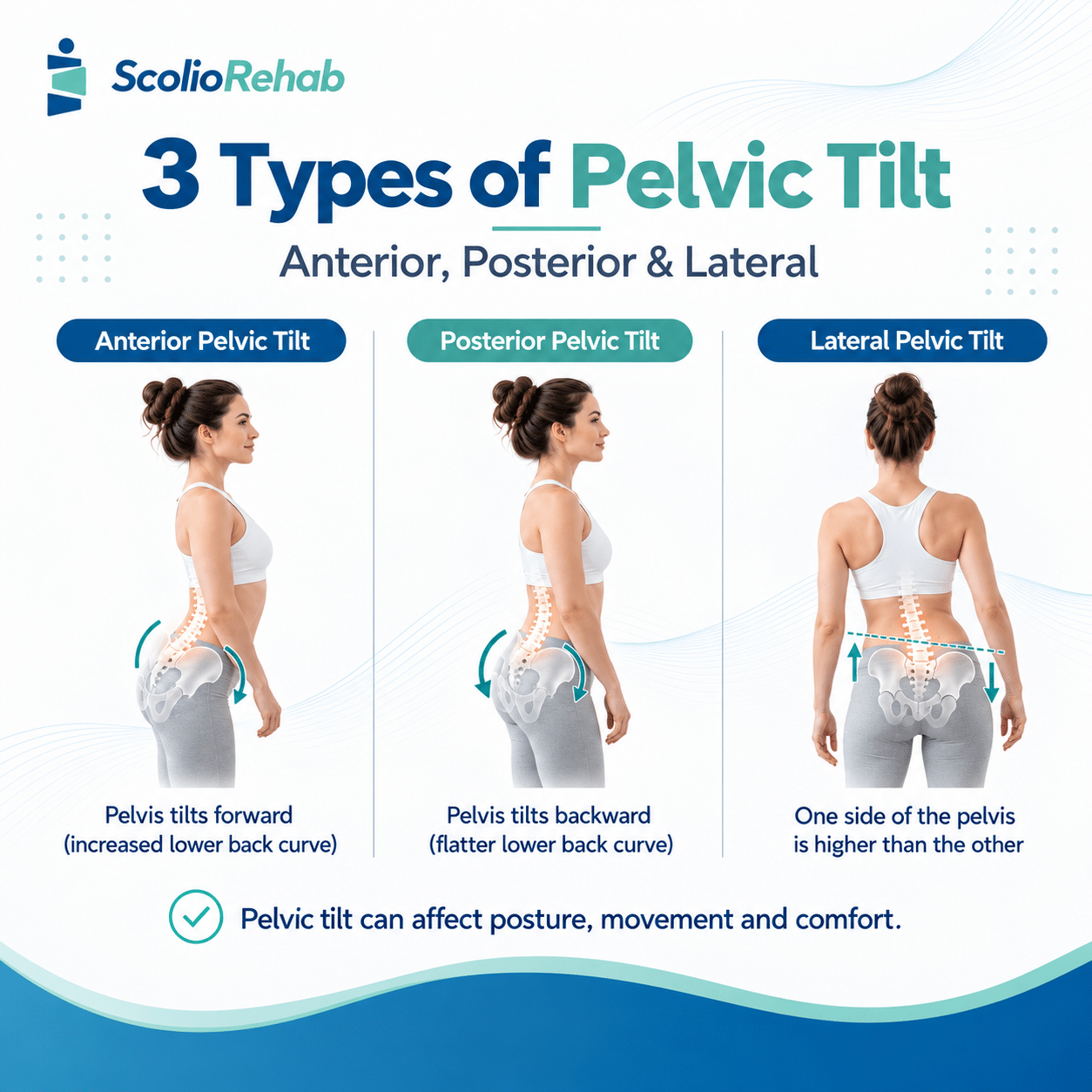
- Tilting your pelvis forward can increase the arch in your lower back.
- Tilting it backward can make your lower back appear flatter.
- Tilting it sideways can make one hip appear higher than the other.
A certain amount of pelvic tilt is completely normal. In fact, everyone’s pelvic alignment is slightly different.
However, a noticeable or persistent change in pelvic position may sometimes be associated with muscular imbalances, differences in leg length, spinal conditions, or movement-related problems.
According to Cleveland Clinic, excessive pelvic tilt can sometimes contribute to changes in posture and lower back discomfort, particularly when combined with prolonged periods of inactivity.
The 3 Types of Pelvic Tilt
Not all pelvic tilts are the same. Understanding the direction of the tilt can help explain why your posture looks a certain way.
1. Anterior Pelvic Tilt (Forward Pelvic Tilt)
Anterior pelvic tilt occurs when the front of your pelvis rotates downward and the back rises.
This position is commonly associated with an increased inward curve of the lower back, known as lumbar lordosis.
You might notice:
- A more pronounced arch in your lower back.
- Your buttocks appearing more prominent.
- Your abdomen projecting forward.
- Difficulty comfortably controlling your pelvic position during certain movements.
Anterior pelvic tilt is often discussed in relation to prolonged sitting, reduced physical activity, and the strength or flexibility of muscles around the hips and abdomen.
However, these factors don’t affect everyone in the same way. Having an anterior pelvic tilt doesn’t necessarily mean your muscles are weak or that you have a medical problem.
Does anterior pelvic tilt cause lower back pain?
Not necessarily.
Some people with a noticeable anterior pelvic tilt experience lower back discomfort, while others have no symptoms at all.
The relationship between pelvic alignment and pain is complex. Back pain may involve several factors, including physical activity, muscle capacity, previous injuries, and other spinal conditions.
2. Posterior Pelvic Tilt (Backward Pelvic Tilt)
Posterior pelvic tilt occurs when the pelvis rotates backward, bringing the front of the pelvis upward.
Instead of having a pronounced lower-back arch, a person with posterior pelvic tilt may have a flatter lumbar curve.
Common characteristics include:
- A relatively flat lower-back appearance.
- The tailbone appearing tucked underneath the body.
- Changes in how the hips and lower back move.
- Difficulty maintaining certain positions comfortably.
Posterior pelvic tilt can be influenced by muscle activity, habitual movement patterns, and individual anatomical differences.
It’s also important to understand that posterior pelvic tilt is not always undesirable.
For example, gently tilting the pelvis backward is a normal movement used in many rehabilitation exercises.
The movement itself isn’t the problem. What matters is whether your pelvic position is associated with symptoms or functional limitations.
3. Lateral Pelvic Tilt (Sideways Pelvic Tilt)
Lateral pelvic tilt refers to a difference in height between the left and right sides of the pelvis.
Imagine standing in front of a mirror and noticing that one hip appears slightly higher than the other.
This is sometimes described as pelvic obliquity.
Potential causes include:
- Differences in leg length.
- Habitual weight shifting.
- Muscle weakness or movement restrictions.
- Hip-related conditions.
- Spinal asymmetry, including scoliosis.
Of the three types, lateral pelvic tilt is particularly relevant when assessing possible spinal asymmetry.
That’s because the pelvis and spine work closely together to maintain balance.
However, uneven hips do not automatically mean you have scoliosis. A proper assessment is necessary to determine whether the difference comes from the pelvis, legs, spine, or a combination of factors.
What Causes Pelvic Tilt?
There isn’t one universal cause of pelvic tilt.
Your pelvic position is influenced by the interaction between your muscles, joints, spinal alignment, physical activities, and individual anatomy.
Here are some possible contributing factors.
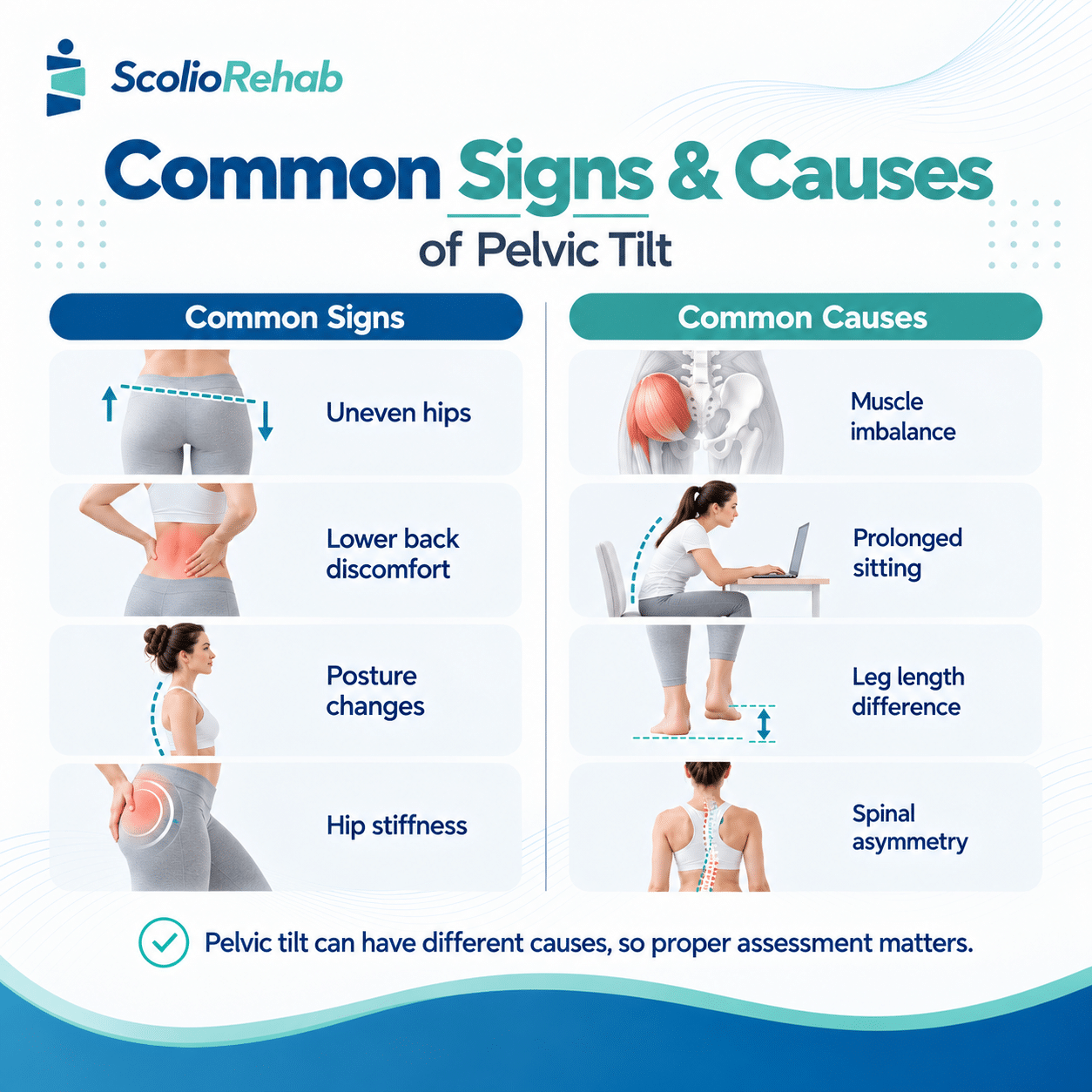
Prolonged Sitting and Limited Movement
If you spend most of your working day sitting, you may notice that your hips and lower back feel stiff when you stand up.
Extended periods of inactivity can influence muscle strength, flexibility, and movement habits.
However, sitting itself is not inherently harmful, and no single sitting position is responsible for every pelvic alignment problem.
Regular movement and exercise are generally more useful than trying to maintain one supposedly perfect posture all day.
Muscle Strength and Flexibility
The muscles around your abdomen, hips, glutes, and lower back help control pelvic movement.
These include:
- Hip flexors
- Gluteal muscles
- Hamstrings
- Abdominal muscles
- Lower-back muscles
Reduced strength, limited flexibility, or poor movement control may influence how your pelvis moves during daily activities.
But appearance alone cannot reliably determine which muscles are weak or tight.
A proper assessment can help identify whether any specific muscle limitations are contributing to your symptoms.
Leg Length Differences
Sometimes, one leg is structurally shorter than the other.
In other cases, the legs may be similar in length, but differences in joint positioning or movement make one side appear shorter.
Either situation can influence how the pelvis sits when standing.
This is especially relevant to lateral pelvic tilt, where one hip appears higher than the other.
Not everyone with a leg length difference needs treatment. The significance depends on the size of the difference, symptoms, and how the body adapts.
Spinal Conditions Such as Scoliosis
The relationship between the pelvis and spine is another important consideration.
In some individuals, spinal curvature and rotation may contribute to an uneven appearance of the waist or hips.
This is particularly relevant to scoliosis, a condition involving a three-dimensional spinal deformity.
However, scoliosis isn’t the only possible explanation for an uneven pelvis, and pelvic tilt alone cannot confirm the diagnosis.
What Are the Symptoms of Pelvic Tilt?
Many people with pelvic tilt experience no symptoms.
Others may notice differences in posture or discomfort during particular activities.
Possible signs include:
- An unusually pronounced or flattened lower-back curve.
- One hip appearing higher than the other.
- Changes in standing posture.
- Lower-back or hip discomfort.
- Stiffness around the hips.
- Difficulty performing certain movements comfortably.
These symptoms are not specific to pelvic tilt. They can also occur with other musculoskeletal conditions.
The important question isn’t simply whether your pelvis looks tilted. It’s whether you have symptoms, movement limitations, or an underlying condition that needs attention.
Is Pelvic Tilt Related to Scoliosis?
Yes, pelvic alignment and scoliosis can be related, particularly when discussing lateral pelvic tilt.
Scoliosis is more than a sideways curve of the spine. It also involves changes in spinal rotation and alignment.
Because the pelvis supports the spine, differences in spinal alignment may sometimes be accompanied by changes in pelvic position.
For example, a person with scoliosis may notice:
- One hip appearing higher than the other.
- An uneven waistline.
- One shoulder sitting higher.
- The trunk shifting slightly to one side.
- Differences in how weight is distributed while standing.
But there’s an important distinction.
Pelvic tilt and scoliosis are not the same condition.
A person may have an uneven pelvis without structural scoliosis. Conversely, someone with scoliosis may not have an obvious pelvic height difference.
A clinical assessment helps determine whether asymmetry originates from the spine, pelvis, lower limbs, or another factor.
If you’re concerned about spinal asymmetry, our guide to what scoliosis is and its early signs explains what clinicians look for during screening.
How to Check for Pelvic Tilt at Home
You can observe certain postural features at home, but remember that these observations cannot diagnose excessive pelvic tilt or determine its cause.
Step 1: Observe Your Posture From the Side
Stand naturally in front of a full-length mirror with your side facing the mirror.
Avoid deliberately arching or flattening your back.
Notice your usual lower-back shape and whether your pelvis appears to rotate noticeably forward or backward.
Keep in mind that some lower-back curvature is normal.
Step 2: Observe Your Hip Height
Stand facing the mirror with your feet comfortably apart.
Look at your waistline and the approximate height of both hips.
Does one side appear consistently higher?
A small difference can be normal, and your clothing or standing position may affect what you see.
Step 3: Notice How You Move
Consider whether you experience:
- Discomfort after prolonged sitting.
- Stiffness when standing up.
- Difficulty bending or rotating.
- Hip or lower-back discomfort during exercise.
The presence, duration, and severity of these symptoms are usually more meaningful than your appearance alone.
Step 4: Know When to Get Checked
If the asymmetry is persistent, appears to be increasing, or is accompanied by pain or reduced function, consider a professional assessment.
A clinician may evaluate your posture, joint mobility, muscle function, leg length, and spinal alignment.
Imaging isn’t always necessary. It may be recommended when your symptoms or examination suggest a condition requiring further investigation.
Can Pelvic Tilt Be Corrected?
In some cases, pelvic positioning and movement control can improve through targeted exercise, rehabilitation, and changes in activity habits.
However, not every pelvic tilt needs to be corrected.
For someone with no pain or functional limitation, a visible pelvic angle may simply reflect normal anatomical variation.
For someone experiencing discomfort, physiotherapy may help improve strength, mobility, movement confidence, and daily function.
The appropriate approach depends on the underlying cause.
For example:
- A person with reduced hip mobility may benefit from mobility exercises.
- Someone with poor muscular endurance may benefit from progressive strengthening.
- A person with a significant leg length difference may require further assessment.
- Someone with scoliosis-related asymmetry may benefit from a scoliosis-specific rehabilitation approach.
Research also suggests caution when promising structural correction. A systematic review of nonsurgical treatments for excessive anterior pelvic tilt found that the available evidence was insufficient to establish that these treatments consistently reduce pelvic tilt or related symptoms.
This doesn’t mean exercise is useless.
It means treatment should focus on meaningful improvements, such as reduced discomfort, better strength, and improved function, rather than promising to achieve one ideal pelvic angle.
5 Pelvic Tilt Exercises to Improve Strength and Mobility
If you have mild stiffness or want to develop better control of your hips and lower back, the following general exercises may be useful.
These exercises are not designed to treat every type of pelvic tilt, and they are not a substitute for an individual rehabilitation programme.
If you have significant pain, diagnosed spinal deformity, or a recent injury, seek professional guidance before starting.
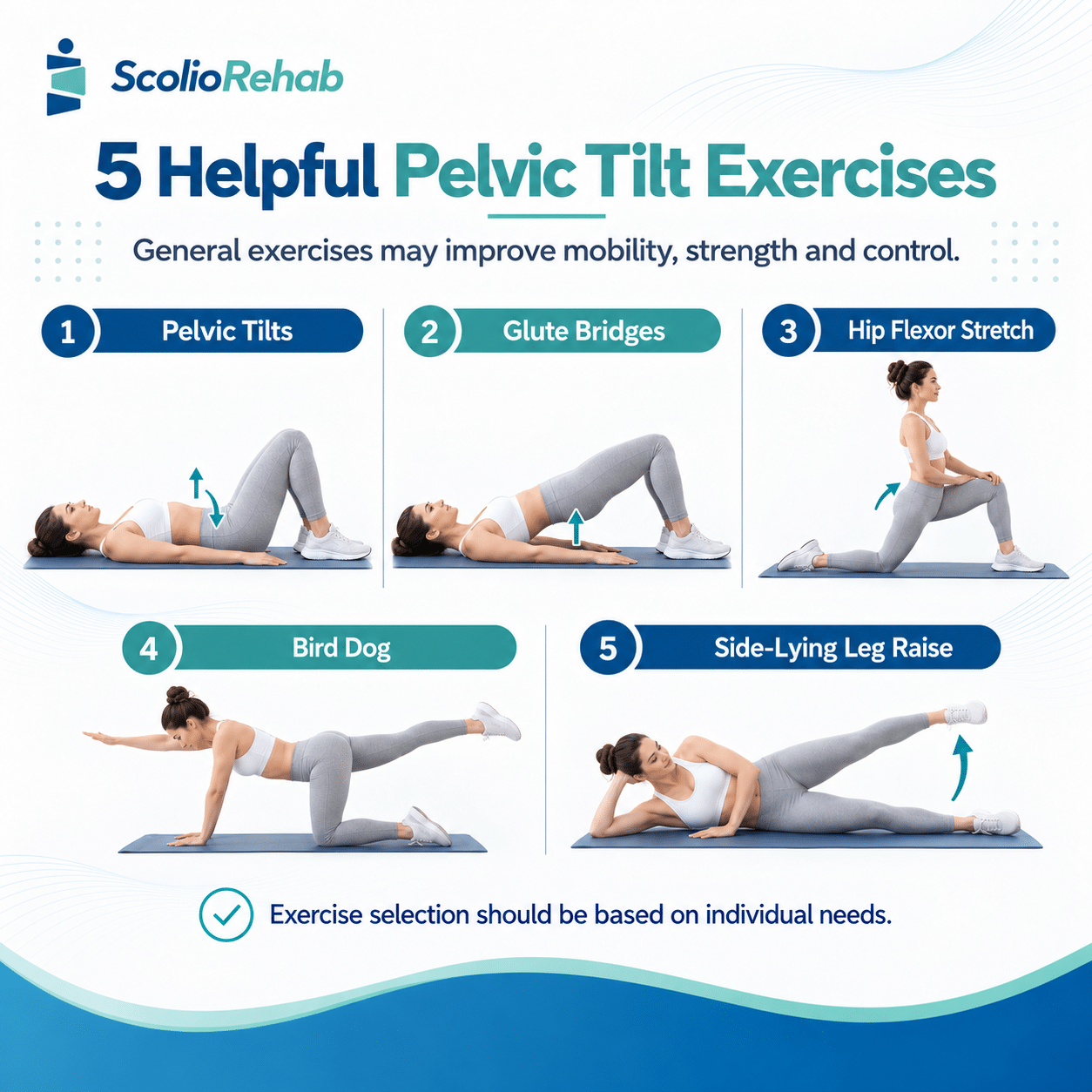
1. Supine Pelvic Tilts
Best for: Learning gentle pelvic movement and lower-back control.
How to do it:
- Lie on your back with your knees bent and feet flat on the floor.
- Gently tighten your abdominal muscles.
- Slowly tilt your pelvis backward, allowing your lower back to move closer to the floor.
- Hold briefly without forcing the movement.
- Relax and return to your starting position.
Try 8–12 slow repetitions, provided the movement remains comfortable.
Tip: Focus on controlled movement rather than pressing your lower back forcefully into the floor.
2. Glute Bridges
Best for: Strengthening the glutes and improving hip extension control.
How to do it:
- Lie on your back with your knees bent.
- Keep your feet approximately hip-width apart.
- Gently tighten your abdominal muscles.
- Push through your feet and lift your hips.
- Pause briefly before lowering slowly.
Start with 8–12 repetitions.
Avoid excessively arching your lower back at the top of the movement.
3. Kneeling Hip Flexor Stretch
Best for: Improving hip mobility when hip flexor tightness is present.
How to do it:
- Start in a half-kneeling position, with one knee on the floor.
- Keep your upper body upright.
- Gently tuck your pelvis and shift your body forward.
- Stop when you feel a comfortable stretch near the front of the hip.
- Hold for approximately 20–30 seconds.
Repeat on the opposite side.
Use a cushion under your knee if necessary.
4. Bird Dog Exercise
Best for: Trunk stability, coordination, and controlled movement.
How to do it:
- Begin on your hands and knees.
- Keep your spine in a comfortable, neutral position.
- Slowly extend one arm and the opposite leg.
- Avoid rotating your pelvis or arching your lower back.
- Return to the starting position and switch sides.
Try 6–10 controlled repetitions on each side.
Quality matters more than speed.
5. Side-Lying Hip Abduction
Best for: Developing strength around the lateral hip.
How to do it:
- Lie on your side with your legs extended.
- Keep your hips stacked.
- Slowly lift your upper leg without rotating your body backward.
- Pause briefly.
- Lower your leg with control.
Try 8–12 repetitions on each side.
This exercise may be useful when hip muscle weakness is identified, but it does not automatically correct an uneven pelvis.
Remember: Stop any exercise that causes sharp pain, worsening symptoms, or unusual numbness. Exercise selection should be based on your individual needs rather than the assumption that everyone with pelvic tilt requires the same routine.
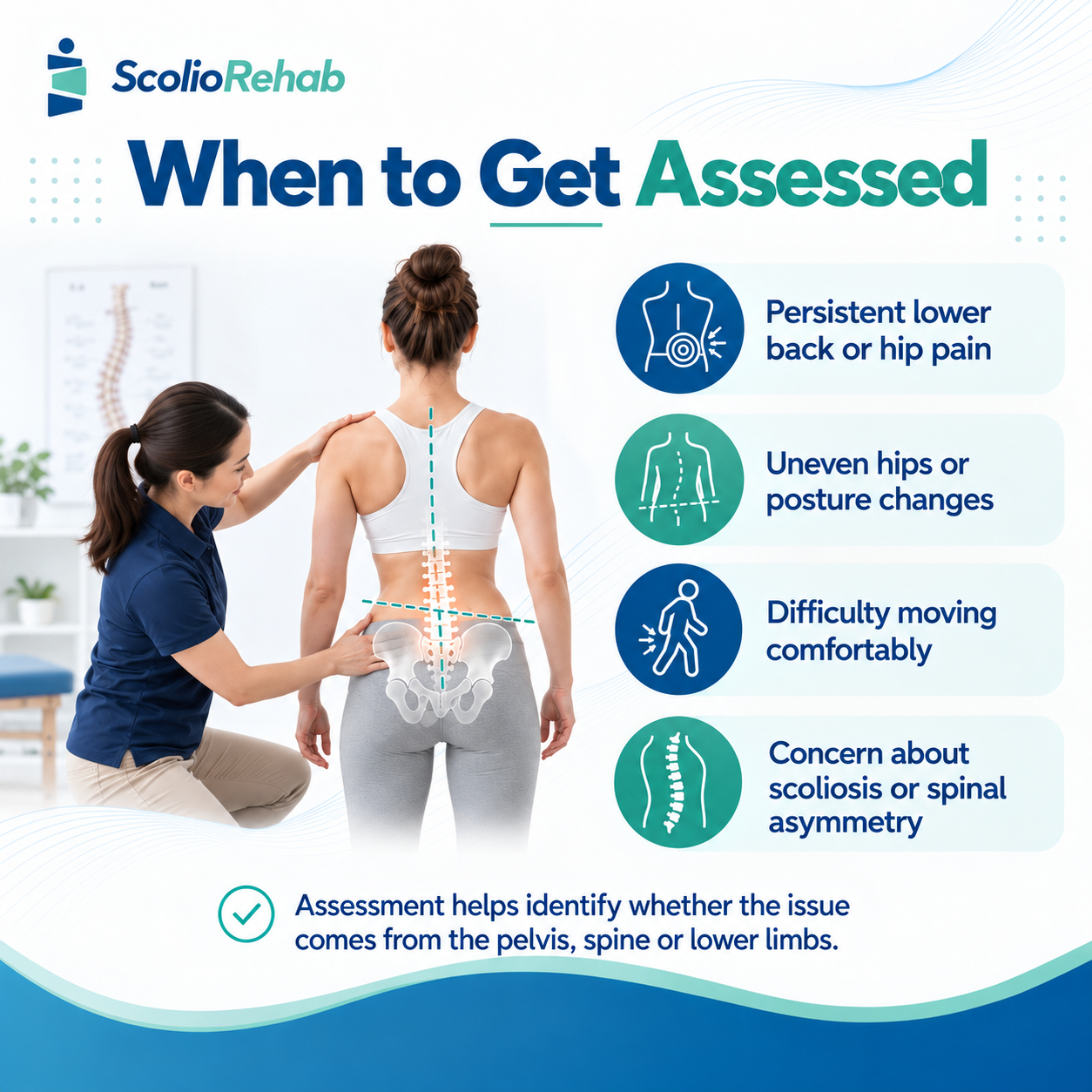
When Should You See a Physiotherapist?
You don’t necessarily need treatment simply because your pelvis looks slightly tilted.
However, an assessment may be helpful when you experience:
- Persistent lower-back or hip pain.
- A noticeable difference in hip height that is new or worsening.
- Difficulty walking or moving comfortably.
- Recurrent discomfort affecting work, sleep, or exercise.
- Suspected scoliosis or significant postural asymmetry.
A physiotherapist can assess your movement, strength, mobility, and functional limitations to help determine an appropriate management plan.
The NHS guide to physiotherapy explains how assessment and personalised exercises can help people manage musculoskeletal problems and improve movement.
Seek urgent medical attention if back pain is accompanied by new bladder or bowel dysfunction, loss of sensation around the groin, or significant or worsening neurological symptoms. These warning signs should not be managed with routine exercises alone.
Pelvic Tilt Assessment and Spinal Rehabilitation in Malaysia
If you’ve noticed uneven hips, an unusual spinal curve, or persistent back discomfort, understanding the underlying cause is more important than trying to force your body into a particular posture.
At ScolioRehab, our clinical focus is on scoliosis assessment and non-surgical spinal rehabilitation.
For individuals with scoliosis-related pelvic or trunk asymmetry, rehabilitation may involve assessing spinal alignment, postural control, mobility, and movement patterns.
Our scoliosis physiotherapy programmes incorporate exercises tailored to each patient’s spinal curve and clinical needs.
Depending on the assessment findings, patients may also benefit from understanding the available scoliosis treatment options in Malaysia.
Not every case of pelvic tilt is related to scoliosis, and not every individual requires specialised spinal rehabilitation. Appropriate treatment begins with identifying the actual problem.
Concerned about uneven hips or possible scoliosis?
ScolioRehab provides scoliosis-focused assessment and rehabilitation services in Petaling Jaya and Ipoh. Contact us to discuss an assessment!
Frequently Asked Questions About Pelvic Tilt
Is pelvic tilt normal?
Yes. Everyone has some degree of pelvic tilt, and the pelvis naturally changes position during movement. A tilted pelvis is not automatically a medical problem.
Can pelvic tilt cause back pain?
An excessive pelvic tilt may be associated with lower-back discomfort in some individuals. However, pelvic alignment alone does not reliably explain back pain, which can have several contributing causes.
How long does it take to fix pelvic tilt?
There is no universal timeline. Progress depends on the cause, symptoms, physical condition, and rehabilitation approach. Some people improve their movement control and comfort through exercise, but changing a measured pelvic angle is not always necessary or achievable.
Does anterior pelvic tilt mean my core is weak?
Not necessarily. Pelvic position alone cannot determine abdominal muscle strength. Muscle function should be assessed through appropriate tests rather than appearance.
Can sleeping position affect pelvic tilt?
Sleeping positions can influence comfort, but there is limited evidence that a particular sleeping position permanently corrects pelvic tilt. Choose a comfortable position that allows you to rest without aggravating symptoms.
Is pelvic tilt the same as scoliosis?
No. Pelvic tilt describes pelvic positioning, while scoliosis involves a three-dimensional spinal deformity. They can occur together, but neither condition automatically confirms the other.
Can pelvic tilt exercises make scoliosis worse?
General exercises are not inherently harmful to everyone with scoliosis. However, people with significant spinal asymmetry may need modified or curve-specific exercises based on their condition. Our guide to scoliosis exercises explains why exercise selection should account for individual curve patterns.
Can pelvic tilt be fixed without surgery?
Many people with pelvic tilt do not require surgery or even treatment. When symptoms are present, conservative management such as physiotherapy and exercise may help. Surgery is considered only in selected cases involving significant underlying structural conditions, not simply because someone has a tilted pelvis.
Final Thoughts: Focus on Function, Not Perfect Posture
It’s easy to worry when your hips look uneven or your lower back appears more curved than someone else’s.
But the human body isn’t perfectly symmetrical, and it doesn’t need to be.
The real goal isn’t to make everyone stand with exactly the same pelvic angle.
It’s to understand whether your pelvic position is affecting your comfort, movement, or spinal health.
If you’re experiencing persistent discomfort or noticing significant asymmetry, a professional assessment can help identify whether it’s simply a postural variation or something that needs further investigation.
Good spinal health isn’t about achieving perfect posture. It’s about helping your body move and function well.