 Angie Lee
You’re standing in the kitchen preparing dinner. Everything feels fine at first, but after 20 or 30 minutes, a dull ache begins to develop in your lower back.
Or perhaps you work in retail, healthcare, or another job that requires you to stand for hours. By the end of your shift, your back feels tired, stiff, and uncomfortable.
The strange part? The pain often improves as soon as you sit down.
If this sounds familiar, you’re not alone.
Lower back pain when standing too long is a common complaint, but there’s an important distinction: Standing isn’t necessarily the problem. Sometimes, it’s how your muscles, joints, and spine respond to prolonged standing.
For some people, the discomfort comes from muscle fatigue. For others, it may be associated with an underlying spinal condition.
So, why does your lower back hurt when standing, and what can you do about it?
Let’s explore seven possible causes, practical ways to relieve the discomfort, and signs that it’s time to seek professional help.
Why Does My Lower Back Hurt When Standing Too Long?
Your lower back, also called the lumbar spine, supports a significant portion of your upper body’s weight.
It works together with your abdominal muscles, hip muscles, ligaments, and other structures to keep you balanced while standing.
When you remain in one position for an extended period, certain muscles must continue working to maintain stability.
Over time, you may notice:
- A dull ache across your lower back.
- Tightness around your waist or hips.
- Discomfort that gradually worsens the longer you stand.
- A feeling of heaviness or fatigue in your lower back.
- Relief when sitting, walking, or changing position.
However, not everyone experiences standing-related back pain for the same reason.
The Cleveland Clinic explains that back pain can originate from muscles, joints, spinal discs, nerves, and other structures.
The key is understanding what triggers your symptoms, what relieves them, and whether you experience any additional warning signs.
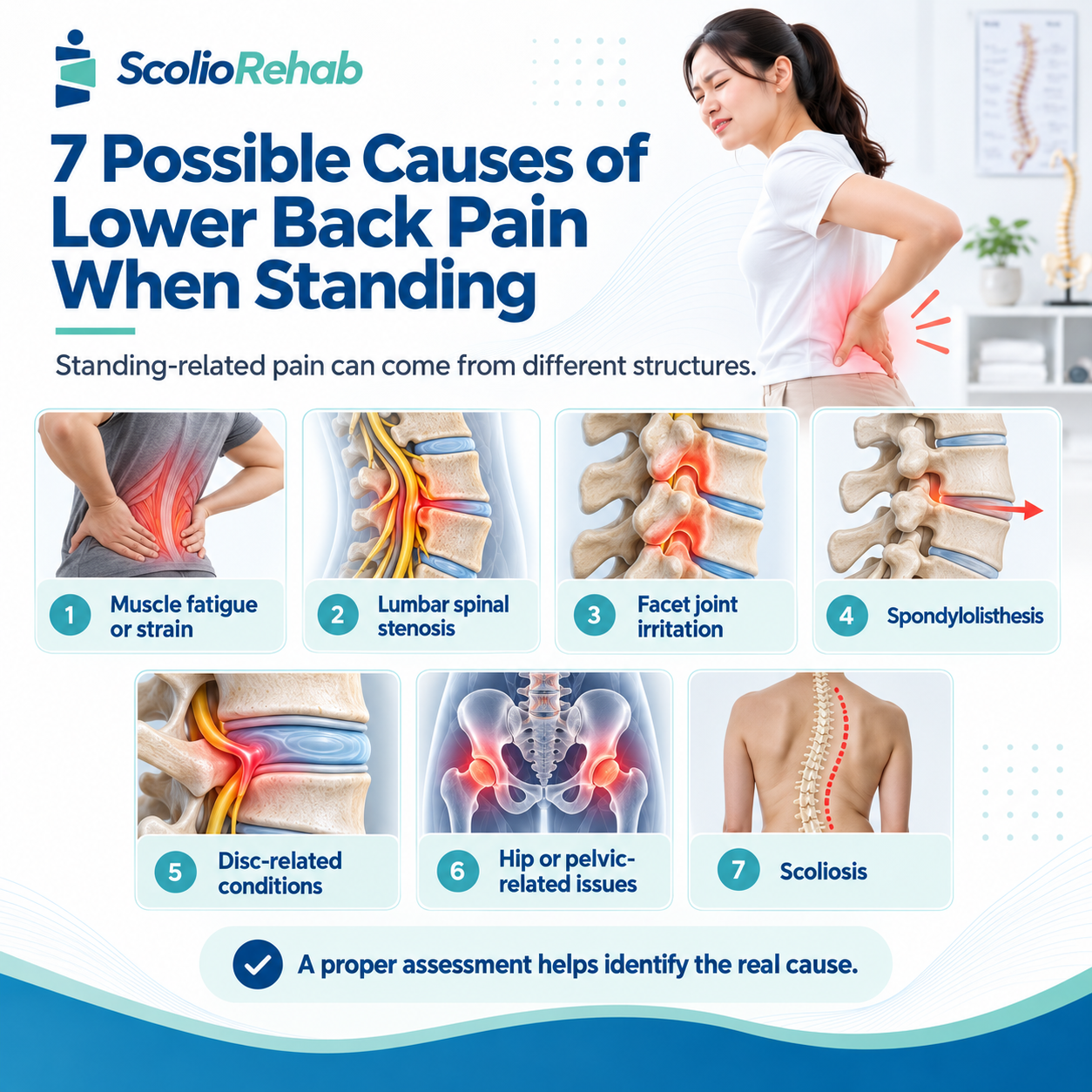
7 Possible Causes of Lower Back Pain When Standing
1. Muscle Fatigue or Strain
One of the more common explanations for back discomfort after prolonged standing is muscle fatigue.
Your back and trunk muscles help stabilise your spine throughout the day. Standing for extended periods, particularly without moving much, can become uncomfortable.
This may be more noticeable if you:
- Recently started a job requiring long periods of standing.
- Spend most of your day sitting and suddenly stand for several hours.
- Have reduced strength or muscular endurance.
- Are recovering from a previous back injury.
- Frequently lift or carry heavy objects.
What does it feel like?
Muscle-related discomfort is often described as a dull ache, tightness, or general tiredness across the lower back.
It may improve when you change position, walk around, or take a short rest.
However, symptoms alone cannot confirm a muscle strain.
2. Lumbar Spinal Stenosis
Lumbar spinal stenosis occurs when spaces within the lower spine become narrower, potentially irritating or compressing nearby nerves.
It is more common in older adults and is often associated with age-related changes in the spine.
One particularly recognisable symptom pattern is pain that becomes worse when standing or walking but improves when sitting or bending forward.
Some people also experience:
- Pain extending into the buttocks or legs.
- Numbness or tingling.
- A heavy feeling in the legs.
- Reduced walking tolerance.
- Relief when leaning forward, such as over a shopping trolley.
This pattern is sometimes called neurogenic claudication.
According to the Cleveland Clinic’s guide to spinal stenosis, these symptoms can occur because standing and walking may further reduce the space available around affected nerves.
Important: Back pain that improves with sitting doesn’t automatically mean you have spinal stenosis. A clinical assessment is needed to determine the cause.
3. Facet Joint-Related Back Pain
Facet joints are small joints located at the back of your spine.
They help guide spinal movement and contribute to stability.
Like other joints, they can sometimes become a source of discomfort, particularly when affected by degenerative changes or irritation.
Some people with facet joint-related pain experience discomfort when:
- Standing upright for extended periods.
- Leaning backward.
- Twisting the lower back.
- Returning to an upright position after bending.
The pain is often felt locally around the lower back, although it may sometimes spread toward the buttocks or upper thighs.
However, there is no single movement or symptom that reliably confirms facet joints as the cause of pain.
A healthcare professional may need to consider other possible explanations before reaching a diagnosis.
4. Spondylolisthesis
Spondylolisthesis is a spinal condition in which one vertebra slips forward or backward relative to the vertebra below it.
Some people have this condition without experiencing any symptoms.
Others may develop:
- Lower back discomfort.
- Pain during prolonged standing.
- Tightness around the hamstrings.
- Discomfort when bending backward.
- Pain or other symptoms extending into the legs.
The significance depends on factors such as the degree of slippage, spinal stability, and whether nearby nerves are affected.
Treatment does not always require surgery. Depending on the condition, conservative management may involve exercise, physiotherapy, activity adjustments, and monitoring.
5. Disc-Related Conditions
Your spinal discs sit between the vertebrae and help absorb loads while allowing movement.
Over time, discs naturally change as part of ageing.
In some individuals, disc-related conditions may contribute to back pain, particularly when nearby nerves become irritated.
Possible symptoms include:
- Lower back pain during certain activities or positions.
- Pain spreading into the buttocks or legs.
- Tingling or numbness.
- Discomfort when lifting or bending.
- Difficulty finding a comfortable position.
However, disc-related pain does not always worsen with standing. Some people experience greater discomfort while sitting or bending forward.
A bulging or degenerating disc seen on an MRI also does not automatically explain someone’s symptoms.
Imaging findings must be interpreted alongside the clinical examination.
6. Hip and Pelvic-Related Problems
Sometimes, discomfort felt in the lower back may also involve the hips or pelvis.
These regions work together during standing, walking, bending, and other daily movements.
For example, reduced hip mobility or certain hip-related conditions may alter movement patterns and contribute to discomfort.
You might notice:
- Hip stiffness.
- Discomfort around the buttocks.
- Lower back fatigue.
- Difficulty standing comfortably.
- Pain during specific hip movements.
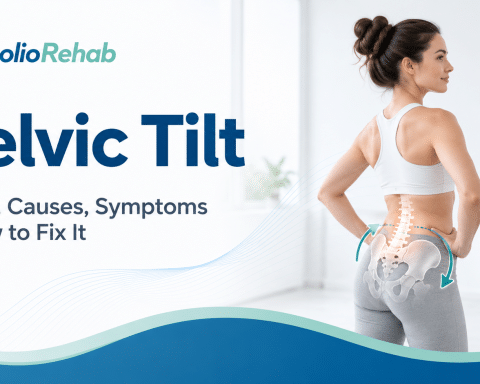
You may also have heard about pelvic tilt, where the pelvis is positioned or rotated forward, backward, or sideways.
However, pelvic tilt itself is not automatically a cause of back pain, and having an anterior or lateral pelvic tilt doesn’t necessarily mean your posture needs correction.
A proper assessment helps determine whether the hips, pelvis, or spine are contributing to your symptoms.
7. Scoliosis
Scoliosis is a three-dimensional spinal deformity involving sideways curvature and rotation of the spine.
Although many people associate scoliosis with children and teenagers, the condition can also affect adults.
Importantly, not everyone with scoliosis experiences back pain.
However, some adults with scoliosis report muscular fatigue, stiffness, or discomfort after prolonged standing.
This may be influenced by changes in spinal balance, muscular loading, degeneration, or associated nerve irritation.
Possible signs include:
- One shoulder appearing higher than the other.
- Uneven hips or waistline.
- A noticeable shift of the trunk to one side.
- Back fatigue after standing.
- Difficulty maintaining an upright position comfortably.
If you notice these changes, you may find our guide to adult scoliosis helpful.
It explains how scoliosis can affect adults, including possible changes in balance, spinal alignment, and daily function.
Remember, scoliosis is only one possible contributor to lower back pain. An assessment is important before assuming your symptoms are caused by a spinal curve.
Why Does My Back Hurt When Standing but Not Sitting?
This is one of the most common questions people ask about standing-related back pain.
If your back feels uncomfortable when standing but improves almost immediately after sitting, the difference may relate to how your spine responds to changes in position.
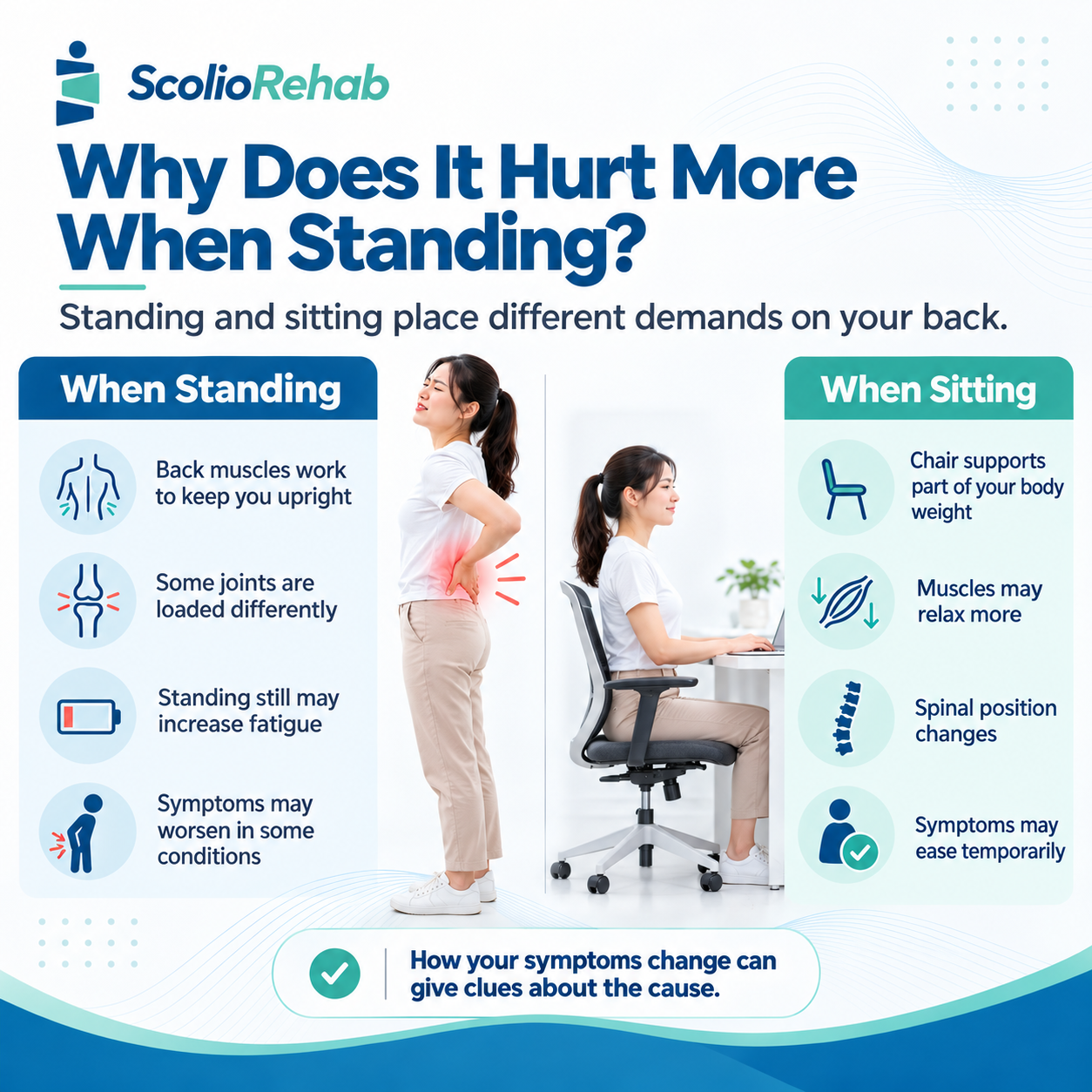
Standing and sitting place different demands on your muscles, joints, and spinal structures.
For example:
When standing:
- Your trunk and hip muscles help maintain balance.
- Certain spinal joints are positioned differently.
- You may remain relatively motionless for long periods.
- Some people experience greater nerve-related symptoms.
When sitting:
- The chair supports part of your body weight.
- Your trunk muscles may not need to work in the same way.
- Your pelvis and lumbar spine change position.
- Certain symptoms may temporarily ease.
One condition associated with this pattern is lumbar spinal stenosis.
As the Mayo Clinic explains, symptoms related to lumbar spinal stenosis may improve when a person sits or bends forward.
However, the pattern alone is insufficient for diagnosis.
A useful question to ask yourself is: Does my back feel better because I’m sitting, or simply because I have stopped standing still?
That distinction can help your healthcare professional better understand your symptoms.
How to Relieve Lower Back Pain After Standing Too Long
If your discomfort is mild and you have no concerning symptoms, several practical strategies may help.
1. Change Positions Regularly
You don’t need to maintain perfect posture every minute.
Instead, try to avoid staying completely still for extended periods.
If your job requires prolonged standing, consider:
- Taking short walking breaks.
- Alternating between standing and sitting when possible.
- Shifting positions naturally.
- Performing gentle movements during breaks.
The goal isn’t to avoid standing altogether.
It’s to give your body opportunities to move.
2. Build Strength and Endurance Gradually
Strengthening your trunk, hips, and lower limbs may help improve your tolerance for daily activities.
Useful exercise categories can include:
- Core strengthening.
- Glute strengthening.
- Hip mobility exercises.
- Walking or other aerobic activities.
- Progressive resistance training.
There is no single exercise programme that works best for every type of back pain.
Your exercise selection should depend on your symptoms, current abilities, and any underlying conditions.
3. Try Heat or Cold Therapy
For some people, a warm pack can help relieve muscular tightness or stiffness.
Others prefer a cold pack, particularly after a recent strain.
Always wrap heat or cold packs in a towel to protect your skin.
Avoid applying extreme temperatures directly to the body.
4. Review Your Working Environment
If your job requires standing for long periods, look for practical adjustments.
For example:
- Wear comfortable, supportive footwear.
- Consider an anti-fatigue mat if you work on a hard surface.
- Adjust your work surface to a comfortable height.
- Avoid repeatedly reaching too far forward.
- Alternate tasks when possible.
These adjustments may improve comfort, although they are not substitutes for treatment when an underlying medical condition is present.
5. Avoid Prolonged Bed Rest
When your back hurts, it can be tempting to lie down for the entire day.
However, prolonged inactivity may make it harder to regain normal movement and activity tolerance.
The NHS recommends remaining active and continuing ordinary activities as much as symptoms allow.
Short periods of rest can be useful when needed, but gradual movement is generally preferable to extended bed rest.
4 Gentle Exercises That May Help
These exercises may be suitable for some people experiencing uncomplicated lower-back stiffness or mild muscular discomfort.
They are not designed to treat every cause of standing-related back pain.
Stop if symptoms worsen, particularly if you develop radiating leg pain, numbness, or weakness.
1. Supine Pelvic Tilts
This exercise encourages gentle movement of the lower back and pelvis.
How to do it:
- Lie on your back with your knees bent.
- Keep your feet flat on the floor.
- Gently tilt your pelvis to flatten your lower back slightly.
- Relax and return to the starting position.
- Repeat slowly for 8–12 repetitions.
Avoid forcing the movement or pushing through pain.
2. Glute Bridges
Glute bridges help strengthen the muscles around your hips.
How to do it:
- Lie on your back with your knees bent.
- Keep your feet approximately hip-width apart.
- Gently lift your hips from the floor.
- Pause briefly.
- Lower slowly with control.
Try 8–12 repetitions as tolerated.
3. Cat-Cow Movement
This gentle movement encourages comfortable spinal mobility.
How to do it:
- Begin on your hands and knees.
- Slowly round your back within a comfortable range.
- Reverse the movement by gently extending your spine.
- Avoid forcing either position.
- Repeat 6–10 times.
4. Gentle Walking
You don’t always need a complicated exercise routine.
For some people, a short walk can help ease stiffness after standing in one position.
Start with a duration that feels comfortable and increase gradually.
However, if walking consistently causes worsening leg pain, heaviness, or numbness that improves when sitting, seek medical assessment rather than repeatedly pushing through the symptoms.
When Should You See a Doctor for Back Pain?
Most lower back pain isn’t caused by a serious condition, and many episodes improve with time and appropriate self-care.
However, persistent or unusual symptoms deserve attention.
Arrange a medical assessment if:
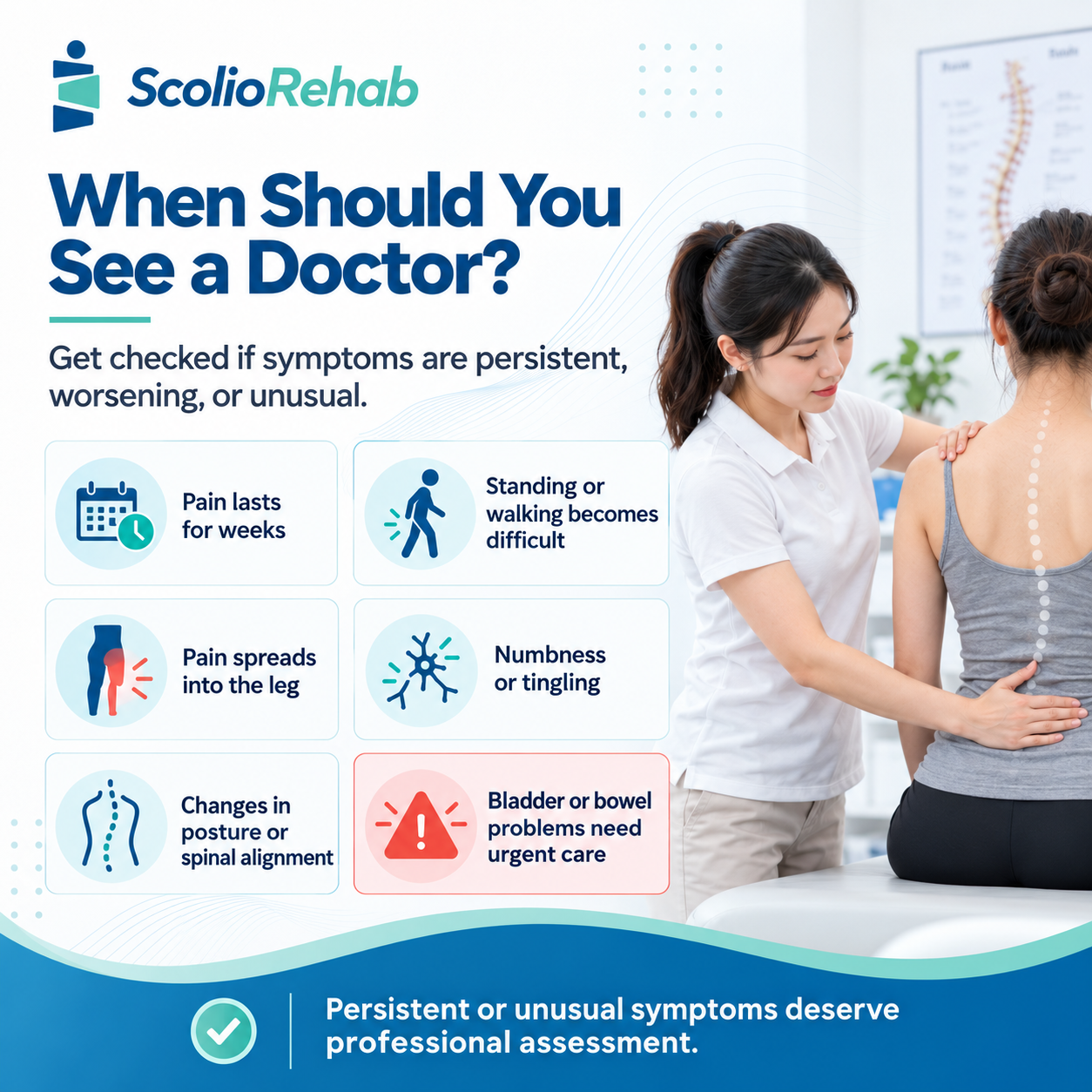
- Pain continues for several weeks despite self-care.
- Standing or walking becomes increasingly difficult.
- Pain repeatedly interrupts your daily activities.
- Symptoms extend into your legs.
- You experience persistent numbness or tingling.
- Your pain is progressively worsening.
- You notice significant changes in posture or spinal alignment.
Seek prompt medical evaluation for severe or rapidly worsening pain, particularly if you also have fever or feel unwell.
Seek emergency medical care immediately if back pain is accompanied by:
- New difficulty controlling your bladder or bowels.
- Loss of sensation around the groin or anus.
- Significant or worsening weakness in both legs.
- New neurological symptoms after a serious accident.
These may indicate a serious condition requiring urgent investigation.
The NHS back pain guidance explains the warning signs that should not be ignored.
Can Physiotherapy Help With Back Pain When Standing?
Physiotherapy can be beneficial for many people experiencing persistent or recurring musculoskeletal back pain.
A physiotherapist may assess:
- How your symptoms respond to different positions.
- Your spinal and hip mobility.
- Muscle strength and endurance.
- Movement patterns.
- Activity tolerance.
- Possible neurological symptoms.
- Functional limitations at work or home.
Depending on the findings, treatment may include tailored exercises, progressive strengthening, education, activity modification, and strategies to improve daily function.
However, physiotherapy isn’t the appropriate first treatment for every possible cause of back pain.
When symptoms suggest significant nerve compression, fracture, infection, or another serious medical condition, further medical investigation may be necessary.
The aim is not simply to make you stand straighter.
It’s to help you move more comfortably, improve your activity tolerance, and manage the factors contributing to your pain.
What If My Back Pain Is Related to Scoliosis?
If you have diagnosed scoliosis and frequently experience discomfort when standing, the assessment may need to consider more than general muscle strength.
For example, your spinal curve pattern, balance, mobility, age-related changes, and possible nerve symptoms may all influence your treatment needs.
At ScolioRehab, our focus is on non-surgical scoliosis management and spinal rehabilitation.
For suitable patients, rehabilitation may include scoliosis-specific exercises, movement training, and strategies to improve postural control and everyday function.
Our scoliosis physiotherapy programme is tailored to the individual’s spinal curve and clinical needs.
You can also explore our scoliosis pain management services for more information about managing discomfort associated with scoliosis.
Importantly, not everyone experiencing standing-related back pain has scoliosis, and not every individual needs scoliosis-specific rehabilitation.
An appropriate assessment helps determine which treatment pathway is suitable.
Looking for Scoliosis Assessment in Malaysia?
ScolioRehab provides scoliosis-focused assessment and non-surgical rehabilitation in Petaling Jaya and Ipoh.
If you have known scoliosis, visible spinal asymmetry, or persistent back discomfort that may be related to your spinal condition, our team can help assess your needs and discuss appropriate next steps.
Contact ScolioRehab to enquire about an assessment.
Frequently Asked Questions
Is it normal for my lower back to hurt after standing all day?
Some people experience muscular fatigue or discomfort after prolonged standing, especially if they’re not accustomed to the activity. However, recurring or severe pain shouldn’t automatically be dismissed as normal. Persistent symptoms may require assessment.
Why does my lower back hurt after standing for just 10 minutes?
Pain beginning after a short period of standing may relate to muscular, joint, or nerve-related factors. If it happens consistently, particularly with leg symptoms, a healthcare professional can help determine the underlying cause.
Why does my back pain disappear when I sit down?
Sitting changes the position and loading of your spine. Some conditions, including lumbar spinal stenosis, may cause symptoms that improve with sitting or forward bending. However, this symptom pattern alone cannot establish a diagnosis.
Is walking better than standing for lower back pain?
For some people, gentle walking feels more comfortable than standing still because it allows movement and changes in muscular activity. For others, particularly those with certain nerve-related conditions, walking may aggravate symptoms. The best approach depends on the cause.
Can weak core muscles cause lower back pain when standing?
Reduced trunk muscle strength or endurance may contribute to difficulty tolerating prolonged activities in some people. However, back pain is multifactorial, and weak core muscles should not automatically be assumed to be the cause.
Can scoliosis cause lower back pain when standing?
Yes, some adults with scoliosis experience muscular fatigue, stiffness, or discomfort after prolonged standing. However, many people with scoliosis have little or no pain, and other spinal conditions may also contribute.
What is the best sleeping position for lower back pain?
There isn’t one universally best sleeping position. Some people prefer sleeping on their side with a pillow between their knees, while others feel comfortable lying on their back with support under the knees. Choose a position that allows restful sleep without aggravating symptoms.
How long should I stand before taking a break?
There is no universal time limit. Your tolerance depends on your health, activity level, working environment, and symptoms. If prolonged standing causes discomfort, changing position or moving briefly at regular intervals may help.
Final Thoughts: Listen to What Your Back Is Telling You
Lower back pain when standing too long can be frustrating, especially when ordinary activities such as cooking, shopping, or working become uncomfortable.
But the solution isn’t always to sit more, stand straighter, or stretch harder.
Sometimes, the answer is improving strength and movement tolerance. Other times, persistent symptoms may indicate an underlying spinal or nerve-related condition that needs assessment.
The most important step is to understand why your back hurts rather than simply trying to tolerate the pain.
With the right assessment and management approach, many people can improve their comfort and return to daily activities with greater confidence.