 scolioadmin
Being told that scoliosis is “severe” can quickly lead to one frightening question:
Will I need surgery?
Sometimes surgery is an appropriate and important treatment for scoliosis. But the decision is more nuanced than reaching one particular Cobb angle and automatically being scheduled for an operation.
Age, remaining growth, curve progression, spinal balance, symptoms and the overall impact of scoliosis all matter.
At ScolioRehab, we do not provide scoliosis surgery. Our practice focuses exclusively on non-surgical scoliosis management. However, part of responsible conservative care is also recognising when a patient should be assessed by an orthopaedic spine surgeon rather than suggesting that every curve can or should be managed without surgery.
At What Degree Is Scoliosis Surgery Considered?
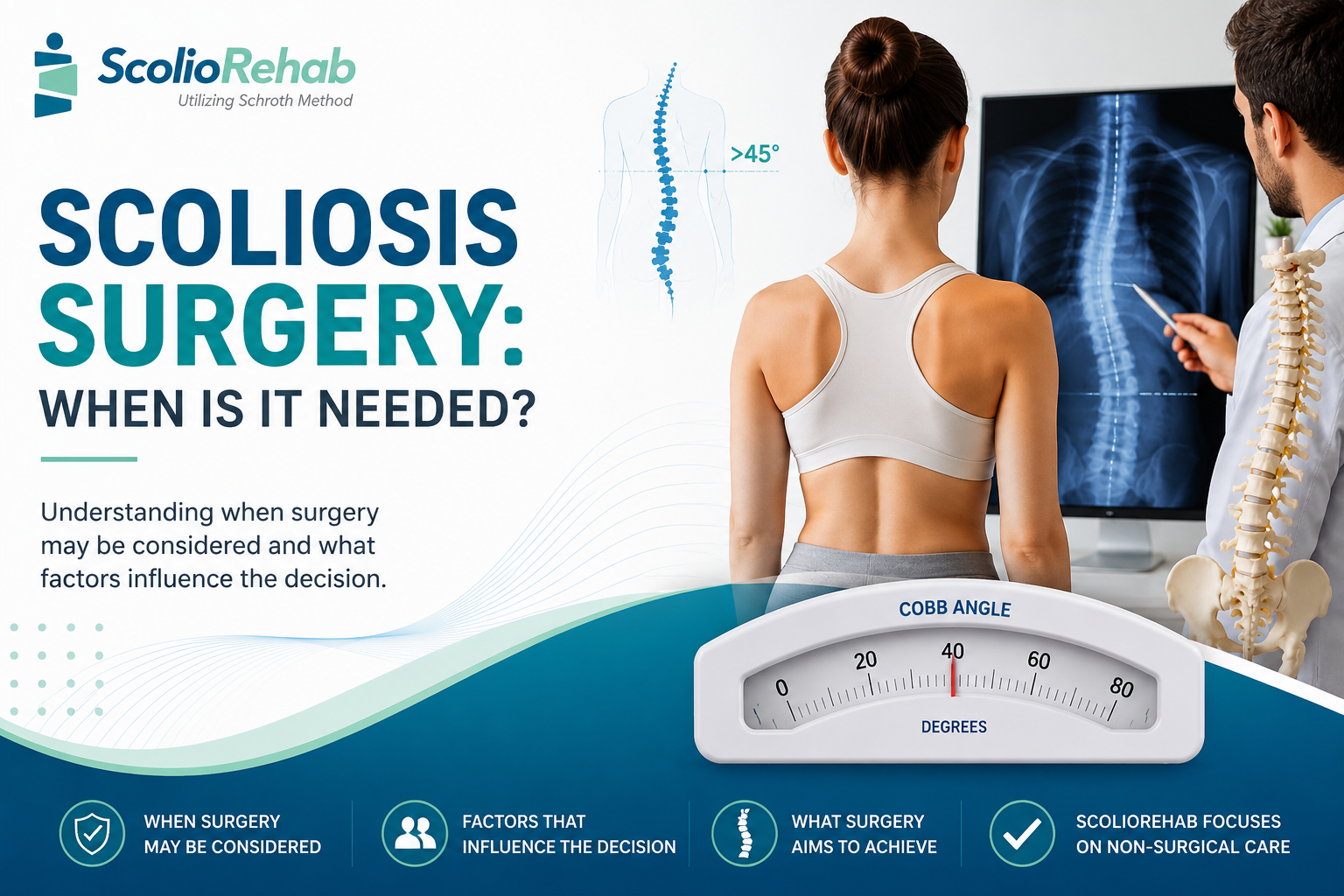
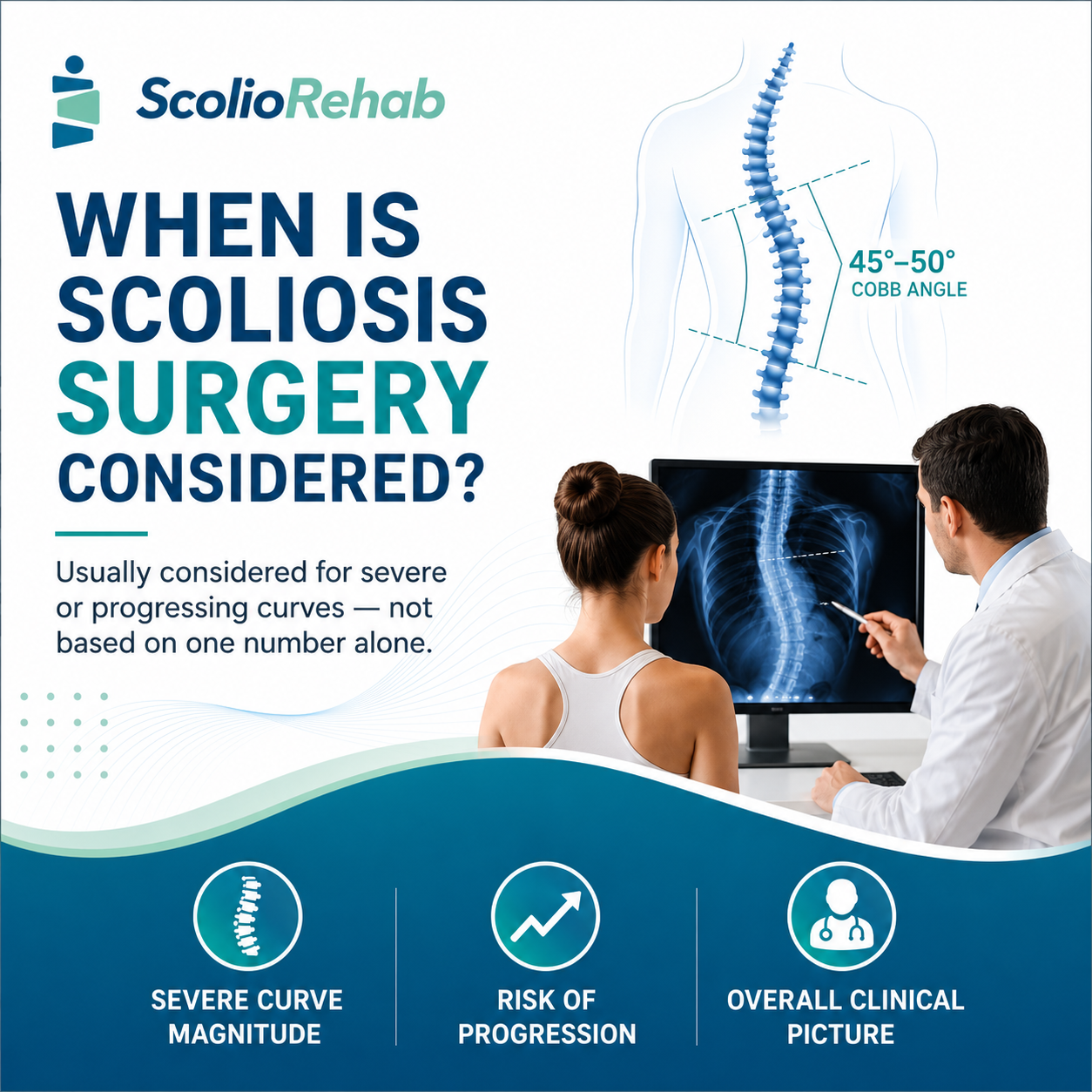
For adolescents with idiopathic scoliosis, the Scoliosis Research Society states that surgery is generally recommended for curves greater than approximately 45° to 50°, particularly when a curve has a high risk of continuing to worsen.
But that number needs context.
A Cobb angle of 50° does not mean every patient has exactly the same situation, just as a 40° curve does not guarantee that surgery will never be discussed.
Doctors may also consider whether the curve has continued progressing, how much growth remains, the curve pattern and the likely behaviour of the scoliosis over time.
If the number on your X-ray is confusing, ScolioRehab’s dedicated guide to Cobb Angle in scoliosis explains what the measurement represents. This article deliberately does not repeat the full Cobb Angle explanation because that topic already has its own page.
Does a 45° or 50° Curve Automatically Mean Surgery?
No. It means a surgical opinion may become increasingly relevant, not that the Cobb angle makes the decision by itself.
The reason larger curves receive more attention is their greater potential to continue progressing, including after skeletal maturity in some cases.
A spine surgeon will therefore look beyond one X-ray measurement.
For a teenager, the question may include whether the child is still growing and how quickly the curve has changed between X-rays.
For an adult, the decision may look very different.
This distinction matters because “scoliosis surgery at 50 degrees” is an oversimplification of a much more individual decision.
When Is Surgery Considered in Adults?
Adult scoliosis should not simply use the same rules as adolescent scoliosis.
According to the Scoliosis Research Society, surgery for adult scoliosis is generally reserved for people with problems such as disabling back or leg pain, significant spinal imbalance, severely restricted function or substantially reduced quality of life, particularly when reasonable non-operative management has not provided sufficient relief.
So an adult having a large curve does not automatically mean an operation is required.
Likewise, someone with a smaller curve but significant nerve compression or loss of function may require a different level of medical evaluation.
ScolioRehab discusses these age-specific differences separately in its guide to Adult Scoliosis, rather than repeating the entire adult-scoliosis topic here.
What Does Scoliosis Surgery Actually Do?
The most established operation for adolescent idiopathic scoliosis remains spinal fusion.
During fusion surgery, the spine is corrected and stabilised using implants while selected vertebrae are fused together so that the corrected section no longer continues to curve independently. The primary aim is to prevent further progression while achieving a safer spinal alignment.
Surgery can produce substantial correction, but it is still major spinal surgery.
The decision therefore involves weighing the expected benefit against factors such as the extent of the operation, recovery, spinal mobility and potential complications.
Those details should be discussed with an appropriately qualified orthopedic spine surgeon who can assess the patient’s actual imaging and condition.
Can Non-Surgical Treatment Prevent the Need for Surgery?
This is where claims need to stay realistic.
Non-surgical treatment can be very important, particularly before a curve reaches a severe stage, but nobody should promise that exercise or bracing can prevent surgery in every patient.
For growing patients whose curves meet appropriate indications, scoliosis management may involve monitoring, scoliosis-specific rehabilitation and bracing with the aim of controlling progression.
At ScolioRehab, our work focuses on this non-surgical side of scoliosis care. Depending on the individual, this can include Schroth Best Practice and the Gensingen Brace by Weiss (GBW).
However, conservative care should not be used to delay an appropriate surgical assessment when a curve is severe, rapidly progressing or associated with significant medical concerns.
Sometimes the responsible recommendation is to obtain a surgical opinion.
That does not mean surgery will definitely be performed. It means the patient deserves to understand all reasonable options.
If Surgery Has Been Suggested, What Should You Ask?
Rather than focusing only on “Do I need surgery?”, it is more useful to understand why it is being recommended.
Ask what your current Cobb angle is and whether it has progressed. Find out how much growth remains if the patient is still young. Ask what could reasonably happen if the curve is monitored instead, what the goals of surgery would be, and whether there are appropriate non-surgical options remaining at this stage.
A second specialist opinion can also be reasonable when facing major spinal surgery, particularly if the patient or family does not fully understand the recommendation.
The goal should not be to choose surgery because you are frightened of the curve, nor to reject surgery simply because you are frightened of the operation.
The decision needs evidence and context.
ScolioRehab Focuses on Non-Surgical Scoliosis Care
ScolioRehab does not perform scoliosis surgery.
Our focus is on personalised non-surgical scoliosis management, including scoliosis-specific rehabilitation and bracing when appropriate. This is also consistent with ScolioRehab’s wider positioning as a non-invasive scoliosis care provider in Malaysia.
For mild to moderate curves and patients who are appropriate for conservative management, these options may form an important part of care.
For severe or progressing scoliosis where surgery may reasonably need to be considered, patients should receive an appropriate medical or orthopaedic spine assessment.
Non-surgical does not mean anti-surgery.
It means using conservative treatment where it is appropriate and recognising when it is no longer responsible to pretend that conservative care is the only option.
For a broader overview of all treatment pathways, see ScolioRehab’s guide to Scoliosis Treatment in Malaysia