
Every scoliosis journey is different. For this 15-year-old patient, one year of consistent conservative scoliosis management was followed by a measurable change in their spinal curve.
The patient first presented to ScolioRehab with a Cobb angle of 25°. Following assessment, the patient was prescribed a custom scoliosis brace and participated in a Schroth-based physiotherapy programme.
After one year, a follow-up X-ray measured the patient’s Cobb angle at 14°, compared with 25° at the initial assessment.
Initial Cobb angle: 25°
Follow-up Cobb angle: 14°
Measured difference: 11°
Treatment period: 1 year
Treatment approach: Custom scoliosis brace + Schroth-based physiotherapy
25° → 14° after one year of conservative scoliosis management
This is an individual patient result. Scoliosis treatment outcomes vary from person to person and similar results cannot be guaranteed.

The Starting Point: 25° Cobb Angle
At the initial assessment, the patient’s scoliosis curve measured 25° using the Cobb angle.
The Cobb angle is a measurement used by healthcare professionals to assess the degree of spinal curvature on an X-ray and monitor how a scoliosis curve changes over time.
However, the Cobb angle is not considered in isolation. Factors such as age, growth, curve characteristics and the individual’s clinical presentation can also influence treatment decisions.
The Treatment Approach
Following assessment, the patient began a conservative scoliosis management programme combining two approaches:
- Custom Scoliosis Bracing
A scoliosis brace was prescribed specifically for the patient as part of the treatment programme. - Schroth-Based Physiotherapy
The patient also participated in Schroth-based rehabilitation, a physiotherapy approach that uses scoliosis-specific exercises adapted to the individual’s spinal curve.
Rather than relying on a single approach, the brace and physiotherapy were used together as part of the patient’s individualized management plan.
After One Year: Cobb Angle Measured at 14°
After one year of consistent brace wear and dedicated Schroth rehabilitation, the patient returned for a follow-up X-ray.
The follow-up showed a Cobb angle of 14°.
Compared with the initial measurement of 25°, this represents an 11° difference in the measured spinal curvature between the two X-rays.
Before and Follow-Up X-Ray
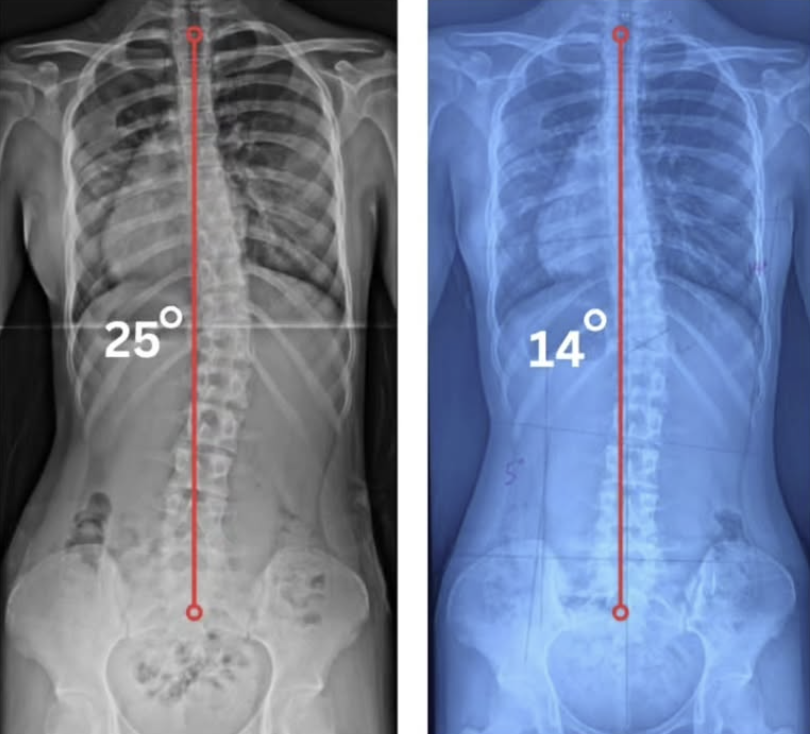
Before: 25° Cobb angle
After one year: 14° Cobb angle
X-rays shown are from this individual patient case. Patient-identifying information should be removed and images published with appropriate permission.
What Can We Learn From This Patient’s Progress?
This case highlights an important aspect of conservative scoliosis management: treatment is a journey that takes place over time.
For this patient, management involved consistent brace wear, participation in Schroth-based rehabilitation and follow-up monitoring over a one-year period.
The change from 25° to 14° reflects this patient’s individual progress during that period.
It does not mean that every patient starting with a similar Cobb angle will experience the same result. Scoliosis can present differently from one person to another, and treatment plans should be based on an individual assessment.
Why Scoliosis Treatment Should Be Individualized
A Cobb angle provides important information about a scoliosis curve, but it does not tell the entire story.
Two patients with a similar Cobb angle may require different management depending on their age, stage of growth, curve characteristics and other clinical considerations.
This is why an appropriate scoliosis management plan should be developed around the individual patient rather than the Cobb angle alone.
Depending on the patient’s assessment, conservative management may include scoliosis-specific physiotherapy, bracing, monitoring or a combination of approaches.
Looking for Scoliosis Assessment in Malaysia?
If you or your child has been diagnosed with scoliosis, understanding the Cobb angle is an important starting point, but determining what to do next requires a more complete assessment.
At ScolioRehab, our team provides scoliosis-focused assessment and conservative management, including Schroth-based physiotherapy and scoliosis bracing, based on each patient’s individual needs.